Category
page 1Acids

acid
thumb|Zinc, a typical metal, reacting with [[hydrochloric acid, a typical acid]]

hydrogen sulfide
chemical compound

acid–base reaction
chemical reaction
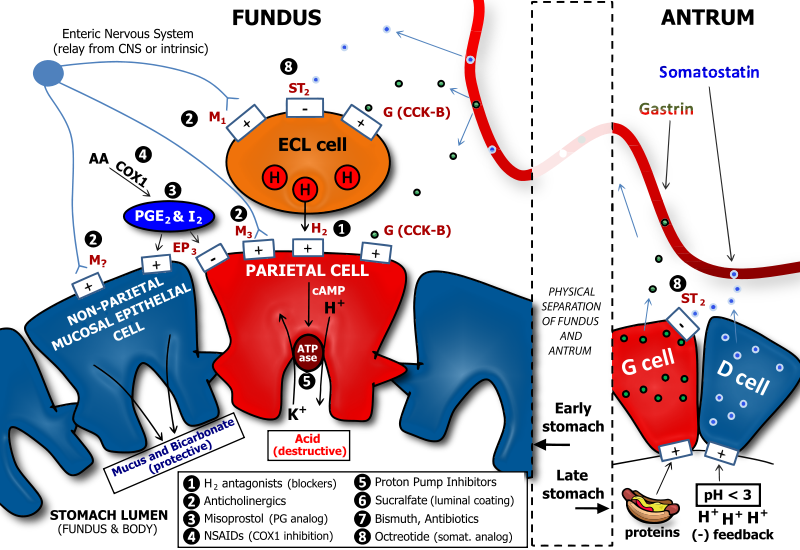
gastric acid
digestive fluid formed in the stomach
acid dissociation constant
equilibrium constant as a measure of acid strength in solution

hydronium
In chemistry, hydronium (hydroxonium in traditional British English) is the cation , also written as , the type of oxonium ion produced by protonation of water. It is often viewed as the positive ion present when an Arrhenius acid is dissolved in water, as Arrhenius acid molecules in solution give up a proton (a positive hydrogen ion, ) to the surrounding water molecules (). In fact, acids must be surrounded by more than a single water molecule in order to ionize, yielding aqueous and conjugate base.
hydrogen azide
unstable, toxic chemical compound
oxyacid
An oxyacid, oxoacid, or ternary acid is an acid that contains oxygen. Specifically, it is a compound that contains hydrogen, oxygen, and at least one other element, with at least one hydrogen atom bonded to oxygen that can dissociate to produce the H+ cation and the anion of the acid.
oleum
Oleum (Latin oleum, meaning oil), or fuming sulfuric acid, is a term referring to solutions of various compositions of sulfur trioxide in sulfuric acid, or sometimes more specifically to disulfuric acid (also known as pyrosulfuric acid).
isocyanic acid
chemical compound of structural formula HNCO
Lewis acid–base theory
chemical bond theory involving the transfer of an electronic pair from the donor (the base) to the acceptor (the acid)
chloroauric acid
chemical compound
hydroiodic acid
solution of hydrogen iodide in water
hydridohelium(1+)
onium ion of helium; protonated helium
acid strength
the tendency of an acid to dissociate
acid salt
any salt whose anion is a partially deprotonated polyprotic acid
picramic acid
chemical compound
polythionic acid
any oxyacid in which the –SO₃H groups are connected by an unbranched chain of sulfur atoms
trinitromethane
Trinitromethane, also referred to as nitroform, is a nitroalkane and oxidizer with chemical formula HC(NO2)3. It was first obtained in 1857 as the ammonium salt by the Russian chemist (1830–1908). In 1900, it was discovered that nitroform can be produced by the reaction of acetylene with anhydrous nitric acid. This method went on to become the industrial process of choice during the 20th century. In the laboratory, nitroform can also be produced by hydrolysis of tetranitromethane under mild basic conditions.

phosphorothioic acid
chemical compound

solid acid
acid that does not dissolve in the reaction medium

acidity function
measure of acidity of a solvent system
resin acid
group of chemical compounds
bromauric acid
chemical compound
diphenylacetic acid
chemical compound
ortho acid
hypothetical organic molecules of the form R–C(OH)3