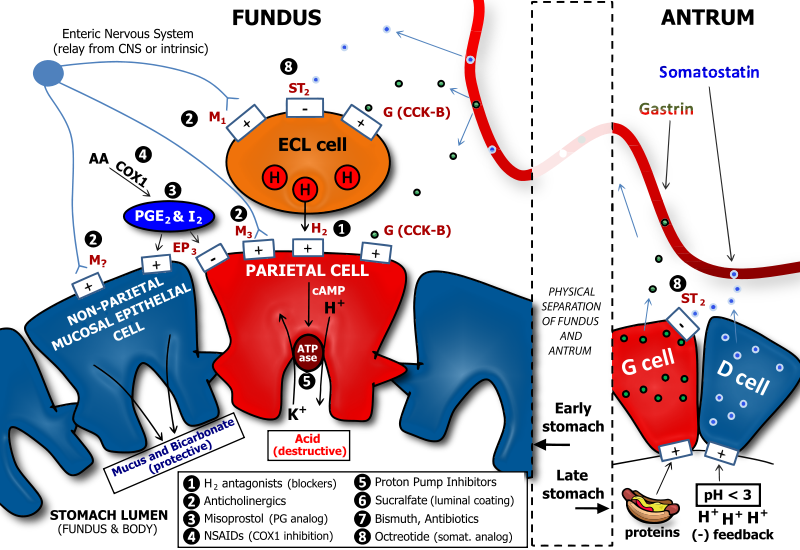
File:Determinants_of_Gastric_Acid_Secretion.svg · Wikimedia Commons · See Wikimedia Commons
Gastric acid is a digestive fluid produced by your stomach that helps break down food so your body can absorb nutrients. It's essential for digestion, but your stomach has a protective lining to prevent the acid from damaging the stomach itself.
AI-generated from the Wikipedia summary — may contain errors.
Research
52,964 papers- Gastric acid and digestive physiology.The Surgical clinics of North America · 2011
- Gastric acid level of humans must decrease in the future.World journal of gastroenterology · 2020
- Gastric acid in vertebrates.Scandinavian journal of gastroenterology. Supplement · 1992
- [Gastric Acid].Revista de gastroenterologia del Peru : organo oficial de la Sociedad de Gastroenterologia del Peru · 1996
- Gastric acid secretion: changes during a century.Best practice & research. Clinical gastroenterology · 2014
via PubMed
Wikidata facts
- Subclass of
- stomach cancer
Show 2 more facts
- has effect
- stomach cancer
- Commons category
- Stomach cancer
Sources (2)
via Wikidata · CC0
~9 min read
Encyclopedic overview
Determinants of gastric acid secretion Gastric acid or stomach acid is the acidic component – hydrochloric acid – of gastric juice, produced by parietal cells in the gastric glands of the stomach lining. In humans, the pH is between one and three, much lower than most other animals, but is very similar to that of carrion-eating carnivores that need protection from ingesting pathogens.
With this higher acidity, gastric acid plays a key protective role against pathogens. It is also key in the digestion of proteins by activating digestive enzymes, which together break down the long chains of amino acids. Gastric acid is regulated in feedback systems to increase production when needed, such as after a meal. Other cells in the stomach produce bicarbonate, a base, to buffer the fluid, ensuring a regulated pH. These cells also produce mucus – a viscous barrier to prevent gastric acid from damaging the stomach. The pancreas further produces large amounts of bicarbonate, secreting this through the pancreatic duct to the duodenum to neutralize gastric acid passing into the digestive tract.
Excerpted from Wikipedia’s “gastric acid” article, available under the CC BY-SA 4.0 licence.