Category
page 1Actinomycetales
Actinomycetales
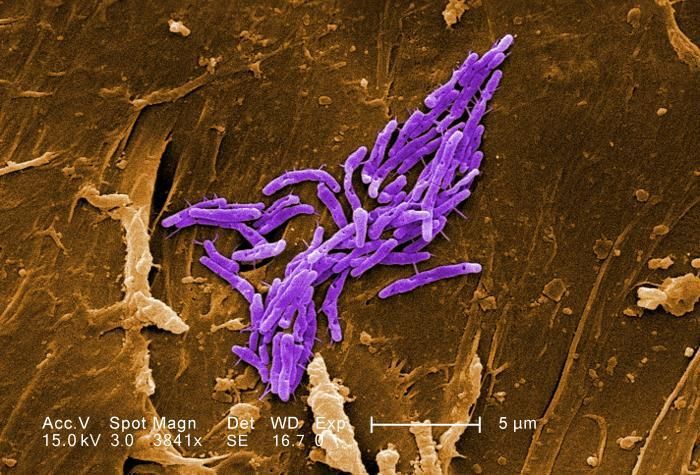
The Actinomycetales is an order of Actinomycetota. A member of the order is often called an actinomycete. Actinomycetales are generally gram-positive and anaerobic and have mycelia in a filamentous and branching growth pattern. Some actinomycetes can form rod- or coccoid-shaped forms, while others can form spores on aerial hyphae. Actinomycetales bacteria can be infected by bacteriophages, which are called actinophages. Actinomycetales can range from harmless bacteria to pathogens with resistance to antibiotics.
Actinomyces
Actinomyces is a genus of the Actinomycetia class of bacteria. They all are Gram-positive and facultatively anaerobic, growing best under anaerobic conditions. While individual bacteria are rod-shaped, Actinomyces colonies form fungus-like branched networks of hyphae. The aspect of these colonies initially led to the incorrect assumption that the organism was a fungus and to the name Actinomyces, "ray fungus" (from Greek , ray or beam, and , fungus).

Actinomycetaceae
The Actinomycetaceae (often called actinomycetes or mycelial bacteria) are a family of bacteria in the order Actinomycetales that contains the medically important genus Actinomyces. These organisms are closely related to the mycobacteria, but were originally classified as fungi because they were thought to be transitional forms between bacteria and fungi.
Actinomyces israelii
species of bacterium
Actinomyces naeslundii
species of bacterium
Intrasporangiaceae
Intrasporangiaceae is an actinomycete family. The family is named after the type genus Intrasporangium. The type species of Intrasporangium (I. calvum) was originally thought to form endospores; however, the mycelium of this strain may bear intercalary vesicles that were originally identified as spores. No members of Intrasporangiaceae are known to form spores.
Arcanobacterium haemolyticum
species of bacterium
Mobiluncus
Mobiluncus is a genus of Gram-positive, anaerobic, rod-shaped bacteria. These bacteria may be stained either Gram-negative or Gram-variable. However, they are classified as Gram-positive rods due to the fact that they possess a Gram-positive cell wall, lack endotoxin and are sensitive to vancomycin, erythromycin and ampicillin, but resistant to colistin.
Trueperella pyogenes
species of bacterium
Actinomyces viscosus
species of bacterium
Actinobaculum
thumb | 220x124px | right | Actinobaculum shaalii
Actinomyces bovis
species of bacterium
Actinobaculum schaalii
species of bacterium