Encyclopedia of Life · EOL (see source)
Actinomycetales
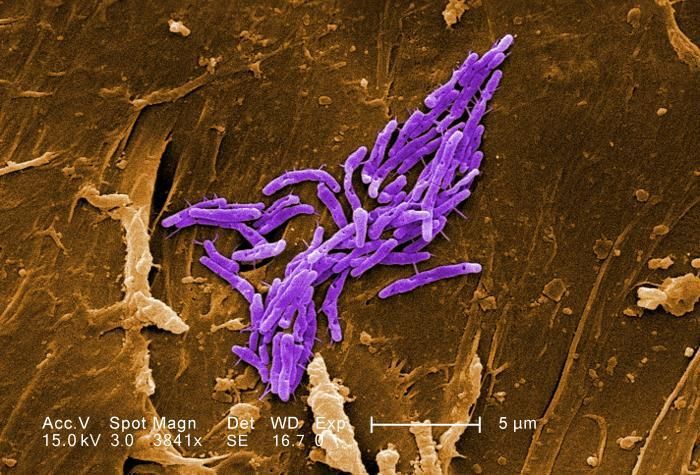
Sign in to saveThe Actinomycetales is an order of Actinomycetota. A member of the order is often called an actinomycete. Actinomycetales are generally gram-positive and anaerobic and have mycelia in a filamentous and branching growth pattern. Some actinomycetes can form rod- or coccoid-shaped forms, while others can form spores on aerial hyphae. Actinomycetales bacteria can be infected by bacteriophages, which are called actinophages. Actinomycetales can range from harmless bacteria to pathogens with resistance to antibiotics.
Species
アクチノミセス目
ORDER
- KingdomBacteria
- PhylumActinobacteriota
- ClassActinomycetia
- OrderActinomycetales
Les Actinobacteria, en français Actinobactéries, sont un groupe de bactéries filamenteuses, Gram-positives. La majorité de ces espèces plutôt que vivre en liberté ont évolué pour devenir commensales et/ou symbiotes de plantes, champignons, insectes, éponges et d'autres organismes... ou elles sont saprophytes et principalement telluriques ; quelques-unes (ex Mycobacterium) peuvent être pathogènes chez des individus à résistance affaiblie. Certaines vivent à l'intérieur de plantes pour lesquelles elles fixent l'azote de l'air et produisent des antibiotiques naturels[1]. Elles étaient auparavant appelées actinomycètes, le suffixe mycète renvoyant aux caractéristiques qu'elles ont en commun avec les champignons, mais pour éviter une confusion avec les champignons, on les appelle désormais actinobactéries[2]. Ces bactéries sont réputées anaérobies tandis que les nocardia (à l'instar des streptomycètes qui leur ressemblent) sont aérobies. Quelques cas d'actinomycètes aquatiques (eau douce) semblant aérobies ont été signalés en 1975 au Canada par deux microbiologistes[3]. Avec les cyanobactéries, elles secrètent, lorsqu'elles produisent des spores, la géosmine qui donne au sol l'odeur de
via GBIF
Research
14,496 papers- The fine structure of the Actinomycetales.Society for Applied Bacteriology symposium series · 1973
- Motile nocardoid Actinomycetales.Applied microbiology · 1970
- Chromosome diversity and similarity within the Actinomycetales.FEMS microbiology letters · 2011
- Morphogenesis and fine structure of Frankia (Actinomycetales): the microsymbiont of nitrogen-fixing actinorhizal root nodules.International review of cytology · 1987
- Actinomycetales from corn.Applied microbiology · 1975
via PubMed
Wikidata facts
- Instance of
- taxon
- Parent taxon
- Actinomycetes
- Image
- Actinomyces israelii.jpg
Show 7 more facts
- Commons category
- Actinomycetales
- taxon rank
- order
- taxon name
- Actinomycetales
- topic's main category
- Category:Actinomycetales
- Gram staining
- gram-positive bacteria
- taxonomic type
- Actinomyces
Sources (2)
via Wikidata · CC0
~3 min read
Encyclopedic overview
6 sectionsContents
- Reproduction
- Presence and associations
- Antimicrobial properties
- Phylogeny
- See also
- References
The Actinomycetales is an order of Actinomycetota. A member of the order is often called an actinomycete. Actinomycetales are generally gram-positive and anaerobic and have mycelia in a filamentous and branching growth pattern. Some actinomycetes can form rod- or coccoid-shaped forms, while others can form spores on aerial hyphae. Actinomycetales bacteria can be infected by bacteriophages, which are called actinophages. Actinomycetales can range from harmless bacteria to pathogens with resistance to antibiotics.
==Reproduction== Actinomycetales have 2 main forms of reproduction: spore formation and hyphae fragmentation. During reproduction, Actinomycetales can form conidiophores, sporangiospores, and oidiospores. In reproducing through hyphae fragmentation, the hyphae formed by Actinomycetales can be a fifth to half the size of fungal hyphae, and bear long spore chains.
Excerpted from Wikipedia’s “Actinomycetales” article, available under the CC BY-SA 4.0 licence.