Category
page 1Afrikaans words and phrases
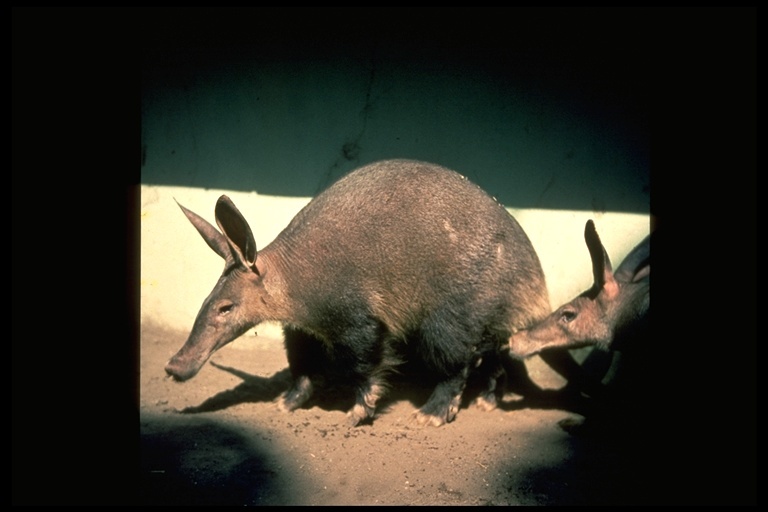
aardvark
The aardvark (; Orycteropus afer) is a medium-sized, burrowing, nocturnal mammal native to Africa. The aardvark is the only living member of the genus Orycteropus, the family Orycteropodidae and the order Tubulidentata.

meerkat
The meerkat (Suricata suricatta) or suricate is a small mongoose found in southern Africa. It is characterised by a broad head, large eyes, a pointed snout, long legs, a thin tapering tail, and a brindled coat pattern. The head-and-body length is around , and the weight is typically between . The coat is light grey to yellowish-brown with alternate, poorly defined light and dark bands on the back. Meerkats have foreclaws adapted for digging and have the ability to thermoregulate to survive in their harsh, dry habitat. Three subspecies are recognised.

Boer
Boers ( ; ; ) are the descendants of the proto Afrikaans-speaking Free Burghers of the eastern Cape frontier in Southern Africa during the 17th, 18th, and 19th centuries. From 1652 to 1795, the Dutch East India Company controlled the Dutch Cape Colony, which the United Kingdom incorporated into the British Empire in 1806. The name of the group is derived from Trekbœr then later "boer", which means "farmer" in Dutch and Afrikaans.
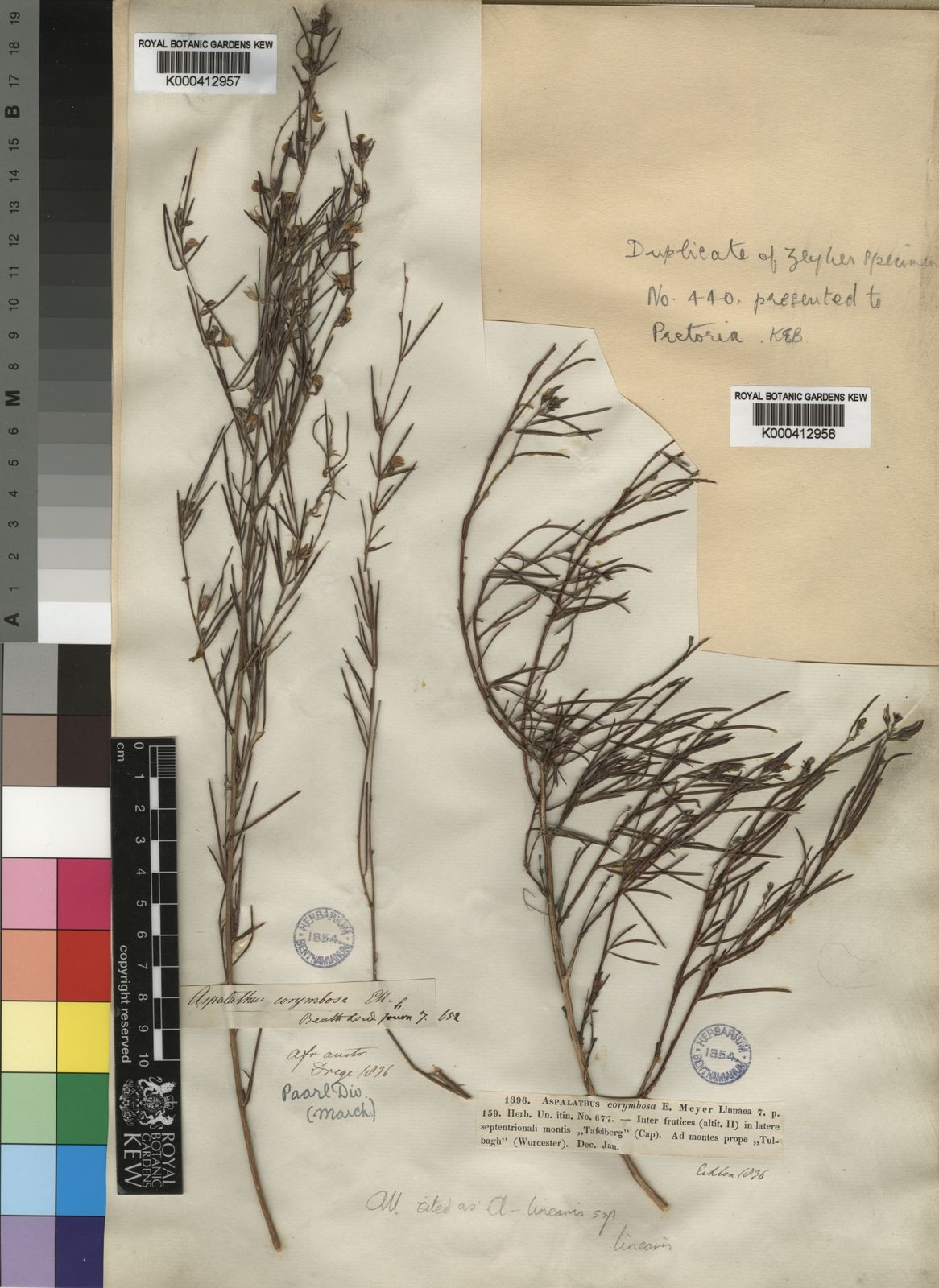
Aspalathus linearis
thumb|Flowers
thumb|Plant
Rooibos ( ; , ), or , is a broom-like member of the plant family Fabaceae that grows in South Africa's Fynbos biome. The leaves are used to make a caffeine-free herbal infusion that has been popular in Southern Africa for generations. Since the 2000s, rooibos has gained popularity internationally, with an earthy flavour and aroma that is similar to those of yerba mate or tobacco.

Oreotragus oreotragus
The klipspringer (; Oreotragus oreotragus) is a small antelope found in eastern and southern Africa. The sole member of its genus and subfamily/tribe, the klipspringer was first described by German zoologist Eberhard August Wilhelm von Zimmermann in 1783. The klipspringer is a small, sturdy antelope; it reaches at the shoulder and weighs from . The coat of the klipspringer, yellowish gray to reddish brown, acts as an efficient camouflage in its rocky habitat. Unlike most other antelopes, the klipspringer has a thick and coarse coat with hollow, brittle hairs. The horns, short and spiky, typica
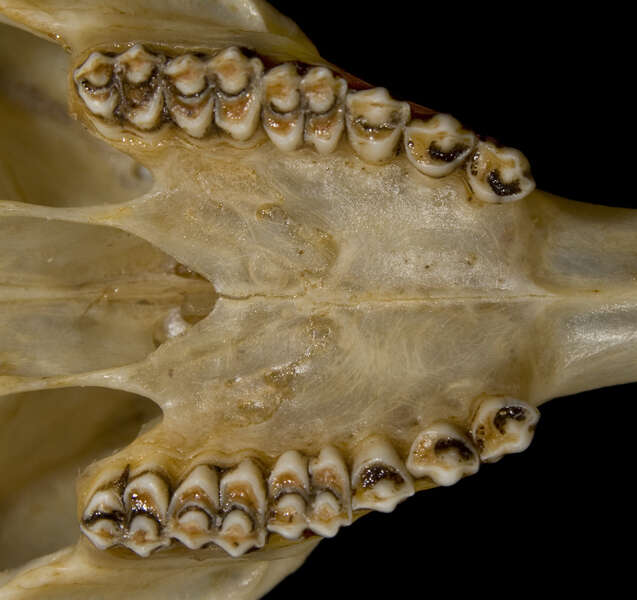
duiker
A duiker is a small to medium-sized brown antelope native to sub-Saharan Africa, found in heavily wooded areas. The 22 extant species, including three sometimes considered to be subspecies of the other species, form a clade or natural grouping, either considered to be the subfamily Cephalophinae or the tribe Cephalophini.
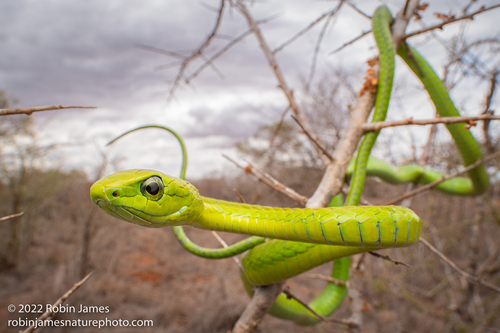
boomslang
The boomslang ( or ; Dispholidus typus) is a highly venomous snake in the family Colubridae. The species is native to Sub-Saharan Africa.

biltong
thumb|right|Homemade beef biltong sticks

Damaliscus pygargus
The bontebok (Damaliscus pygargus) is an antelope found in South Africa, Lesotho and Namibia. D. pygargus has two subspecies; the nominate subspecies (D. p. pygargus), occurring naturally in the Fynbos and Renosterveld areas of the Western Cape, and the blesbok (D. p. phillipsi) occurring in the Highveld.

Rinkhals
The rinkhals (; Hemachatus haemachatus), also known as the ringhals or ring-necked spitting cobra, is a species of venomous snake in the family Elapidae. The species is found in parts of southern Africa. It is not a true cobra in that it does not belong to the genus Naja, but instead belongs to the monotypic genus Hemachatus. While rinkhals bear a great resemblance to true cobras, they also possess some remarkable differences from these, resulting in their placement outside the genus Naja.
In 2023, the Zimbabwe population was described as a new species, H. nyangensis.
.jpg)
veld
thumb|upright=1.3|Typical veld near Petrified forest, Khorixas|Petrified forest in [[Namibia]]
thumb|Springbok in growing veld; [[Etosha National Park, Namibia]]
thumb|Springboks in the burned veld; Etosha National Park, Namibia
Boerboel
The Boerboel () is a South African breed of large dog of mastiff type, used as a family guard dog. It is large, with a short coat, strong bone structure and well-developed muscles.

boerewors
Boerewors () is a type of sausage which originated in South Africa. It is an important part of South African, Setswana, Zimbabwean cuisine and is popular across Southern Africa. The name is derived from the Afrikaans words (literally, a farmer) and ('sausage'). According to South African government regulation, boerewors must contain at least 90 percent meat or fat from beef, pork, lamb or goat. The other 10% is made up of spices and other ingredients. Not more than 30% of the meat content may be fat. Boerewors may not contain offal other than the casings, or any mechanically separated meat (as

morgen
A morgen (Mg) is a historical, but still occasionally used, German unit of area used in agriculture. Officially, it is no longer in use, having been supplanted by the hectare. While today it is approximately equivalent to the Prussian morgen, measuring 25 ares or 2,500 square meters (), its area once ranged from , but usually between . In the 20th century, the quarter hectare became standard for one morgen. The Morgen unit of land measurement was also used in the Netherlands, Poland, Lithuania, and parts of the Dutch colonial empire, such as South Africa. It was also used in the Balkans, Norwa

kraal
thumb|260px|An illustration of a kraal near Bulawayo in the 19th century.
thumb|260px|Building an African Kraal (July 1853, X, p.78)
thumb|260px|Zulu people|Zulu kraal near [[Umlazi, Natal]]
Kraal (also spelled craal or kraul) is an Afrikaans and Dutch word, also used in South African English, for an enclosure for cattle or other livestock, located within a Southern African settlement or village surrounded by a fence of thorn-bush branches, a palisade, mud wall, or other fencing, roughly circular in form. It is similar to a boma in eastern or central Africa.
Voortrekkers
REDIRECT Great Trek
+
Category:Afrikaans words and phrases
Category:Voortrekker
droëwors
Droëwors (; Afrikaans for "dry sausage", from Dutch: "droge worst") is a Southern African snack food, based on the traditional, coriander-seed spiced boerewors sausage. It is usually made as a dunwors (Afrikaans for "thin sausage") rather than dikwors ("thick sausage"), as the thinner sausage dries more quickly and is thus less likely to spoil before it can be preserved. If dikwors is to be used, it is usually flattened to provide a larger surface area for drying.
braai
REDIRECT Regional variations of barbecue#South Africa
.JPG)
rondavel
thumb|250px|An undecorated rondavel
Rondavel is a style of African hut known in literature as cone on cylinder or cone on drum. The word comes from the Afrikaans rondawel.

Uitlander
thumb|Uitlander cemetery at Pilgrim's Rest, South Africa|Pilgrim's Rest, [[Mpumalanga]]
An uitlander, Afrikaans for "foreigner" (), was a foreign (mainly British) migrant worker during the Witwatersrand Gold Rush in the independent Transvaal Republic following the discovery of gold in 1886. The limited rights granted to this group in the independent Boer Republics was one of the contributing factors behind the Second Boer War.
== Second Boer War ==
thumb|Breathing Time - JM Staniforth. The problem with "Krugerism".
thumb|1899 Editorial cartoon|political cartoon by J. M. Staniforth depicting T
Boer pony
The Boerperd is a modern South African breed of riding horse. It is a re-creation of the traditional Cape Horse or old-type Boer Horse, which is now extinct.
.jpg)
sjambok
The sjambok (), or litupa, is a heavy leather whip. It is traditionally made from adult hippopotamus or rhinoceros hide, but it is also commonly made out of plastic.

Trekboer
thumb|upright=1.35|An aquatint by [[Samuel Daniell of Trekboers making camp. Depicted around 1804.]]
Baasskap
thumb|J. G. Strijdom, [[Prime Minister of South Africa (1954–1958), an uncompromising supporter of baaskap ]]
Baasskap () (also spelled baaskap), literally "boss-ship" or "boss-hood", was a political philosophy prevalent during South African apartheid that advocated the social, political and economic domination of South Africa by its minority white population generally and by Afrikaners in particular. The term is sometimes translated to the English-language as "Chief in Charge" and functioned either as a description or an endorsement of the "owner of slaves" in South Africa.
ʼn
N-apostrophe (’n, a letter preceded by an apostrophe) is a digraph used in Afrikaans, a language spoken in South Africa and Namibia.
Genootskap van Regte Afrikaners
Society to promote the Afrikaans language
Zef
thumb|Yolandi Visser wearing a zef T-shirt
Zef () is a South African counter-culture movement.
Q219101
Landdrost () was the title of various officials with local jurisdiction in the Netherlands and a number of former territories in the Dutch Empire. The term is a Dutch compound, with land meaning "region" and drost, from Middle Dutch drossāte (droes-state, bloke-castle, state-holder) which originally referred to a lord’s chief retainer (who later became the medieval seneschal or steward), equivalent to:
an English reeve or steward;
a Low German Drost(e) of Northern Germany (cognate with German Truchsess); or
German Meier (from Latin majordomus).
Bittereinder
thumb|Plaque on the Potchefstroom Concentration Camp Memorial. Translated text: Memorial stone / In honor of the / 967 children 117 women and 57 men / who died in the camps here / during the war of 1899-1902. / "Their memory will live on" / Revealed by / Mrs. the widow. Gen J. H de la Rey. / On 16 Dec. 1918. / C.F. Kirkbride
Spoor
any sign of a creature or trace by which the progress of someone or something may be followed; may include tracks, scents, scat, or broken foliage
Berg wind
hot, dry foehn-type wind in South Africa
Kloof
Kloof is a town that includes a smaller area called Everton, located approximately 26 km north-west of Durban in KwaZulu-Natal, South Africa. Once an independent municipality, it now forms part of the greater Durban area, itself a part of the eThekwini Metropolitan Municipality.
Volkspele
thumb|Folk dancers in traditional costume doing Volkspele at a saamtrek
thumb|Folk dancers in traditional costume doing Volkspele while on tour in Europe
thumb|Two Volkspele participants, Willie van Vollenhoven and Dr. Anton van Vollenhoven with the bust of Dr. SH Pellisier in Boshof, South Africa
Veldskoen
thumb|A pair of "vellies"
Vlaamperd
The '''''' is a South African breed of light draught or harness horse; it is also suitable for riding and is used in dressage. It was bred in the Western Cape region of South Africa in the early twentieth century, and resulted from cross-breeding of local mares with imported European stallions, particularly Friesians. The horses are usually black, though mares may be dark seal brown. A stud-book was started in 1983.
predikant
'''''' is a minister in the Dutch Reformed Church, especially in South Africa; is the Afrikaans term for 'pastor'.