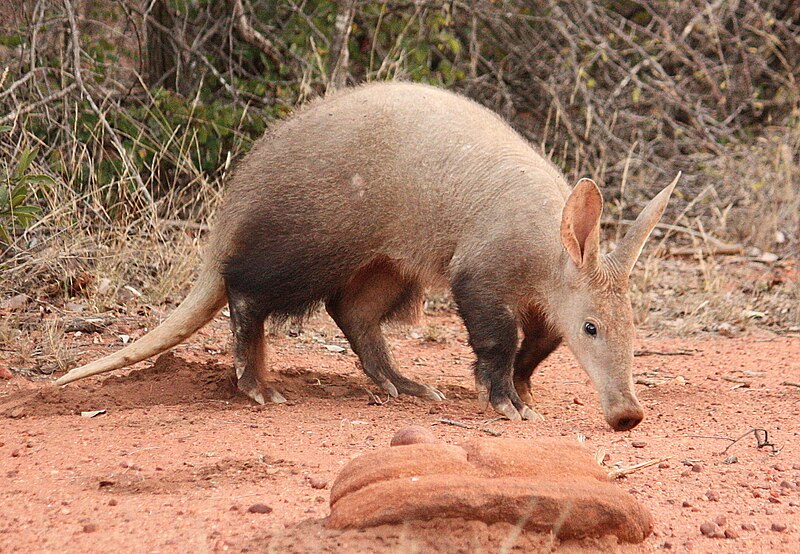
File:Orycteropus_afer_175359469.jpg · Wikimedia Commons · See Wikimedia Commons
aardvark
Sign in to saveAlso known as Orycteropus afer
The aardvark (; Orycteropus afer) is a medium-sized, burrowing, nocturnal mammal native to Africa. The aardvark is the only living member of the genus Orycteropus, the family Orycteropodidae and the order Tubulidentata.
OverviewAI-generated
The aardvark (Orycteropus afer) is a species of mammal and insectivore endemic to Africa. It belongs to the parent taxon Orycteropus and is also referred to by the common names Oryctérope, Antbear, and Ant Bear. The organism has a short name of O. afer.
The IUCN lists the aardvark as Least Concern, a status recorded in 2015. The species has a gestation period of 7, a mass of 1.9, and a litter size of 1. The longest observed lifespan is 29.8 years, with one captive specimen living for this duration. The taxon was described in sources including the Nordisk familjebok and the Encyclopædia Britannica 11th edition.
Synthesized by Vinony from 29 facts across 5 sources: Wikidata, IUCN Red List, iNaturalist, Encyclopedia of Life, Vinony graph. Generated from structured data (not the Wikipedia text) and checked against those facts — may still contain errors.
Species
Least ConcernAardvark
species
Maximum longevity: 29.8 years (captivity) Observations: One captive specimen lived for 29.8 years (Richard Weigl 2005).
via IUCN
Wikidata facts
- Instance of
- taxon
- Subclass of
- mammal
- Parent taxon
- Orycteropus
- Mass
- 1.9
- Image
- Orycteropus afer stuffed.jpg
Show 15 more facts
- endemic to
- Africa
- taxon rank
- species
- IUCN conservation status
- Least Concern
- Commons category
- Orycteropus afer
- taxon name
- Orycteropus afer
- described by source
- Encyclopædia Britannica 11th edition
- Commons gallery
- Orycteropus afer
- taxon common name
- Cerdo hormiguero
- gestation period
- 7
- litter size
- 1
- longest observed lifespan
- 29.8
- start time
- 5000000-00
- sequenced genome URL
- www.dnazoo.org/assemblies/Orycteropus_afer
- on focus list of Wikimedia project
- Wikipedia:Vital articles/Level/4
- short name
- O. afer
via Wikidata · CC0
~21 min read
Encyclopedic overview
19 sectionsContents
- Name and taxonomy
- Name
- Taxonomy
- Evolutionary history
- Subspecies
- Description
- Head
- Digestive system
- Habitat and range
- Ecology and behaviour
- Feeding
- Vocalisation
- Movement
- Reproduction
- Conservation
- Mythology and popular culture
- Footnotes
- References
- External links
The aardvark (; Orycteropus afer) is a medium-sized, burrowing, nocturnal mammal native to Africa. The aardvark is the only living member of the genus Orycteropus, the family Orycteropodidae and the order Tubulidentata.
The aardvark is an afrotherian, a clade that also includes elephants, manatees, and hyraxes.
Excerpted from Wikipedia’s “aardvark” article, available under the CC BY-SA 4.0 licence.
Gallery (76)
Available in 104 languages
- Español
- Français
- Deutsch
- 中文
- 日本語
- Русский
- Português
- Italiano
- العربية
- Afrikaans
- Assamese
- Asturian
- azb
- Azerbaijani
- Bahasa Indonesia
- Balinese
- Bambara
- Bangla
Show 85 more
- Basque
- Bavarian
- Belarusian
- Breton
- Bulgarian
- Burmese
- Catalan
- Cebuano
- Central Kurdish
- Cornish
- Croatian
- Czech
- dag
- Danish
- Dinka
- Egyptian Arabic
- Esperanto
- Estonian
- Filipino
- Finnish
- Galician
- Georgian
- Greek
- Hausa
- Hebrew
- Hungarian
- Icelandic
- Ido
- Irish
- Javanese
- Kannada
- Kazakh
- Kotava
- Kurdish
- Latin
- Latvian
- Ligurian
- Limburgish
- Lingua Franca Nova
- Lithuanian
- Lojban
- Malagasy
- Malay
- Malayalam
- Maltese
- Manx
- Mazanderani
- Navajo
- nds_nl
- Nederlands
- Northern Frisian
- Northern Sotho
- Norwegian
- nrm
- Occitan
- Old English
- Polski
- Scots
- Scottish Gaelic
- Serbian
- Serbian (Latin)
- Shona
- Sicilian
- simple
- Slovak
- Slovenian
- Svenska
- Swahili
- Swati
- Tamil
- Tiếng Việt
- Türkçe
- Ukrainian
- Urdu
- Uzbek
- Waray
- Welsh
- Wu Chinese
- Yakut
- Zaza
- zh_yue
- Zulu
- فارسی
- ไทย
- 한국어
via Wikidata sitelinks · CC0