Category
page 1Air pollution

internal combustion engine
engine in which the combustion of a fuel occurs with an oxidizer in a combustion chamber

smoke
thumb|Smoke from a fire|alt=

ozone
Ozone (), also called trioxygen, is an inorganic molecule with the chemical formula ''''''. It is a pale-blue gas with a distinctively pungent odour. It is an allotrope of oxygen that is much less stable than the diatomic allotrope , breaking down in the lower atmosphere to (dioxygen). Ozone is formed from dioxygen by the action of ultraviolet (UV) light and electrical discharges within the Earth's atmosphere. It is present in very low concentrations throughout the atmosphere, with its highest concentration high in the ozone layer of the stratosphere, which absorbs most of the Sun's ultraviole
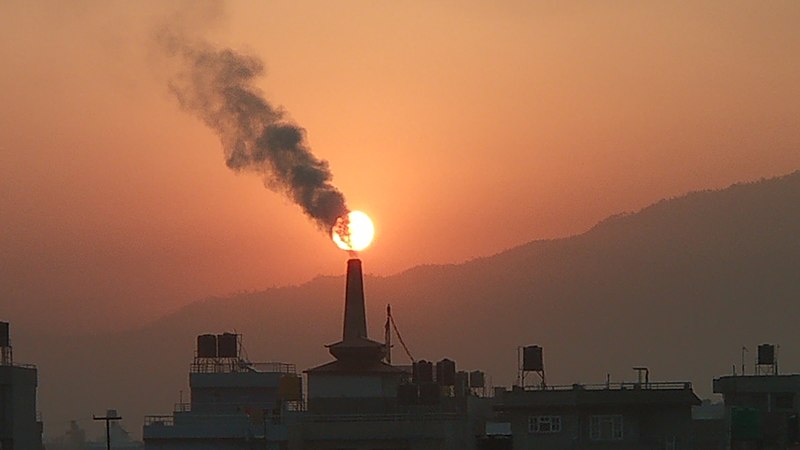
air pollution
presence of dangerous substances in the atmosphere

acid rain
rain that is unusually acidic

smog
alt=A hazy cityscape to the right and a clear one to the left|thumb|Smog and a sunny day within a 10-day interval in Fanhe Town, Tieling|Fanhe, China

aerosol
thumb|upright=1.4|Mist and [[fog are aerosols|alt=photograph of heavy mist]]

ozone depletion
stratospheric phenomena of Earth

soot
thumb|Emission of soot in the exhaust gas of a large diesel truck, without particle filters

mist
thumb|A misty autumn morning in the outskirts of Rakhiv, [[Carpathian Biosphere Reserve, Ukraine]]
thumb|The Château de Chambord in France, in mist
Mist is a natural phenomenon caused by small droplets of water aerosols suspended in the cold air, usually by condensation. Physically, it is an example of a dispersion, most commonly seen where water vapor in warm, moist air meets sudden cooling, such as in exhaled air in the winter, or when hot sauna steam is suddenly released outside. Mist occurs naturally as part of weather, typically when humid air comes into contact with surfaces that are muc

chlorofluorocarbon
Chlorofluorocarbons (CFCs) and hydrochlorofluorocarbons (HCFCs) are fully or partly halogenated hydrocarbons that contain carbon (C), hydrogen (H), chlorine (Cl), and fluorine (F). They are produced as volatile derivatives of methane, ethane, and propane.

haze
thumb|Harmattan Haze in [[Abuja]]
thumb|right|Haze over the Mojave Desert from a [[brush fire in Santa Barbara, California, seen as the Sun descends on the 2016 June solstice, allows the Sun to be photographed without a filter.]]
thumb|Haze as smoke pollution over the Mojave from fires in the Inland Empire, June 2016, demonstrates the loss of contrast to the [[Sun, and the landscape in general.]]

passive smoking
inhalation of smoke by persons other than the intended active smoker
particulates
microscopic solid or liquid matter suspended in the Earth's atmosphere

global dimming
gradual reduction in the amount of global direct irradiance at the Earth's surface; approx. 4% reduction over 1960–1990; caused by an increase in atmospheric particulates (e.g. sulfate aerosols) due to human action
volatile organic compound
organic chemical with appreciable vapor pressure at room temperature
exhaust gas
emitted as a result of the combustion of fuels such as natural gas, gasoline, petrol, biodiesel blends, diesel fuel, fuel oil, or coal
air quality index
measure of pollution

Thomas Midgley
American chemist and engineer (1889–1944)
low-emission zone
defined area
agricultural pollution
type of pollution caused by agriculture
Kuwaiti oil fires
oil well fires in 1991
black carbon
atmospheric soot; component of fine particulate matter
gas flare
gas combustion device
environmental effects of aviation
aviation affecting environment
Stubble burning
agricultural practice
Atmospheric dispersion modeling
mathematical simulation of how air pollutants disperse in the ambient atmosphere
Convention on Long-Range Transboundary Air Pollution
treaty
best available technology
approved environmental solutions
flue gas
gas exiting to the atmosphere via a flue
emission standard
legal requirements governing air pollutants released into the atmosphere; set quantitative limits on the permissible amount of specific air pollutants that may be released from specific sources over specific timeframes
aerotoxic syndrome
syndrome
Global distillation
Movement of pollutant chemicals
buffer strip
Land use and runoff management technique
Arctic haze
Air pollution in the Arctic caused by sources further South
energy poverty and cooking
diesel exhaust
exhaust of a diesel engine
Czech Hydrometeorological Institute
Czech meteorological organization
effects of the car on societies
positive and negative impacts of cars on society
rolling coal
diesel engine modification to emit large amounts of dark exhaust fumes
International Day of Clean Air for blue skies
world day
household air pollution
air pollution within a household
Twomey effect
the effect of solar radiation being deflected by clouds
Aarhus Protocol on Persistent Organic Pollutants
treaty
smog tower
Urban large-scale air purifier
Air quality law
type of law
NIOSH air filtration rating
rating system for respirators designed to protect against contaminated air particles
environmental issues in Africa
Africa faces severe degradation.
list of most polluted cities in the world by air quality
Wikimedia list article
burn pit
area of a deployed military base devoted to open-air combustion of waste
Air pollution in Iran
environmental issue in Iran
air pollution measurement
process of collecting and measuring the components of air pollution
New car smell
common odor found in new cars
laze
acid rain and air pollution arising from steam explosions and large plume clouds containing extremely acidic condensate (mainly hydrochloric acid), which occur when molten lava flows enter cold oceans; a portmanteau of lava and haze
Working Environment (Air Pollution, Noise and Vibration) Convention, 1977
International Labour Organization Convention