Category
page 1Akkadian Empire

Akkadian Empire
ancient empire in the Mesopotamia (2334–2154 BC)

Enheduanna
Enheduanna ( , also transliterated as , , or variants; ) was the (high) priestess of the moon god Nanna (Sīn) in the Sumerian city-state of Ur in the reign of her father, Sargon of Akkad ( BCE). She was likely appointed by her father as the leader of the religious group at Ur to cement ties between the Akkadian religion of her father and the native Sumerian religion. Enheduanna has been celebrated as the earliest known named author in world history.
Akkad
ancient Mesopotamian city

Inanna
Inanna is the ancient Mesopotamian goddess of war, love, and sex. She is also associated with political power, divine law, sensuality, and procreation. Originally worshipped in Sumer, she was known by the Akkadians, Babylonians, and Assyrians as Ishtar. Her primary title is "the Queen of Heaven".

Naram-Sin of Akkad
ruler of the Akkadian Empire (c. 2254–2218 BC)
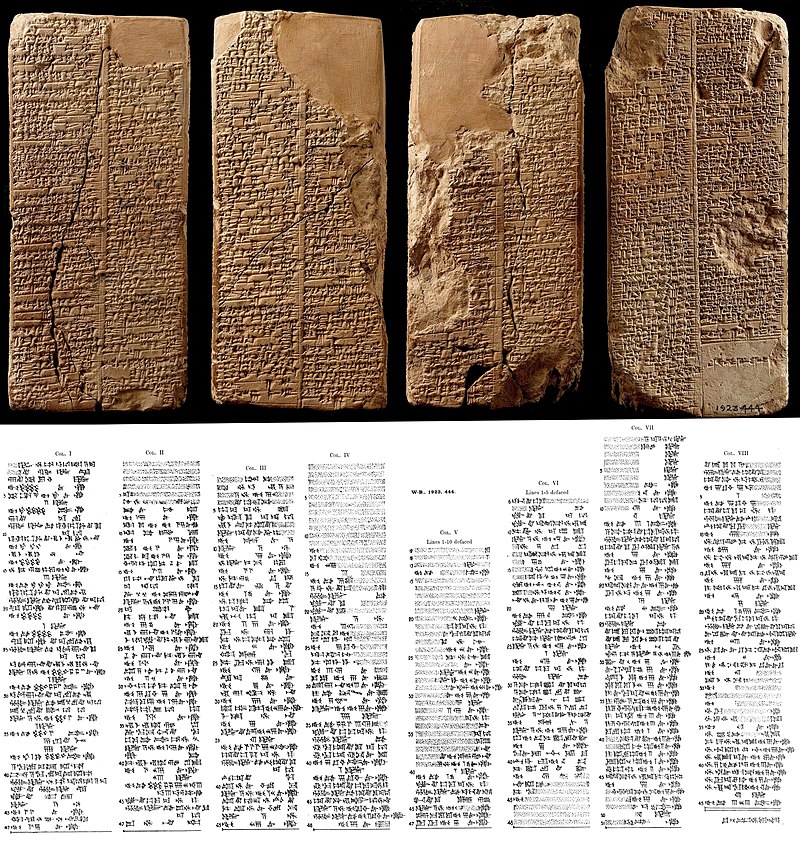
Sumerian King List
Mesopotamian literary composition

Shar-Kali-Sharri
thumb|Akkadian language cuneiform for Sharkalisharri. The star symbol "𒀭", the "[[Dingir", is a silent honorific for "Divine".]]
Shar-Kali-Sharri (, DShar-ka-li-Sharri; died 2193 BC) reigned c. 2218–2193 BC (middle chronology) as the ruler of Akkad. In the early days of cuneiform scholarship the name was transcribed as "Shar-Gani-sharri". In the 1870s, Assyriologists thought Shar-Kali-Sharri was identical with the Sargon of Akkad, first ruler of Akkad, but this identification was recognized as mistaken in the 1910s. His name was sometimes written with the leading Dingir sign demarking deifica

Lullubi
Lullubi, Lulubi (), more commonly known as Lullu, were a group of Bronze Age tribes who existed and disappeared during the 3rd millennium BC. They were from a region known as Lulubum, now the Sharazor plain of the Zagros Mountains of modern-day Sulaymaniyah Governorate in Kurdistan Region, Iraq. Lullubi was a neighbour and sometimes ally with the Hurrian Simurrum kingdom and came into conflict with the Semitic Akkadian Empire and Assyria. Frayne (1990) identified their city Lulubuna or Luluban with the region's modern town of Halabja.
4.2 kiloyear event
severe climatic event (c. 22nd century BCE), defining the beginning of the Meghalayan age, linked to the collapses of the Old Kingdom in Egypt, Akkadian Empire, Liangzhu culture, and Indus Valley Civilization
list of kings of Akkad
Wikimedia list article

Urkesh
Urkesh, also transliterated Urkish (Akkadian: 𒌨𒆧𒆠 UR.KIŠKI, 𒌨𒋙𒀭𒄲𒆠 UR.KEŠ3KI; modern Tell Mozan; ), is a tell, or settlement mound, located in the foothills of the Taurus Mountains in Al-Hasakah Governorate, northeastern Syria. It was founded during the fourth millennium BC, possibly by the Hurrians, on a site which appears to have been inhabited previously for a few centuries. The city god of Urkesh was Kumarbi, father of Teshup.
Stele of Naram-Sim
Old-Akkadian victory stele
King of the Universe
ancient Mesopotamian title
Tashlultum
Tashlultum () was a wife of King Sargon of Akkad. Her name is known to archaeology only from a single shard of an alabaster vase or bowl with an inscription indicating it was dedicated to the temple by her steward/scribe. This dedication provides insight into the position and features of Akkadian queenship: it is notable that Tashlultum had staff which included men, and these men were learned officials.
King of the Four Corners
title from ancient Mesopotamia

Indus-Mesopotamia relations
The trade relations between Harappan civilization and Mesopotamian civilization.
King of Sumer and Akkad
Royal title in Ancient Mesopotamia
Bassetki Statue
statue from circa 2340-2200 BCE
Battle of Uruk
Barton Cylinder
Sumerian creation myth
Shakkanakku
thumb|upright|Inscription "Statue of Iddi-Ilum|Iddi-Ilum, shakkanakku of Mari", using the Sumerian: , šagina, on the [[Statue of Iddi-Ilum.]]
Shakkanakku (Sumerian: , GIR.NITA or šagina, , Shakkanakku), was an Akkadian-language title designating a military governor. Mari was ruled by a dynasty of hereditary Shakkanakkus which was originally set by the Akkadian Empire and gained independence following Akkad's collapse. It is considered that the Shakkanakkus gained some form of independence and came to be considered as "Kings" from the time of Apil-Kin. A critical analysis of the Shakkanakku Lis
Anobanini rock relief
rock relief from the Isin-Larsa period