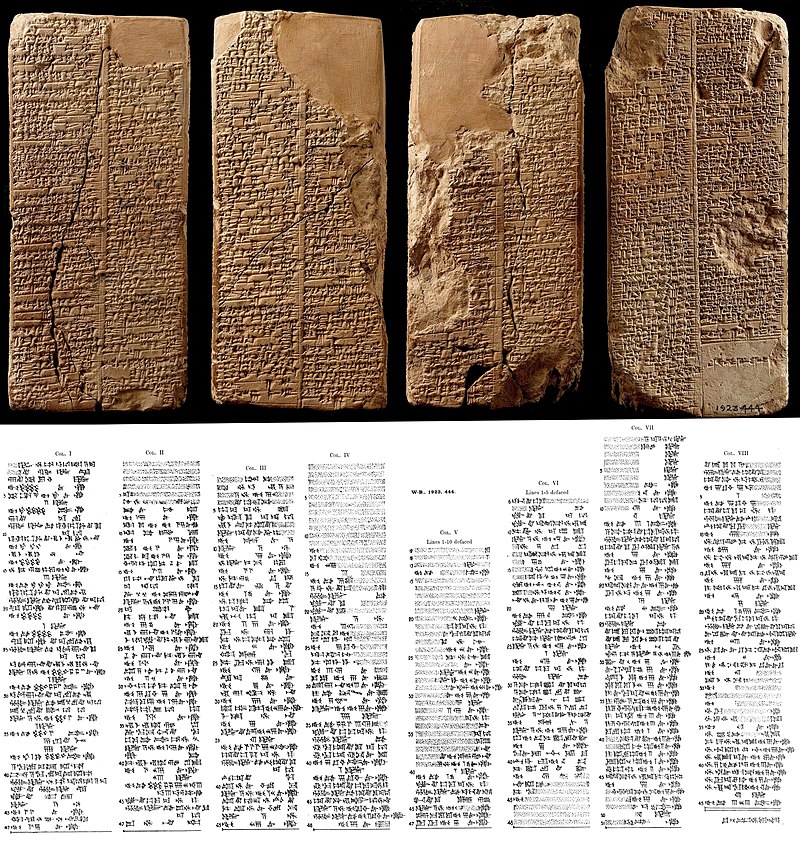
File:Weld-Blundell_Prism_with_transcription_by_Stephen_Herbert_Langdon_(1876-1937).jpg · Wikimedia Commons · See Wikimedia Commons
Sumerian King List
Sign in to saveAlso known as SKL, Chronicle of the One Monarchy
Mesopotamian literary composition
Key facts
- Original title
- 𒉆𒈗 (Nam-Lugal "Kingship").
- Translator
- Jean-Vincent Scheil Stephen Langdon Thorkild Jacobsen
- Language
- Sumerian
- Subject
- Regnal list
- Genre
- Literary
- Set in
- Late-third to early-second millennia BC, ( c. 2900 – c. 1792 BC )
- Publication date
- Ur III to Old Babylonian periods , ( c. 2084 – c. 1648 BC )
- Publication place
- Sumer ( ancient Iraq )
- Published in english
- AD 1911–2014
- Media type
- Clay tablets
- Text
- Sumerian King List at the Electronic Text Corpus of Sumerian Literature
via Wikipedia infobox
Wikidata facts
- Image
- Weld-Blundell Prism with transcription by Stephen Herbert Langdon (1876-1937).jpg
Show 5 more facts
- characters
- Ur-Nammu
- topic has template
- Template:Sumerian King List
- Commons category
- Sumerian King List
- language of work or name
- Sumerian
- writing system
- cuneiform
Sources (1)
via Wikidata · CC0
~29 min read
Encyclopedic overview
The Sumerian King List (abbreviated SKL) or Chronicle of the One Monarchy is an ancient literary composition written in Sumerian that was likely created and redacted to legitimize the claims to power of various city-states and kingdoms in southern Mesopotamia during the late third and early second millennium BC. It does so by repetitively listing Sumerian cities, the kings that ruled there, and the lengths of their reigns. Especially in the early part of the list, these reigns often span thousands of years. In the oldest known version, dated to the Ur III period (c. 2112 – c. 2004 BC) but probably based on Akkadian source material, the SKL reflected a more linear transition of power from Kish, the first city to receive kingship, to Akkad. In later versions from the Old Babylonian period, the list consisted of a large number of cities between which kingship was transferred, reflecting a more cyclical view of how kingship came to a city, only to be inevitably replaced by the next. In its best-known and best-preserved version, as recorded on the Weld-Blundell Prism, the SKL begins with a number of fictional antediluvian kings, who ruled before a flood swept over the land, after which kingship went to Kish. It ends with a dynasty from Isin (early second millennium BC), which is well-known from other contemporary sources.
The SKL is preserved in several versions, the first fragment of which was published in 1906 by Hermann Volrath Hilprecht, and the second in 1911 by Jean-Vincent Scheil. Most of these date to the Old Babylonian period, but the oldest version of the SKL dates back to the Ur III period. The clay tablets on which the SKL was recorded were generally found on sites in southern Mesopotamia. These versions differ in their exact content; some sections are missing, others are arranged in a different order, names of kings may be absent or the lengths of their reigns may vary. These differences are both the result of copying errors, and of deliberate editorial decisions to change the text to fit current needs.
Excerpted from Wikipedia’s “Sumerian King List” article, available under the CC BY-SA 4.0 licence.