Category
page 1Alan Turing

Alan Turing
English computer scientist (1912–1954)
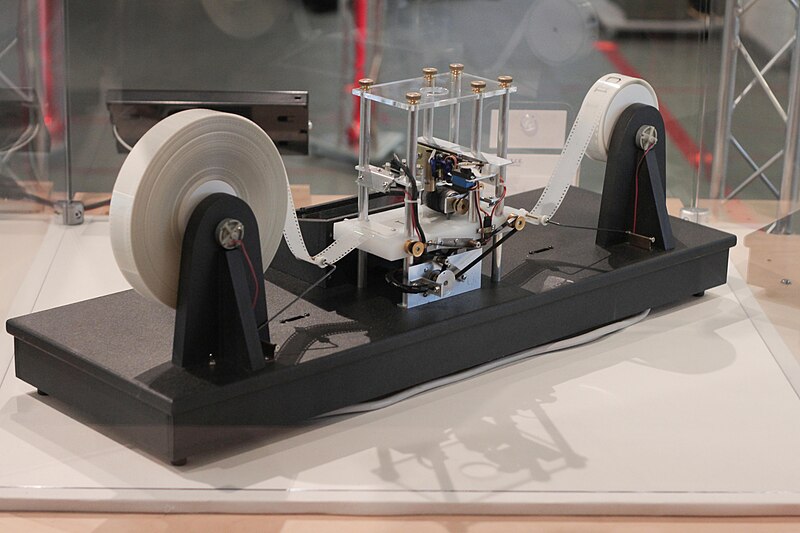
Turing machine
abstract computation model; mathematical model of computation that defines an abstract machine which manipulates symbols on a strip of tape according to a table of rules

Turing test
test of a machine's ability to exhibit intelligent behaviour equivalent to, or indistinguishable from, that of a human

Turing Award
computer science award
Church–Turing thesis
thesis about the nature of computable functions
I. J. Good
British statistician and cryptographer (1916–2009)
National Physical Laboratory
National Measurement Institution of the United Kingdom
recursively enumerable language
a formal language that can be output (enumerated) by an algorithm (mathematical logic, computability theory)

Bombe
thumb|220px|A wartime picture of a Bletchley Park Bombe
Automatic Computing Engine
British early electronic serial stored-program computer
Andrew Hodges
mathematician and popular science author

D. G. Champernowne
British mathematician and economist
Turing reduction
concept in computability theory
Turing degree
measurement for the level of algorithmic unsolvability of a set
Alan Turing law
2017 British law pardoning formerly-illegal sex acts
Turing tarpit
programming language or computer interface that allows for flexibility in function but is difficult to learn and use because it offers little or no support for common tasks
Turochamp
thumb|upright=1.2|The 1952 game between Turochamp (White) and Alick Glennie (Black). After 29 moves, White is one pawn up but about to lose its Pin (chess)|pinned Queen on the next move. Therefore, White resigns.
Turing pattern
how patterns in nature, such as stripes and spots, can arise naturally and autonomously from a homogeneous, uniform state
Alan Turing Institute
research institute in Britain
Turing
programming language
Church–Turing–Deutsch principle
stronger, physical form of the Church–Turing thesis, that a universal Turing machine can simulate every physical process
Banburismus
Banburismus was a cryptanalytic process developed by Alan Turing at Bletchley Park in Britain during the Second World War. It was used by Bletchley Park's Hut 8 to help break German Kriegsmarine (naval) messages enciphered on Enigma machines. The process used sequential conditional probability to infer information about the likely settings of the Enigma machine. It gave rise to Turing's invention of the ban as a measure of the weight of evidence in favour of a hypothesis. This concept was later applied in Turingery and all the other methods used for breaking the Lorenz cipher.
Symmetric Turing machine
graph Machine
The chemical basis of morphogenesis
1952 article by Alan Turing