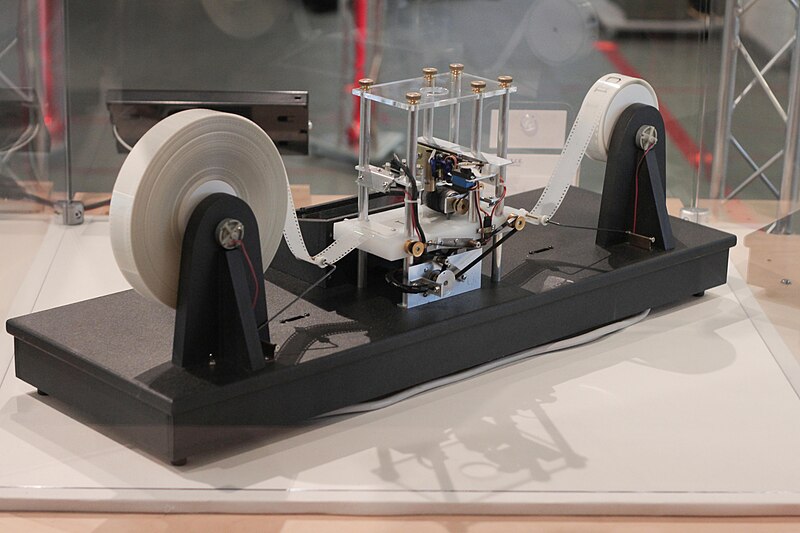
File:Turing_Machine_Model_Davey_2012.jpg · Wikimedia Commons · See Wikimedia Commons
Turing machine
Sign in to saveAlso known as deterministic Turing machine
abstract computation model; mathematical model of computation that defines an abstract machine which manipulates symbols on a strip of tape according to a table of rules
A Turing machine is a theoretical device that performs computations by reading and writing symbols on a strip of tape while following a set of rules—it's not a real physical machine, but rather a mathematical model that helps us understand how computation works. It matters because it provides a foundational framework for thinking about what problems can and cannot be solved by any computing device.
AI-generated from the Wikipedia summary — may contain errors.
Wikidata facts
- Named after
- Alan Turing
- Image
- Maquina.png
Show 10 more facts
- discoverer or inventor
- Alan Turing
- Commons category
- Turing machines
- topic's main category
- Category:Turing machine
- Stack Exchange tag
- cstheory.stackexchange.com/tags/turing-machines
- Commons gallery
- Turing Machine
- maintained by WikiProject
- WikiProject Mathematics
- inception
- 1936-00-00
- location of creation
- King's College London
- studied by
- theory of computation
- used by
- computer science
via Wikidata · CC0
~40 min read
Encyclopedic overview
A physical Turing machine model constructed by Mike Davey. A true Turing machine would need to be provided more memory (tape) if and when required; physical models can only have a finite amount.
A Turing machine is a mathematical model of computation describing an abstract machine that manipulates symbols on a strip of tape according to a table of rules. Despite the model's simplicity, it is capable of implementing any computer algorithm.
Excerpted from Wikipedia’s “Turing machine” article, available under the CC BY-SA 4.0 licence.
Gallery (9)
Available in 68 languages
- Español
- Français
- Deutsch
- 中文
- 日本語
- Русский
- Português
- Italiano
- العربية
- Afrikaans
- Albanian
- Albanian
- Armenian
- Bahasa Indonesia
- Basque
- be_x_old
- Belarusian
- Bosnian
Show 49 more
- Bulgarian
- Catalan
- Central Kurdish
- Croatian
- Czech
- Danish
- Esperanto
- Estonian
- Filipino
- Finnish
- Friulian
- Galician
- Georgian
- Greek
- Hebrew
- Hungarian
- Ido
- Interlingua
- Irish
- Kikuyu
- Latin
- Latvian
- Lithuanian
- Lombard
- Luxembourgish
- Macedonian
- Malayalam
- Mirandese
- Nederlands
- Norwegian
- Norwegian Nynorsk
- Occitan
- Polski
- Romanian
- Serbian
- Serbian (Latin)
- simple
- Slovak
- Slovenian
- Svenska
- Tiếng Việt
- Türkçe
- Ukrainian
- Wu Chinese
- zh_min_nan
- zh_yue
- فارسی
- ไทย
- 한국어
via Wikidata sitelinks · CC0