Category
page 1Alemanni
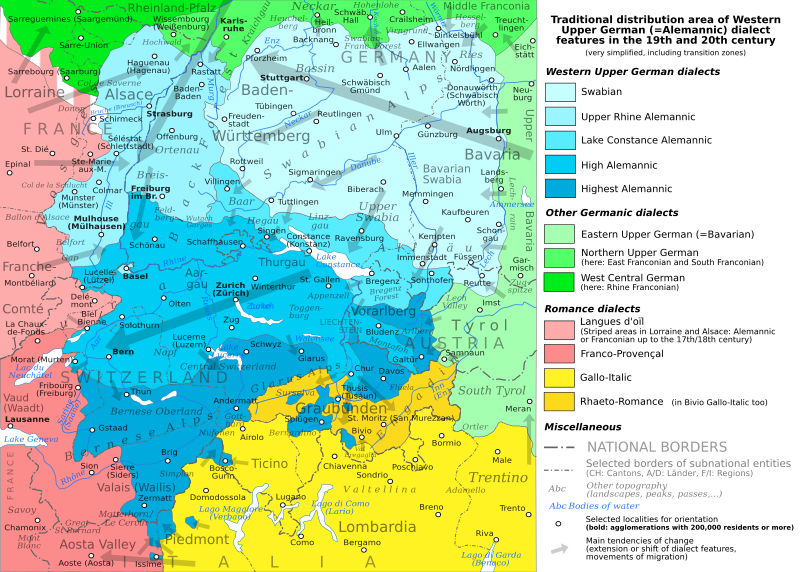
Alemannic
group of dialects of the Upper German branch of the Germanic language family

Alamanni
thumb|upright=1.6|Area settled by the Alemanni, and sites of Roman–Alemannic battles, 3rd to 6th centuries

Alamannia
Alamannia, or Alemania, was the kingdom established and inhabited by the Alemanni, a Germanic tribal confederation that had broken through the Roman limes in 213.

Perchta
upright=1.2|thumbnail|Peruchty in , Kingdom of Bohemia, 1910
' or ' ('Bertha'; ), also commonly known as '''''' () and other variations, was thought to be a goddess in Alpine paganism in the Upper German and also Austrian and Slovenian regions of the Alps. Her name may mean 'the bright one' or 'the bearer' (, from Proto-Germanic *berhtaz) and is probably related to the name , meaning 'the feast of the Epiphany'. Eugen Mogk provides an alternative etymology, attributing the origin of the name to the Old High German verb , meaning 'hidden' or 'covered'. The exact origin or time of origin is unkn

Juthungi
thumb|right|Memorial stone from Augsburg
The Juthungi (, ) were a Germanic tribe in the region north of the rivers Danube and Altmühl in what is now the modern German state of Bavaria.
Blood court at Cannstatt

Bucinobantes
thumb|Sign of the Bucinobantes on the shields of the ancient Roman army
The Bucinobantes (German: Bucinobanten) were an Alemannic tribe in the region of the modern city of Mainz on the river Main.
Lentienses
The Lentienses (German Lentienser) were a 4th-century Germanic tribe associated with the Alemanni, in the region between the river Danube in the North, the river Iller in the East, and Lake Constance in the South, in what is now southern Germany.
They were reported to be one of the most rebellious tribes at the time. There are only two mentions of the Lentienses, both by the Roman historian Ammianus Marcellinus (330–395).
Lex Alamannorum
early medieval law code of the Alamanni
Brisgavi
The Brisigavi or Brisgavi were a Germanic tribe dwelling in the southern region of the Black Forest, in south Germany, during the 5th century AD.
Armalausi
The Armalausi (or Armilausini) were an obscure Germanic tribe of late antiquity. Their name means "those who wear the armilausa", a type of shirt open at the front and back but connected at the shoulders.
German and Sarmatian campaigns of Constantine
Military campaigns
Swabian-Alemannic Carnival
Carnival folkways of southwestern Germany, north-central Switzerland, Alsace (France) and Vorarlberg (Austria)
Pliezhausen brooch
7th-century brooch
Raetovari
The Raetovari (or Raetobari, , ) were an Alamannic tribe in the region of the Nördlinger Ries in the west of the German state of Bavaria. They lived in the upper Danube region. They were mentioned by the Roman historian Ammianus Marcellinus (330–395).