Category
page 1Algebraic curves

parabola
thumb|right|upright=1.36|Part of a parabola (blue), with various features (other colours). The complete parabola has no endpoints. In this orientation, it extends infinitely to the left, right, and upward.
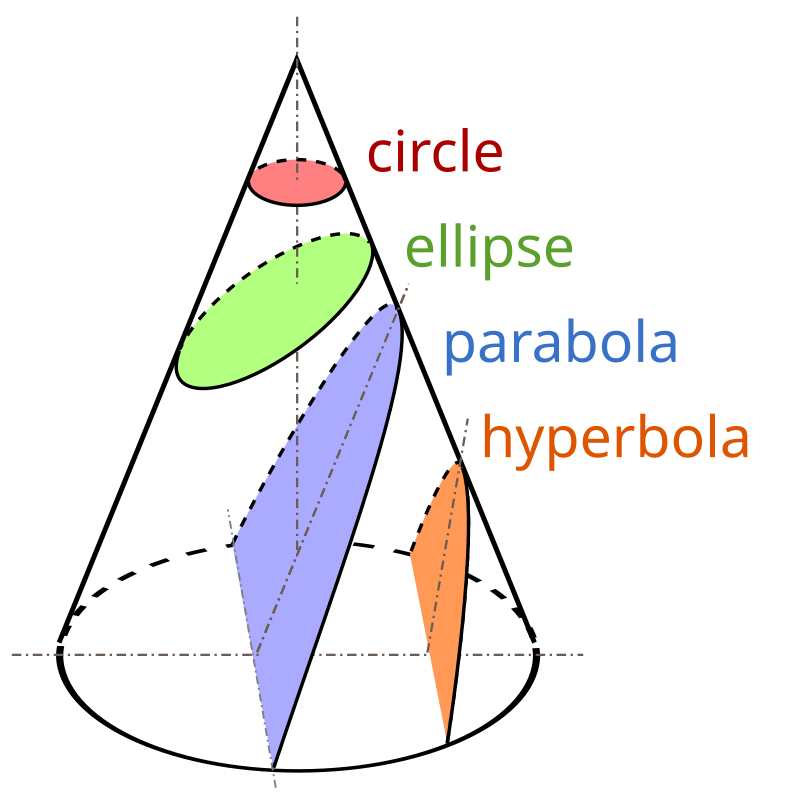
thumb|The parabola is a member of the family of conic sections.
conic section
curve obtained by intersecting a cone and a plane
.svg)
hyperbola
thumb|A hyperbola is an open curve with two branches, the intersection of a plane (geometry)|plane with both halves of a double cone. The plane does not have to be parallel to the axis of the cone; the hyperbola will be symmetrical in any case.|alt=The image shows a double cone in which a geometrical plane has sliced off parts of the top and bottom half; the boundary curve of the slice on the cone is the hyperbola. A double cone consists of two cones stacked point-to-point and sharing the same axis of rotation; it may be generated by rotating a line about an axis that passes through a point of

epicycloid
thumb|500px|The red curve is an epicycloid traced as the small circle (radius rolls around the outside of the large circle (radius .
In geometry, an epicycloid (also called hypercycloid) is a plane curve produced by tracing the path of a chosen point on the circumference of a circle—called an epicycle—which rolls without slipping around a fixed circle. It is a particular kind of roulette.
genus
topological property
algebraic curve
algebraic variety of dimension one
modularity theorem
theorem in mathematics
cusp
point on a curve where a moving point on the curve must start to move backward
singular point of a curve
where the curve is not given by a smooth embedding of a parameter
Weierstrass's elliptic functions
class of mathematical functions

cissoid
[[File:Allgemeine zissoide_english.svg|thumb|upright=1.5|
abelian variety
projective abelian algebraic group
global field
mathematical concept
abelian integral
a function related to the indefinite integral of a differential of the first kind

acnode
thumb|right|An acnode at the origin (curve described in text)
projective line
one-dimensional projective space

sinusoidal spiral
family of curves of the form r^n = a^n cos(nθ)
hyperelliptic curve
algebraic curve that is a ramified double cover of the projective line
list of curves
Wikimedia list article
Ribet's theorem
Result concerning properties of Galois representations associated with modular forms
superegg
right|thumb|Brass superegg by Piet Hein (Denmark)|Piet Hein.
thumb|Piet Hein Superegg
modular curve
algebraic curve constructed as a quotient of the complex upper half-plane by the action of a congruence subgroup of the modular group of integral 2×2 matrices
Cayley–Bacharach theorem
statement about cubic curves in the projective plane
Puiseux series
power series with rational exponents
Fermat curve
mathematical concept
bifolium
thumb|500px|Bifolium with
A bifolium is a quartic plane curve with equation in Cartesian coordinates:
crunode
thumb|right|300px|A crunode at the origin of the curve defined by y^2 - x^2(x+1)=0.
Hilbert's twenty-first problem
On linear differential equations with certain properties
Bitangent
right|frame|The Trott curve (black) has 28 real bitangents (red).
This image shows 7 of them; the others are symmetric with respect to 90° rotations through the origin and reflections through the two blue axes.
Riemann–Hurwitz formula
mathematical formula
Plücker formula
Jacobian variety
moduli space of degree 0 line bundles on a curve; the identity component of the Picard group
Cramer's paradox
the statement that the number of points of intersection of two planar higher-order curves can be greater than the number of arbitrary points usually needed to define one such curve
stable curve
curve that is stable in the sense of geometric invariant theory; one with only “mild” singularities and whose automorphism group is finite, such that it can be in the moduli space of curves
Belyi's theorem
connects non-singular algebraic curves with compact Riemann surfaces
n-ellipse
thumb|right|300px|Examples of 3-ellipses for three given foci. The progression of the distances is not linear.
rational normal curve
Moment curve
Goppa code
kind of mathematical linear code
Mordell curve
type of elliptic curve
tacnode
thumb|right|214px|A tacnode at the origin of the curve defined by (x^2+y^2-3x)^2 - 4x^2(2-x) = 0.