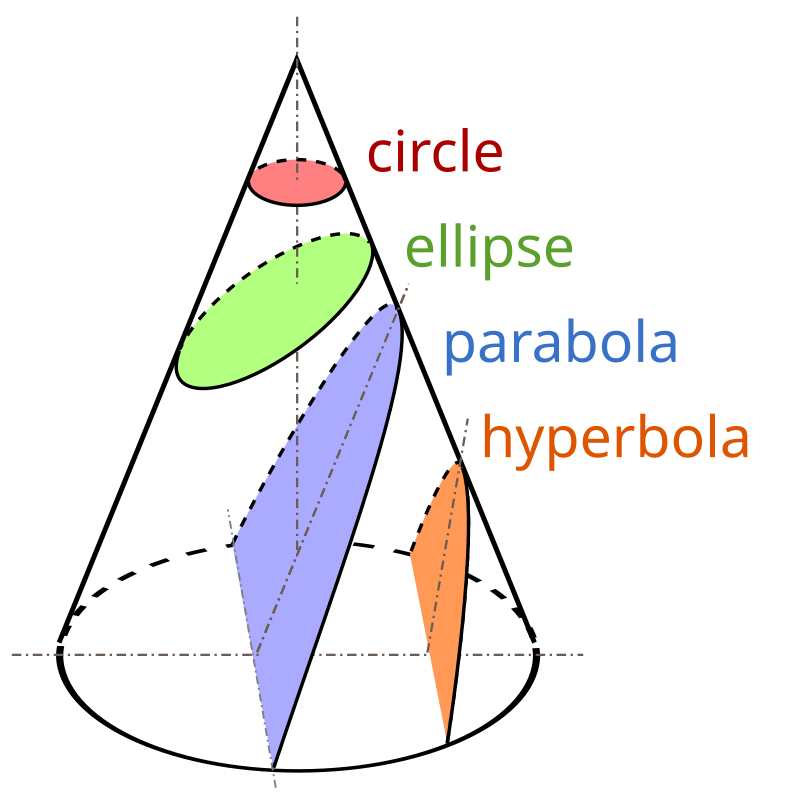
File:Conic_Sections.svg · Wikimedia Commons · See Wikimedia Commons
conic section
Sign in to saveAlso known as conic curve
curve obtained by intersecting a cone and a plane
A conic section is a curve created when a flat plane cuts through a cone at different angles. These curves—which include circles, ellipses, parabolas, and hyperbolas—appear frequently in nature and science, making them important for understanding everything from planetary orbits to the shape of satellite dishes.
AI-generated from the Wikipedia summary — may contain errors.
Wikidata facts
- Subclass of
- quadratic curve
- Part of
- Dandelin spheres
- Has part
- circle
Show 6 more facts
- Commons category
- Conic sections
- topic's main category
- Category:Conic sections
- has characteristic
- eccentricity
- different from
- quadratic curve
- on focus list of Wikimedia project
- Wikipedia:Vital articles/Level/4
- maintained by WikiProject
- WikiProject Mathematics
via Wikidata · CC0
~40 min read
Encyclopedic overview
The black boundaries of the colored regions are conic sections. Not shown is the other half of the hyperbola, which is on the unshown other half of the double cone. Conic sections visualized with torch light This diagram clarifies the different angles of the cutting planes that result in the different properties of the three types of conic section.
A conic section, conic or a quadratic curve is a curve obtained from a cone's surface intersecting a plane. The three types of conic section are the hyperbola, the parabola, and the ellipse; the circle is a special case of the ellipse, though it was sometimes considered a fourth type. The ancient Greek mathematicians studied conic sections, culminating around 200 BC with Apollonius of Perga's systematic work on their properties.
Excerpted from Wikipedia’s “conic section” article, available under the CC BY-SA 4.0 licence.
Gallery (12)
Available in 80 languages
- Español
- Français
- Deutsch
- 中文
- 日本語
- Русский
- Português
- Italiano
- العربية
- हिन्दी
- Afrikaans
- Albanian
- Amharic
- Armenian
- Asturian
- Bahasa Indonesia
- Bangla
- Basque
Show 61 more
- be_x_old
- Belarusian
- Bosnian
- Bulgarian
- Catalan
- Central Kurdish
- Chuvash
- Croatian
- Czech
- Danish
- Egyptian Arabic
- Esperanto
- Estonian
- Finnish
- fiu_vro
- Galician
- Greek
- Hebrew
- Hungarian
- Icelandic
- Ido
- Irish
- Kabyle
- Kannada
- Kazakh
- Latin
- Latvian
- Lithuanian
- Macedonian
- Malay
- Malayalam
- Nederlands
- Norwegian
- Norwegian Nynorsk
- Occitan
- Oromo
- Piedmontese
- Polski
- Romanian
- Rusyn
- Serbian
- Serbian (Latin)
- Sicilian
- simple
- Slovak
- Slovenian
- Sundanese
- Svenska
- Tamil
- Tiếng Việt
- Türkçe
- Ukrainian
- Urdu
- Uzbek
- Welsh
- Wu Chinese
- zh_classical
- zh_yue
- فارسی
- ไทย
- 한국어
via Wikidata sitelinks · CC0