Category
page 1Analog circuits
analog signal
signal where the time-varying feature is an analogous representation of some other time-varying quantity
analog electronics
electronic systems with a continuously variable signal

multivibrator
A multivibrator is an electronic circuit used to implement a variety of simple two-state devices such as relaxation oscillators, timers, latches and flip-flops. The first multivibrator circuit, the astable multivibrator oscillator, was invented by Henri Abraham and Eugene Bloch during World War I. It consisted of two vacuum tube amplifiers cross-coupled by a resistor-capacitor network. They called their circuit a "multivibrator" because its output waveform was rich in harmonics. A variety of active devices can be used to implement multivibrators that produce similar harmonic-rich wave forms; t
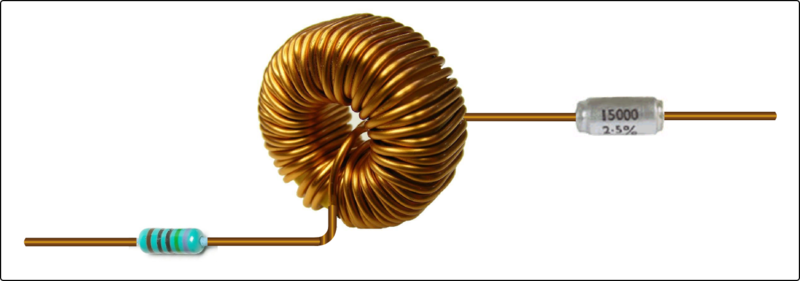
RLC circuit
electrical circuit consisting of a resistor, an inductor and a capacitor, connected in series or in parallel
voltage divider
linear circuit that produces an output voltage that is a fraction of its input voltage

voltage regulator
regulator, designed to automatically maintain a constant voltage level;may: use a simple feed-forward design or include negative feedback, use an electromechanical mechanism or electronic components
negative feedback
stability mechanism which occurs when some function of the output of a system, process, mechanism is fed back in a manner that tends to reduce the fluctuations in the output, whether caused by changes in the input or by other disturbances
LC circuit
electric circuit consisting of an inductor and a capacitor
voltage source
electrical element which maintains a fixed voltage across its two terminals, regardless of current
RC circuit
electric circuit composed of resistors and capacitors driven by a voltage or current source
current source
electrical component that conducts a fixed current, independent of the voltage across it
electrical ballast
used to stabilize the current flow in lamps
impulse response
a dynamic system's output when inputted with a brief input signal, used to parameterize the dynamic behavior of the system
low-noise block downconverter
patented by Murat Koksal turkish scientist born in Ankara 1972
current divider
device
Miller effect
increase in the equivalent input capacitance of an inverting voltage amplifier
automatic gain control
electronic circuit to automatically adjust signal strength
RL circuit
consisting of a resistance and an inductance
audio crossover
type of electronic filter circuitry for audio applications, especially for loudspeaker boxes; thereby mostly analog, very seldom digital

gyrator
A gyrator is a passive, linear, lossless, two-port electrical network element proposed in 1948 by Bernard D. H. Tellegen as a hypothetical fifth linear element after the resistor, capacitor, inductor and ideal transformer. Unlike the four conventional elements, the gyrator is non-reciprocal. Gyrators permit network realizations of two-(or-more)-port devices which cannot be realized with just the four conventional elements. In particular, gyrators make possible network realizations of isolators and circulators. Gyrators do not however change the range of one-port devices that can be realized. A
active filter
a type of analog circuit implementing an electronic filter using active components, typically an amplifier
current mirror
circuit designed to copy a current through one active device
mechanical filter
Type of signal processing filter
phase detector
frequency mixer, analog multiplier or logic circuit that generates a voltage signal which represents the difference in phase between two signal inputs; part of a phase-locked loop
linear circuit
electronic circuits obeying the superposition principle
Wien bridge oscillator
type of electronic oscillator
Gilbert cell
electronic frequency mixer
step response
time behavior
voltage doubler
electronic circuit
Miller theorem
process of creating equivalent circuits
current-to-voltage converter
amplifier that converts current to voltage

differentiator
In electronics, a differentiator is a circuit that outputs a signal approximately proportional to the rate of change (i.e. the derivative with respect to time) of its input signal. Because the derivative of a sinusoid is another sinusoid whose amplitude is multiplied by its frequency, a true differentiator that works across all frequencies can't be realized (as its gain would have to increase indefinitely as frequency increase). Real circuits such as a 1-order high-pass filter are able to approximate differentiation at lower frequencies by limiting the gain above its cutoff frequency. An activ

propagation coefficient
complex measure of the attenuation (real part) and phase angle (imaginary part) along the path travelled by a plane wave
resistor ladder
electrical circuit
Analog multiplier
device that multiplies two analog signals
Passive analogue filter development
filter used in signal processing on continuous-time signals
Quarter-wave impedance transformer
electrical component
flyback diode
diode connected across an inductor used to eliminate flyback (voltage spikes across inductive loads)
Successive approximation ADC
type of analog-digital conversion
Bandgap voltage reference
reference voltage independent of temperature
damping factor
ratio of impedance of a loudspeaker
analog delay line
electronic device
dual impedance
electrical circuits that are the dual of each other

Flash ADC
type of analog-to-digital converter
precision rectifier
electrical circuit
decade box
electronic test equipment
Zobel network
type of filter section based on the image-impedance design principle
analog device
combination of both analog machine and analog media
field-programmable analog array
integrated device containing configurable analog blocks and interconnects between these blocks
nullator
right|170px|thumb|Nullator electronic symbol
In electronics, a nullator is a theoretical linear, time-invariant one-port defined as having zero current and voltage across its terminals. Nullators are strange in the sense that they simultaneously have properties of both a short (zero voltage) and an open circuit (zero current). They are neither current nor voltage sources, yet both at the same time.
overcurrent protection
safety feature that cuts off or limits excessive electrical current
electronic mixer
a circuit for summing or subtracting value of several input signals (voltages or currents)
RC time constant
time constant of an RC circuit
prototype filter
electronic filter designs that are used as a template to produce a modified filter design for a particular application
LED circuit
electrical circuit used to power a light-emitting diode
nullor
right|200px|thumb|Nullor electronic symbol (balanced version)
right|200px|thumb|Nullor electronic symbol (unbalanced version)
Norator
right|170px|thumb|Norator electronic symbol
In electronics, a norator is a theoretical linear, time-invariant one-port which can have an arbitrary current and voltage between its terminals. A norator represents a controlled voltage or current source with infinite gain.
Equivalent impedance transforms
equivalent circuit for impedance networks
Impedance bridging
load measures the source's voltage without affecting it
Analog front-end
analog signal conditioning circuitry