Category
page 1Analytical chemistry
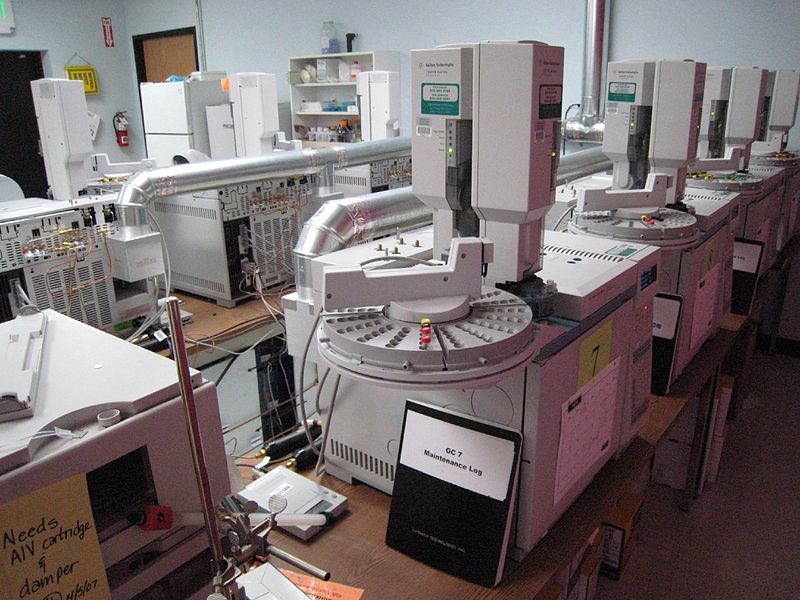
analytical chemistry
study of the separation, identification, and quantification of the chemical components of materials

titration
thumb|A burette and [[Erlenmeyer flask (conical flask) being used for an acid–base titration.]]
Titration (also known as titrimetry and volumetric analysis) is a common laboratory method of quantitative chemical analysis to determine the concentration of an identified analyte (a substance to be analyzed). A reagent, termed the titrant or titrator, is prepared as a standard solution of known concentration and volume. The titrant reacts with a solution of analyte (which may also be termed the titrand) to determine the analyte's concentration. The volume of titrant that reacted with the analyte i

chemical equilibrium
state in which both reactants and products are present in concentrations which have no further tendency to change with time.There are no net changes in the concentrations of the reactant(s) and product(s). Such a state is known as dynamic equilibrium

crucible
thumb| A modern crucible used in the production of silicon ingots via the [[Czochralski process|400x400px]]
thumb|Smaller clay graphite crucibles for copper alloy melting|300x300px
A crucible is a container in which metals or other substances may be melted or subjected to very high temperatures. Although crucibles have historically tended to be made out of clay, they can be made from any material that withstands temperatures high enough to melt or otherwise alter its contents.
empirical formula
formula which tells relative ratio of different atoms in a compound

emission spectrum
frequencies of light emitted by atoms or chemical compounds

acid dissociation constant
equilibrium constant as a measure of acid strength in solution

filtration
right|thumb|300px|Diagram of simple filtration: oversize particles in the feed cannot pass through the lattice structure of the filter, while fluid and small particles pass through, becoming filtrate.
separation process
method to achieve any phenomenon that converts a mixture of chemical substance into two or more distinct product mixtures, which may be referred to as mixture, at least one of which is enriched in one or more of the initial mixture's constituents

atomic absorption spectroscopy
Method to identify chemical elements by their absorption of radiation

extraction
chemical separation of a substance from a matrix
ion exchange
exchange of ions between two electrolytes or between an electrolyte solution and a complex
trace element
chemical element whose concentration (or other measure of amount) is very low

decantation
thumb|Decanting a liquid from a solid
gravimetric analysis
quantitative determination of a chemical species based on its mass
separatory funnel
laboratory glassware
Dulong–Petit law
empirical thermodynamic law that the molar heat capacities of many solids are approximately the same at 3𝑅≈25 J/(K·mol)
Soxhlet extractor
piece of laboratory apparatus
chemical composition
concept in chemistry that has different, but similar, meanings if referred to a single pure substance or a mixture
ionic strength
quantification of the electrical interactions between ions in solution
.jpg)
argentometry
In analytical chemistry, argentometry is a type of titration involving the silver(I) ion. Typically, it is used to determine the amount of chloride present in a sample. The sample solution is titrated against a solution of silver nitrate of known concentration. Chloride ions react with silver(I) ions to give the insoluble silver chloride:
filter paper
semi-permeable paper barrier
absorption spectroscopy
spectroscopic techniques that measure the absorption of radiation
quantitative analysis
analysis which determines the quantity or number of something
chemometrics
Chemometrics is the science of extracting information from chemical systems by data-driven means. Chemometrics is inherently interdisciplinary, using methods frequently employed in core data-analytic disciplines such as multivariate statistics, applied mathematics, and computer science, in order to address problems in chemistry, biochemistry, medicine, biology and chemical engineering. In this way, it mirrors other interdisciplinary fields, such as psychometrics and econometrics.
electric glow discharge
plasma formed by the passage of electric current through a gas
analyte
An analyte, component (in clinical chemistry), titrand (in titrations), or chemical species is a substance or chemical constituent that is of interest in an analytical procedure. The remainder of the sample is called the matrix. The procedure of analysis measures the analyte's chemical or physical properties, thus establishing its identity or concentration in the sample.
thermogravimetric analysis
method of thermal analysis in which the mass of a sample is measured over time as the temperature changes
atomic emission spectroscopy
Method using radiation to identify chemical elements in a sample.
iodine value
mass of iodine in grams that is consumed by 100 grams of a chemical substance
standard solution
Solution with a precisely known concentration of something
parts-per notation
set of pseudo units to describe small values of miscellaneous dimensionless quantities
chemoreceptor cell
A chemoreceptor, also known as chemosensor, is a specialized sensory receptor which transduces a chemical substance (endogenous or induced) to generate a biological signal. This signal may be in the form of an action potential, if the chemoreceptor is a neuron, or in the form of a neurotransmitter that can activate a nerve fiber if the chemoreceptor is a specialized cell, such as taste receptors, or an internal peripheral chemoreceptor, such as the carotid bodies. In physiology, a chemoreceptor detects changes in the normal environment, such as an increase in blood levels of carbon dioxide (hy
sample
limited quantity of material which is intended to be similar to and represent a larger amount of that material
Kjeldahl method
analytical chemistry method to determine the amount of nitrogen in certain organic compounds
acid value
mass of potassium hydroxide (in mg) necessary to neutralise the free fatty acids contained in 1 g of fat
elemental analysis
process of analytical chemistry
Eriochrome Black T
chemical compound
volume fraction
dimensionless quantity
Inductively coupled plasma mass spectrometry
type of mass spectrometry that uses an inductively coupled plasma to ionize the sample
water content
quantity of water contained in a material
qualitative inorganic analysis
method of analytical chemistry

elution
thumb|right|Elution principle of column chromatography
In analytical and organic chemistry, elution is the process of extracting one material from another by washing with a solvent: washing of loaded ion-exchange resins to remove captured ions, or eluting proteins or other biopolymers from an electrophoresis or chromatography column.
aluminon
Aluminon, the triammonium salt of aurintricarboxylic acid, is a dye often used to detect the presence of the aluminium ion in an aqueous solution. Aluminon forms a red complex salt in combination with Al3+.
left|thumb|Deep purple pigment in a neutral aqueous solution. Made from aluminon and ferric (Fe3+) ions.
In addition to its use in qualitative inorganic analysis, aluminon has applications in pigment production. It forms brilliantly colored lake pigments with many metals. The pigments are red in combination with Be2+ and Ga3+. The pigment is deep purple or reddish-brown in combination with
neutron activation analysis
method used for determining the concentrations of elements in many materials
saponification value
number of milligrams of potassium hydroxide required to saponify 1g of fat under the conditions specified
Instrumental chemistry
Study of analytes using scientific instruments
electron multiplier
vacuum-tube structure that multiplies incident charges by means of secondary emission
detection limit
for a given analytical procedure, concentration or quantity derived from the smallest measure that can be detected with reasonable certainty
Bradford protein assay
method to determine protein concentration
permanganometry
Permanganommetry is one of the techniques used in chemical quantitative analysis. It is a redox titration that involves the use of permanganates to measure the amount of analyte present in unknown chemical samples. It involves two steps, namely the titration of the analyte with potassium permanganate solution and then the standardization of potassium permanganate solution with standard sodium oxalate solution. The titration involves volumetric manipulations to prepare the analyte solutions.
biomonitoring
In analytical chemistry, biomonitoring is the measurement of the body burden of toxic chemical compounds, elements, or their metabolites, in biological substances. Often, these measurements are done in blood and urine. Biomonitoring is performed in both environmental health, and in occupational safety and health as a means of exposure assessment and workplace health surveillance.
differential thermal analysis
technique by which phase transitions of chemical reactions can be followed by observation of the heat absorbed or liberated
rhodizonic acid
chemical compound
dielectrophoresis
thumb|320px|alt="dielectrophoresis of cancer cells"|Dielectrophoresis assembling cancer cells in a 3D microfluidic model.
quantification
act of counting and measuring that maps human sense observations and experiences into quantities
total analysis system
chemical analysis technology
pervaporation
Pervaporation (or pervaporative separation) is a processing method for the separation of mixtures of liquids by partial vaporization through a non-porous or porous membrane.
extent of reaction
difference between equilibrium and initial amount of a substance, divided by its stoichiometric number
solid phase extraction
sample preparation process by which compounds that are dissolved or suspended in a liquid mixture are separated from other compounds in the mixture according to their physical and chemical properties