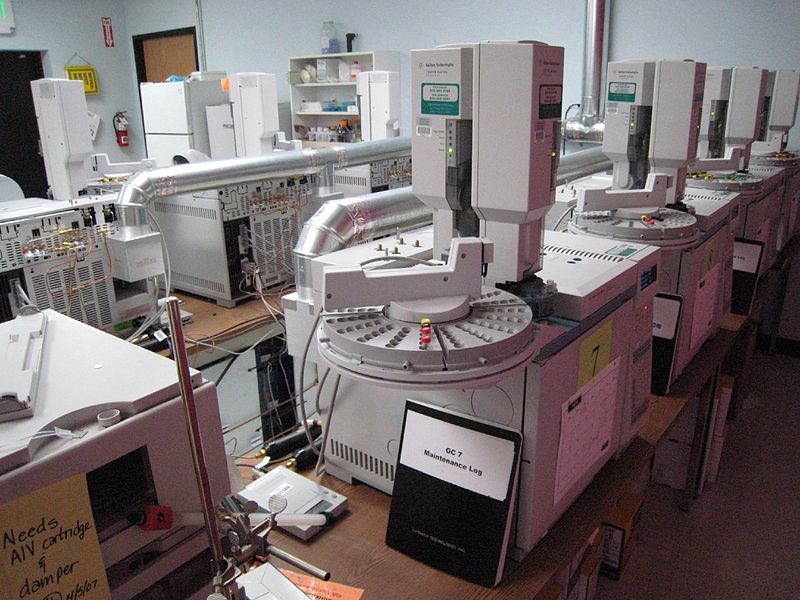
File:Gas_Chromatography_Laboratory.jpg · Wikimedia Commons · See Wikimedia Commons
analytical chemistry
Sign in to savestudy of the separation, identification, and quantification of the chemical components of materials
Analytical chemistry is the scientific field focused on breaking down materials into their individual chemical components and figuring out what they are and how much of each is present. It matters because understanding what substances contain and in what amounts is essential for everything from ensuring food safety and developing medicines to monitoring pollution and quality control in manufacturing.
AI-generated from the Wikipedia summary — may contain errors.
Research
242,562 papers- Making waves in analytical chemistry.Analytical and bioanalytical chemistry · 2022Irrgeher J, Rampler E, Steininger-Mairinger TDOI: 10.1007/s00216-022-04273-3
- Sustainability in (bio-)analytical chemistry.Analytical and bioanalytical chemistry · 2022Baeumner AJ, Gauglitz G, Mondello L et al.DOI: 10.1007/s00216-022-04211-3
- Nanomaterials in analytical chemistry.Analytical chemistry · 2013Ligler FS, White HSDOI: 10.1021/ac403331m
- Fundamental and Applied Reviews in Analytical Chemistry.Analytical chemistry · 2022Ren BDOI: 10.1021/acs.analchem.1c05291
- Fundamental and Applied Reviews in Analytical Chemistry: 2023.Analytical chemistry · 2023Ren BDOI: 10.1021/acs.analchem.2c05717
- Analytical chemistry in archaeological research.ReviewAnalytical chemistry · 2015Nigra BT, Faull KF, Barnard HDOI: 10.1021/ac5029616
- Teaching Analytical Chemistry in the Time of COVID-19.Analytical chemistry · 2020DOI: 10.1021/acs.analchem.0c02981
- ANALYTICAL chemistry.Manufacturing chemist and aerosol news · 1951
via PubMed
Wikidata facts
- Instance of
- academic major
- Subclass of
- chemistry
- Image
- Gas Chromatography Laboratory.jpg
Show 5 more facts
- Commons category
- Analytical chemistry
- topic's main category
- Category:Analytical chemistry
- on focus list of Wikimedia project
- Wikipedia:Vital articles/Level/4
- topic has template
- Template:Analytical chemistry
via Wikidata · CC0
~24 min read
Encyclopedic overview
Gas chromatography laboratory
Analytical chemistry (or chemical analysis) is the branch of chemistry concerned with the development and application of methods to identify the chemical composition of materials and quantify the amounts of components in mixtures. It focuses on methods to identify unknown compounds, possibly in a mixture or solution, and quantify a compound's presence in terms of amount of substance (in any phase), concentration (in aqueous or solution phase), percentage by mass or number of moles in a mixture of compounds (or partial pressure in the case of gas phase).
Excerpted from Wikipedia’s “analytical chemistry” article, available under the CC BY-SA 4.0 licence.
Gallery (11)
Available in 104 languages
- Español
- Français
- Deutsch
- 中文
- 日本語
- Русский
- Português
- Italiano
- العربية
- हिन्दी
- Afrikaans
- Albanian
- Albanian
- Aragonese
- Armenian
- Assamese
- Asturian
- azb
Show 85 more
- Azerbaijani
- Bahasa Indonesia
- Bangla
- Bashkir
- Basque
- bat_smg
- be_x_old
- Belarusian
- Bikol
- Bosnian
- Bulgarian
- Catalan
- Central Kurdish
- Chuvash
- Croatian
- Czech
- Danish
- Esperanto
- Estonian
- Faroese
- Fiji Hindi
- Filipino
- Finnish
- Galician
- Georgian
- Greek
- Hebrew
- Hungarian
- Icelandic
- Interlingua
- Irish
- Javanese
- Kannada
- Kazakh
- Kyrgyz
- Latin
- Latvian
- Lithuanian
- Lombard
- Low German
- Macedonian
- Malay
- Malayalam
- Mongolian
- Nederlands
- Norwegian
- Norwegian Nynorsk
- Occitan
- Pashto
- Piedmontese
- Polski
- Punjabi
- Romanian
- Scottish Gaelic
- Serbian
- Serbian (Latin)
- Sicilian
- simple
- Sindhi
- Sinhala
- Slovak
- Slovenian
- Sundanese
- Svenska
- Swahili
- Tamil
- Tatar
- Telugu
- Tiếng Việt
- Türkçe
- Ukrainian
- Urdu
- Uzbek
- Veps
- Waray
- Welsh
- Western Panjabi
- Wu Chinese
- Yakut
- Yiddish
- zh_min_nan
- zh_yue
- فارسی
- ไทย
- 한국어
via Wikidata sitelinks · CC0