Category
page 1Ancient Indian poems
Abhigyanashakuntalam
Sanskrit play by Kālidāsa

Raghuvaṃśa
'''''' (Devanagari: , lit. 'lineage of Raghu') is a Sanskrit epic poem (mahakavya) by the celebrated Sanskrit poet Kalidasa. Though an exact date of composition is unknown, the poet is presumed to have flourished in the 5th century CE. It narrates, in 19 sargas (cantos), the stories related to the Raghu dynasty, namely the family of Dilipa and his descendants up to Agnivarna, who include Raghu, Dasharatha and Rama.

Meghadūta
thumb|upright=1.35|King looking at a cloud in a night sky. Meghadūta illustration. Guler State|Guler School of [[Pahari painting, c. 1800. Lahore Museum]]
thumb|A Sanskrit manuscript of मेघदूतम् (Meghadūtam), the celebrated long poem by Kālidāsa, fl. ca. 5th century AD, India.
thumb|upright|A scene from Meghaduta with the yaksha and the cloud messenger, with the first verse of the poem - on an Indian stamp (1960)
thumb|upright|Artist's impression of Kalidasa composing the Meghaduta
Meghadūta (, Sanskrit: मेघदूतम्, literally Cloud Messenger) is a lyric poem written by Kālidāsa (c. 4th–5th centu

Buddhacarita
thumbnail|Buddha's First Sermon', India, 11th century|alt=A sculpture of Buddha sitting
Buddhacharita (; ) is an epic poem in the Sanskrit mahakavya style on the life of Gautama Buddha by Aśvaghoṣa of Sāketa (modern Ayodhya), composed in the early second century CE.

Kumārasaṃbhava
Kumārasambhavam ( ) (transl. - "The Birth of Kumāra") is an epic poem by Kālidāsa. It is widely regarded as the finest work of Kalidasa as well as the greatest kāvya poem in Classical Sanskrit. The style of description of spring set the standard for nature metaphors pervading many centuries of Indian literary tradition. Kumārasaṃbhavam narrates the birth of Kumāra (Kārtikeya), the son of Shiva (Śiva) and Pārvatī (Umā). The period of composition is uncertain, although Kalidasa is thought to have lived in the 5th century.

Silappatikaram
Cilappatikāram (, ), also referred to as Silappathikaram or Silappatikaram, is the earliest Tamil epic. It is a poem of 5,730 lines in almost entirely akaval (aciriyam) meter. The epic is a tragic love story of an ordinary couple, Kaṇṇaki and her husband Kōvalaṉ. The Cilappatikāram has more ancient roots in the Tamil bardic tradition, as Kannaki and other characters of the story are mentioned or alluded to in the Sangam literature such as in the Natṟiṇai and later texts such as the Kovalam Katai. It is attributed to a prince-turned-jain-monk Iḷaṅkō Aṭikaḷ, and was probably composed in the 5th
Vikramōrvaśīyam
Vikramōrvaśīyam () is a five-act Sanskrit play by ancient Indian poet Kālidāsa, who lived in the 4th or 5th Century CE, on the Vedic love story of King Pururavas and an Apsarā (celestial nymph) named Ūrvaśī, known for her beauty.

Ṛtusaṃhāra
Ṛtusaṃhāra, often written Ritusamhara, (Devanagari: ऋतुसंहार; ऋतु , "season"; संहार , "compilation") is a medium length Sanskrit poem. The poem has six cantos – one for each of the six Indian seasons, which are Grīṣhma (Summer), Varṣā (Monsoon), Śāradā (Autumn), Hemanta (Early winter), Śiśira (Winter) and Vasanta (Spring).
Kirātārjunīya
Kirātārjunīya (, Of Kirata and Arjuna) is an epic poem by Bhāravi, written in Sanskrit. Believed to have been composed in the 6th century or earlier, it consists of eighteen cantos describing the combat between Shiva (in the guise of a kirata, or "mountain-dwelling hunter"), and Arjuna. Along with the Naiṣadhacarita and the Shishupala Vadha, it is one of the larger three of the six Sanskrit mahakavyas, or great epics. It is noted among Sanskrit critics both for its gravity or depth of meaning, and for its forceful and sometimes playful expression. This includes a canto set aside for demonstrat

Manimekalai
Maṇimēkalai (, ), also spelled Manimekhalai or Manimekalai, is a Tamil Buddhist epic composed by Kulavāṇikaṉ Seethalai Sataṉar probably somewhere between the 2nd century to the 6th century. It is an "anti-love story", a sequel to the "love story" in the earliest Tamil epic Cilappatikaram, with some characters from it and their next generation. The epic consists of 4,861 lines in akaval meter, arranged in 30 cantos.
Ainkurunuru
Ainkurunuru ( meaning five hundred short poems) is a classical Tamil poetic work and traditionally the third of the Eight Anthologies (Ettuthokai) in the Sangam literature. It is divided into five groups of 100 short stanzas of 3 to 6 lines, each hundred subdivided into 10s, or pattu. The five groups are based on tinai (landscapes): riverine, sea coast, mountain, arid and pastoral. According to Martha Selby, the love poems in Ainkurunuru are generally dated from about the late-2nd-to-3rd-century-CE (Sangam period). According to Takanobu Takahashi – a Tamil literature scholar, these poems were
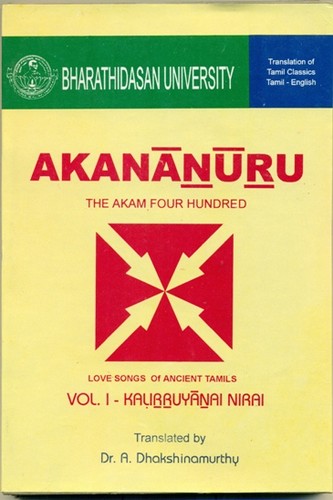
Akanaṉūṟu
thumb|150px|Man-size sculpture of Rama|Sri Rama in [[Srivaikuntanathan Perumal temple located in Tamil Nadu.]]