Category
page 1Ancient Roman architectural elements

dome
A dome () is an architectural element similar to the hollow upper half of a sphere. There is significant overlap with the term cupola, which may also refer to a dome or a structure on top of a dome. The precise definition of a dome has been a matter of controversy and there are a wide variety of forms and specialized terms to describe them.

architrave
thumb| Architrave of the left-side Portal (architecture)|portal in the [[facade of the Basilica of Sant'Ambrogio in Milan, Italy (with a relieving arch above)]]
thumb|Architrave in the Basilica of San Salvatore, Spoleto, Italy.

Corinthian order
latest of the three principal classical orders of ancient Greek and Roman architecture

pediment
thumb|300px|Types of pediment; "curved" and "broken" examples at the lower right

portico
225px|thumb|The portico of Croome Court in [[Croome D'Abitot (England)]]
225px|thumb|Temple diagram with location of the pronaos highlighted
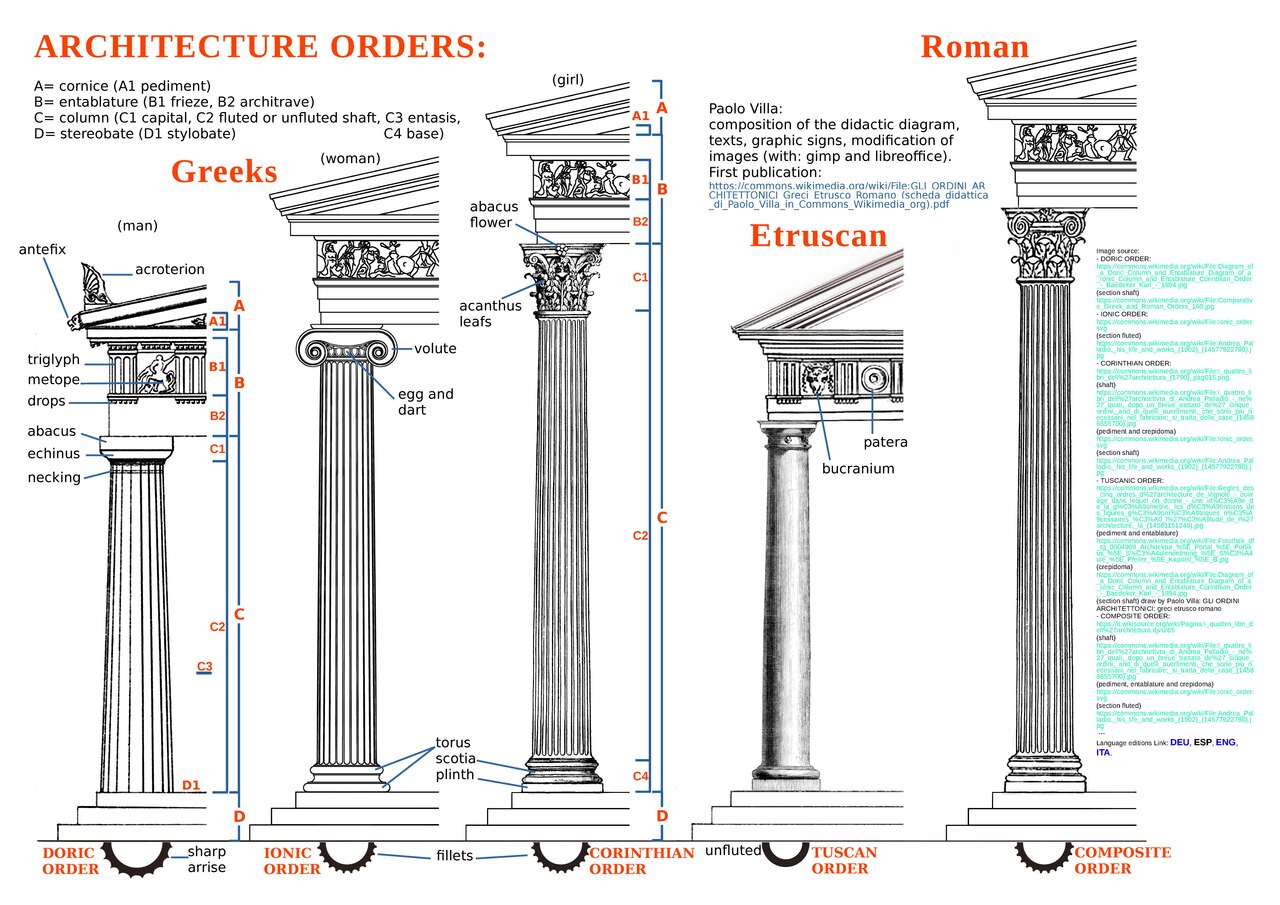
architectural order
styles of classical architecture, most readily recognizable by the type of column employed
%20(2)%20(cropped).jpg)
metope
thumb|Metope from the Elgin Marbles|Parthenon marbles depicting part of the battle between the Centaurs and the Lapiths; 442–438 BC; marble; height: 1.06 m; [[British Museum (London)]]

palisade
thumb|right|Reconstruction of a palisade in a Celtic village at St Fagans National History Museum, [[Wales]]
thumb|right|Reconstruction of a medieval palisade in Germany

volute
right|thumb|Examples of Ionic volutes. From Julien David LeRoy, Les ruines plus beaux des monuments de la Grèce, Paris, 1758 (Plate XX)
A volute is a spiral, scroll-like ornament that forms the basis of the Ionic order, found in the capital of the Ionic column. It was later incorporated into Corinthian order and Composite column capitals. Four are normally to be found on an Ionic capital, eight on Composite capitals and smaller versions (sometimes called helix) on the Corinthian capital.

acroterion
thumb|right|Examples of acroteria

aedicula
thumb|Classical shrine from Marsala|Lilybaeum, with sign of [[Baal Hammon, signs of Tanit and caduceus]]
In ancient Roman religion, an ' (: ') is a small shrine, and in classical architecture refers to a niche covered by a pediment or entablature supported by a pair of columns and typically framing a statue. The early Christian ones sometimes contained funeral urns. are also represented in art as a form of ornamentation.

exedra
thumb|Exedra of Pamphilidas, Acropolis of Lindos, Rhodes, Greece
thumb|right|The foundations and partial floor of a late Roman villa. The floored part is the exedra. The rest of the floor has deteriorated and is missing, with only parts of the [[hypocaust columns remaining. Hot air circulated through the hypocaust to heat the house.]]
An exedra (: exedras or exedrae) is a semicircular architectural recess or platform, sometimes crowned by a semi-dome, and either set into a building's façade or free-standing. The original Greek word ('a seat out of doors') was applied to a room that opened onto

tetrapylon
thumb|The North Tetrapylon at Jerash in Jordan

impluvium
thumb|300px|A domus, with impluvium numbered 7

spolia
thumb|An Ionic order|Ionic capital embedded in the south wall of the Church of St. Peter at Ennea Pyrgoi, [[Kalyvia Thorikou, Greece]]
Spolia (Latin for 'spoils'; : spolium) are stones taken from an old structure and repurposed for new construction or decorative purposes. It is the result of an ancient and widespread practice (spoliation) whereby stone that has been quarried, cut and used in a built structure is carried away to be used elsewhere. The practice is of particular interest to historians, archaeologists and architectural historians since the gravestones, monuments and architectural

pseudoperipteral
thumb|right|The Maison Carrée at [[Nîmes, a hexastyle pseudoperipteral Roman temple]]

tablinum
thumb|upright=1.4|Architectural details of a with the marked number 5
In Roman architecture, a '''' (or , from , board, picture) was a room in a domus'' (house) generally situated on one side of the atrium and opposite to the entrance; it opened in the rear onto the peristyle, with either a large window or only an anteroom or curtain. The walls may be richly decorated with fresco pictures, and often busts of the family were arranged on pedestals on the two sides of the room.
Opus reticulatum
Roman masonry in diamond-shaped bricks of tuff, covering a core of opus caementicium

vomitorium
thumb|upright=1.35|Vomitorium at the Amphitheatre of Pompeii in [[Pompeii]]
Monk and Nun
style of roof tiling using arched tiles in both layers
Roman brick
style of brick used in Ancient Roman architecture

Semi-dome
thumb|257x257px|Typical Early Christian/Byzantine apse with a hemispherical semi-dome decorated in [[mosaic (Basilica di Sant'Apollinare in Classe in Ravenna)]]
In architecture, a semi-dome (or half-dome) is a half dome that covers a semi-circular area in a building.
agger
architectural structure

velarium
thumb|An awning is visible at the top of this contemporary fresco of a riot on and around the Amphitheatre of Pompeii|Pompeii Amphitheater. Surviving graffiti in Pompeii advertise that next games will have awnings ().
thumb|right| is visible in the background in Jean-Léon Gérôme's painting
thumb|Model of the Colosseum with its velarium in the Museum of Roman Civilization
A '''''' ("curtain") was a type of awning used in Roman times. It stretched over the whole of the , the seating area in amphitheaters, to protect spectators from the sun. Retractable awnings were relatively common throughout
%2001.jpg)
puteal
thumb|upright|Roman marble puteal with Cult of Dionysus|Bacchic procession, late 1st-century CE
A puteal (Latin: from puteus ("well") – : putealia) is a classical wellhead built around a water well's access opening.
Diocletian window
type of semicircular window

Suspensura
thumb|Remains of the thermae in Glanum, on the southern outskirts of [[Saint-Rémy-de-Provence, France]]
Suspensura is the architectural term given by Vitruvius to piers of square bricks (about 20 cm × 20 cm) that supported a suspended floor of a Roman bath covering a hypocaust cavity through which hot air would flow.
taenia
raised band or fillet, often placed along the top of a Doric architrave
fauces
Architectural element
imbrex and tegula
overlapping roof tiles used in ancient Greek and Roman architecture as a waterproof and durable roof covering
post and lintel
building system where horizontal elements (beams or lintels) are held up by vertical elements (posts)
Pteron
In Classical architecture, a pteron (, 'wing') is an external colonnade around a building, especially an Ancient Greek temple. The pteroma or peristasis is the passage between the columns and the wall in a temple, the peristyle that in an inward-facing courtyard or garden.
Roman masonry
ancient roman building techniques
history of Roman and Byzantine domes
aspect of history
Scaenae frons
architectural background of a Roman theatre stage
sphaeristerium
Sphaeristerium (Latin; from the Greek σφαιριστήριον; from σφαῖρα, ball) is a term in Classical architecture given to a large open space connected with the Roman thermae for exercise with balls after the bather had been anointed. They were also provided in Roman villas.