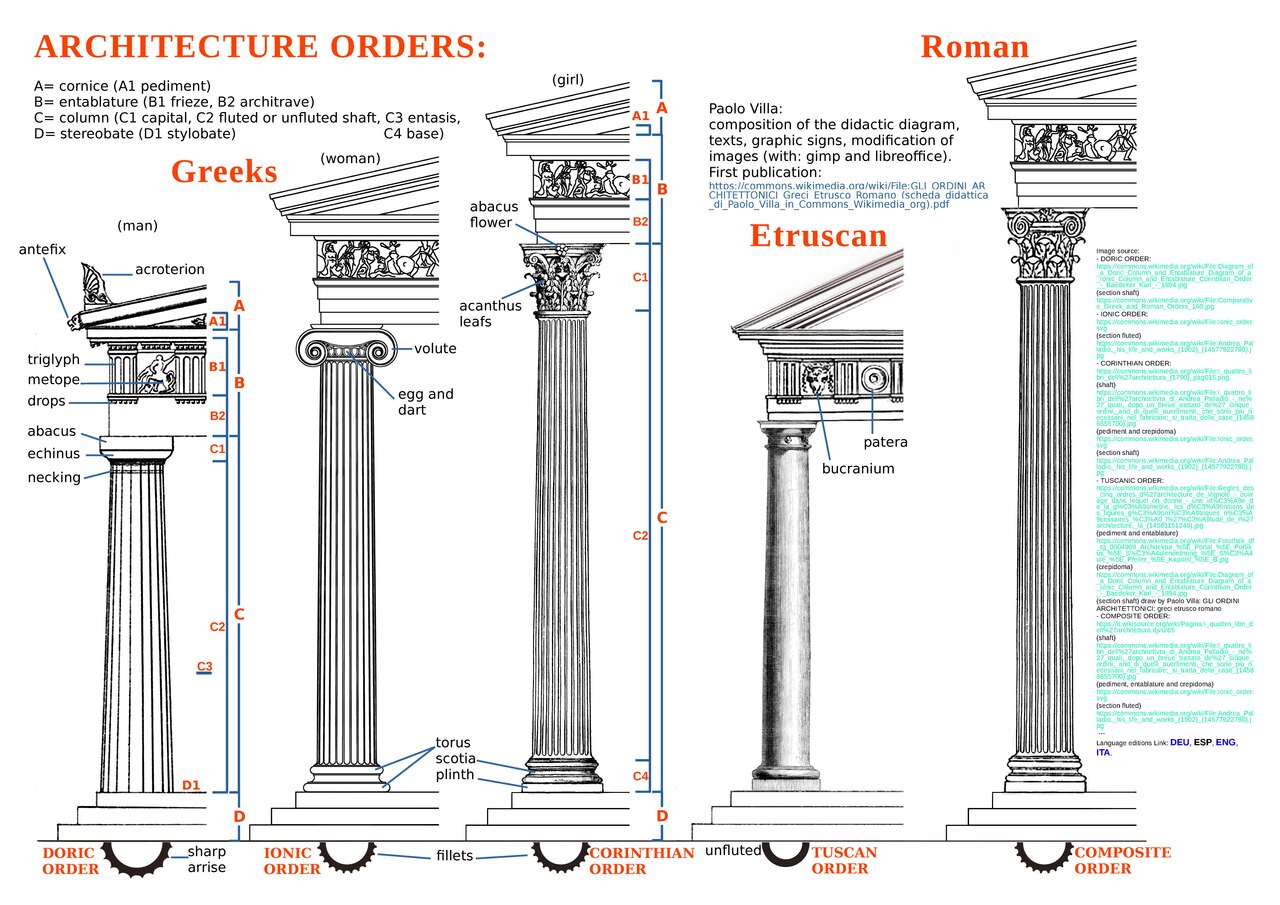
File:ARCHITECTURE_ORDERS_Greeks_Etruscan_Roman_(Doric_Ionic_Corinthian_Tuscan_Composite)_by_Paolo_Villa_ENG_edition.pdf · Wikimedia Commons · See Wikimedia Commons
architectural order
Sign in to saveAlso known as classical order
styles of classical architecture, most readily recognizable by the type of column employed
Wikidata facts
- Subclass of
- conceptual system
- Image
- Schema Saeulenordnungen.jpg
Show 5 more facts
- described by source
- Granat Encyclopedic Dictionary
- topic's main category
- Category:Orders of columns
- facet of
- baroque architecture
- Commons category
- Columns
- is metaclass for
- architectural structure
Sources (2)
via Wikidata · CC0
~20 min read
Encyclopedic overview
Greek, "Etruscan" and Roman orders, with stylobate and pediment
An order in architecture is a certain assemblage of parts subject to uniform established proportions, regulated by the office that each part has to perform. Coming down to the present from Ancient Greek and Ancient Roman civilization, the architectural orders are the styles of classical architecture, each distinguished by its proportions and characteristic profiles and details, and most readily recognizable by the type of column employed. The three orders of architecture—the Doric, Ionic, and Corinthian—originated in Greece. To these the Romans added, in practice if not in name, the Tuscan, which they made simpler than Doric, and the Composite, which was more ornamental than the Corinthian. The architectural order of a classical building is akin to the mode or key of classical music; the grammar or rhetoric of a written composition. It is established by certain modules like the intervals of music, and it raises certain expectations in an audience attuned to its language.
Excerpted from Wikipedia’s “architectural order” article, available under the CC BY-SA 4.0 licence.