Category
page 1Ancient Roman generals

Trajan
Trajan ( ; born Marcus Ulpius Traianus, 18 September 53) was a Roman emperor from AD 98 to 117, remembered as the second of the Five Good Emperors of the Nerva–Antonine dynasty. He was a philanthropic ruler and a successful soldier-emperor who presided over one of the greatest military expansions in Roman history, during which, by the time of his death, the Roman Empire reached its maximum territorial extent. He was given the title of optimus princeps ('the best ruler') by the Roman Senate.
.png)
Titus
Titus Flavius Vespasianus (; 30 December 39 – 13 September 81 AD) was Roman emperor from 79 to 81 AD. A member of the Flavian dynasty, Titus succeeded his father Vespasian upon his death, becoming the first Roman emperor ever to succeed his biological father.
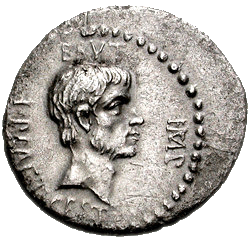
Marcus Junius Brutus
assassin of Julius Caesar

Marcus Vipsanius Agrippa
ancient Roman statesman and general
Arrian
Arrian of Nicomedia (; Greek: Arrianós; ; )

Nero Claudius Drusus
Roman general and statesman (38–9 BC)

Publius Quinctilius Varus
ancient Roman politician and governor; known for being defeated by the Germans led by Arminius at the battle of the Teutoburg Forest

Gaius Cassius Longinus
ancient Roman politician, known for his role in the assassination of Julius Caesar

Constantine III
Western Roman Emperor from 407 to 411

Gnaeus Julius Agricola
Roman governor and general, AD 40-93 (40-93)

Cincinnatus
two time Roman dictator

Lucius Junius Brutus
Semi-legendary 6th-century BC founder of Roman Republic

Lucius Cornelius Cinna
ancient Roman politician, consul in 87, 86, 85 and 84 BC, father-in-law of Julius Caesar

Marcus Furius Camillus
politician and soldier (446–365 BCE)

Decimus Junius Brutus Albinus
Roman general, politician, and assassin of Julius Caesar (81–43 BC)
Eugenius
Eugenius (died 6 September 394) was a Western Roman emperor from 392 to 394, unrecognized by the Eastern Roman emperor Theodosius I. While Christian himself, Eugenius capitalized on the discontent in the West caused by Theodosius' religious policies targeting pagans. He renovated the pagan Temple of Venus and Roma and restored the Altar of Victory after continued petitions from the Roman Senate. Eugenius replaced Theodosius' administrators with men loyal to him. This included pagans, reviving the pagan cause. His army fought the army of Theodosius at the Battle of the Frigidus, where he was ca

Odaenathus
Septimius Odaenathus (; ; – 267) was the founding king (malik) of the Palmyrene Kingdom who ruled from Palmyra, Syria. He elevated the status of his kingdom from a regional center subordinate to Rome into a formidable state in South-West Asia. Odaenathus was born into an aristocratic Palmyrene family that had received Roman citizenship in the 190s under the Severan Dynasty. He was the son of Hairan, the descendant of Nasor. The circumstances surrounding his rise are ambiguous; he became the lord (ras) of the city, a position created for him, as early as the 240s and by 258, he was styled a con
Avidius Cassius
Roman general and usurper (c. 130–175)
.png)
Crispus
Flavius Julius Crispus (; 300 – 326) was the eldest son of the Roman emperor Constantine I, as well as his junior colleague (caesar) from March 317 until his execution by his father in 326. The grandson of the augustus Constantius I, Crispus was the elder half-brother of the future augustus Constantine II and became co-caesar with him and with his cousin Licinius II at Serdica, part of the settlement ending the Cibalensean War between Constantine and his father's rival Licinius I. Crispus ruled from Augusta Treverorum (Trier) in Roman Gaul between 318 and 323 and defeated the navy of Licinius
Gnaeus Marcius Coriolanus
5th-century BC Roman general

Gaius Julius Caesar
Roman senator and father of Julius Caesar (c.140 BC - 85 BC)

Quintus Tullius Cicero
brother of Marcus Tullius Cicero

Gaius Asinius Pollio
Roman politician, historian and writer (75 BC–AD 4)

Drusus Julius Caesar
son of Emperor Tiberius
Aureolus
Aureolus was a Roman military commander during the reign of Emperor Gallienus before he attempted to usurp the Roman Empire. After turning against Gallienus, Aureolus was killed during the political turmoil that surrounded the Emperor's assassination in a conspiracy orchestrated by his senior officers. Aureolus is known as one of the Thirty Tyrants and is referenced in ancient sources including the Historia Augusta, Zonaras' epitome and Zosimus' Historia Nova.

Gaius Julius Civilis
leader of the Batavian rebellion against the Romans in 69 AD

Quintus Caecilius Metellus Pius Scipio Nasica
ancient Roman consul and optimate
Gundobad
Gundobad (; ; 452 – 516) was King of the Burgundians (473–516), succeeding his father Gundioc of Burgundy. Previous to this, he had been a patrician of the moribund Western Roman Empire in 472–473, three years before its collapse, succeeding his uncle Ricimer. He is perhaps best known today as the probable issuer of the Lex Burgundionum legal codes, which synthesized Roman law with ancient Germanic customs. He was the husband of Caretene.
.jpg)
Dexippus
thumb|Fragmentary statue base erected for Dexippus at Eleusis (I.Eleusis 656 = IG II² 3671)
Publius Herennius Dexippus (; c. 210–273 AD), Greek historian, statesman and general, was an hereditary priest of the Eleusinian family of the Kerykes, and held the offices of archon basileus and eponymous in Athens.
Lucius Antonius
brother of Roman triumvir Mark Antony
Marcus Valerius Messalla Corvinus
1st-century BC Roman politician and general

Tiberius Sempronius Longus
Roman general
Quintus Lutatius Catulus
Roman politician and general (149–87 BC)
Aulus Gabinius
Roman statesman and general
Gaius Suetonius Paulinus
1st century Roman general and provincial governor
Gnaeus Pompeius Strabo
ancient Roman consul, father of Pompey
Marcus Antonius
Roman orator and grandfather of Mark Antony the triumvir
Gaius Claudius Nero
Roman general active during the Second Punic War
Gnaeus Pompeius Magnus
eldest son of Pompey the Great
Publius Claudius Pulcher
Roman consul 249 BC
Aulus Plautius
governor of Roman Britain and suffect consul (5-57)
Quintus Servilius Caepio
Roman consul in 106 BCE
Marcus Antonius Creticus
1st-century BC Roman politician
Bonosus
Usurper of the Roman Empire (died 280)
Quintus Petillius Cerialis
son-in-law of emperor Vespasian
Publius Rutilius Rufus
Roman consul 105 BC
Lucius Papirius Cursor
Roman dictator 325 and 310 BC
Gaius Antonius
brother of the triumvir Mark Antony
Gaius Licinius Mucianus
Roman writer, politician and soldier
Marcus Terentius Varro Lucullus
Roman consul in 73 BC
Servius Sulpicius Galba
consul of Rome in 144 BC
Publius Ventidius
officer under Mark Antony
Lucius Manlius Vulso Longus
politician and soldier
Lusius Quietus
2nd century Roman general and governor of Judaea
Publius Decius Mus
Roman general and statesman (died 295 BC)
Gnaeus Domitius Ahenobarbus
consul of Rome in 122 BC
Gaius Trebonius
suffect consul in 45 BC
Marcus Valerius Corvus
4th-century BC Roman general and statesman

Titus Larcius
early 5th-century BC Roman senator and general
Gnaeus Mallius Maximus
Roman consul