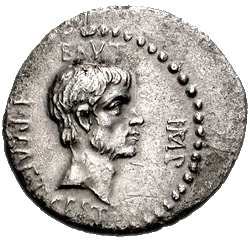
File:Brutusidesobv.gif · Wikimedia Commons · See Wikimedia Commons
Marcus Junius Brutus
Sign in to saveAlso known as Brutus, Quintus Servilius Caepio Brutus, Marcus Iunius Brutus, Q. Caepio Brutus, Quintus Servilius Caepio Junianus, Marcus Junius Brutus the Younger, Quintus Caepio Brutus
assassin of Julius Caesar
OverviewAI-generated
Marcus Junius Brutus was a male human from Ancient Rome, belonging to the Junia gens. He worked as a philosopher, poet, and politician. His career included holding the positions of praetor, quaestor, Roman governor, and triumvir monetalis. He participated in the assassination of Julius Caesar. Brutus was the son of Marcus Junius Brutus the Elder and Quintus Servilius Caepio, and his mother was Servilia, Hortensia. He was married to Porcia and had an unmarried partner named Volumnia Cytheris.
Brutus wrote in Latin. His notable works include *Marco Bruto*, *Phalaridos Epistolai tyrannou Akragantinōn*, *Diogenis Epistole. Bruti. Yppocratis medici*, *Phalaridis & Brvti Epistolae*, and *M. T. Ciceronis epistolarum ad Atticum, ad Brutum, // ad Quintum fratrem, libri XX*. He is described in sources such as *Parallel Lives* and appears in *The Divine Comedy*. He died in 42 BCE at Philippi from penetrating trauma resulting in suicide. He was born around 85 B.C.
Synthesized by Vinony from 28 facts across 3 sources: Wikidata, Open Library, Europeana Sparql. Generated from structured data (not the Wikipedia text) and checked against those facts — may still contain errors.
In the Vinony graph
Within Vinony's link graph, Marcus Junius Brutus is referenced by 756 other articles, and connects out to Julius Caesar, Servilia and William Shakespeare.
Vinony files it under 42 BC deaths, 85 BC births and Ancient Roman adoptees.
Its subject is documented across 64 Wikipedia language editions.
Person · Open Library
- Born
- 85? B.C.
- Died
- 42 B.C.
- Works
- 5
Top works
- Marco Bruto
- Phalaridos Epistolai tyrannou Akragantinōn
- Diogenis Epistole. Bruti. Yppocratis medici
- Lettres de Brutus et de Ciceron, touchant les affaires de la Republique Romaine depuis la mort de Iules Cesar iusques au Trium-virat
- Phalaridis & Brvti Epistolae
via Open Library + Wikidata
Wikidata facts
- Instance of
- human
- Gender
- male
- Citizenship
- Ancient Rome
- Place of death
- Philippi
- Spouse
- Porcia
- Father
- Quintus Servilius Caepio
- Mother
- Hortensia
- Sibling
- Junia Secunda
- Occupation
- politician
- Languages spoken
- Latin
- Participant in
- assassination of Julius Caesar
- Image
- Portrait Brutus Massimo.jpg
- Significant event
- proscription
Show 16 more facts
- Commons category
- Marcus Junius Brutus
- date of death
- 0042-00-00
- manner of death
- Suicide
- Commons gallery
- Marcus Junius Brutus
- topic's main category
- Category:Marcus Junius Brutus
- cause of death
- penetrating trauma
- gens
- Junia gens
- name in native language
- Marcus Junius Brutus
- writing language
- Latin
- present in work
- The Divine Comedy
- unmarried partner
- Volumnia Cytheris
- relative
- Decimus Junius Brutus Albinus
- different from
- Marcus Junius Brutus
- social classification
- nobiles
- date of birth
- 0085-00-00
- cognomen
- Brutus
Sources (5)
via Wikidata · CC0
Works in European collections
5 objects attributed to Marcus Junius Brutus, held across European museums, libraries & archives · via Europeana

~40 min read
Encyclopedic overview
Marcus Junius Brutus (/ˈbruːtəs/; Latin: [ˈmaːrkʊs juːniʊs ˈbruːtʊs]; c. 85 BC – 23 October 42 BC) was a Roman politician, orator, and the most famous of the assassins of Julius Caesar. After being adopted by a relative, he used the name Quintus Servilius Caepio Brutus, which was retained as his legal name. He is often referred to simply as Brutus.
Early in his political career, Brutus opposed Pompey, who was responsible for Brutus' father's death. He also was close to Caesar. However, Caesar's attempts to evade accountability in the law courts put him at greater odds with his opponents in the Roman elite and the senate. Brutus eventually came to oppose Caesar and sided with Pompey against Caesar's forces during the ensuing civil war (49–45 BC). Pompey was defeated at the Battle of Pharsalus in 48, after which Brutus surrendered to Caesar, who granted him amnesty.
Excerpted from Wikipedia’s “Marcus Junius Brutus” article, available under the CC BY-SA 4.0 licence.
Gallery (9)
Available in 64 languages
- Español
- Français
- Deutsch
- 中文
- 日本語
- Русский
- Português
- Italiano
- العربية
- Afrikaans
- Armenian
- Asturian
- Azerbaijani
- Bahasa Indonesia
- Basque
- Belarusian
- Breton
- Bulgarian
Show 45 more
- Catalan
- Croatian
- Czech
- Danish
- Egyptian Arabic
- Esperanto
- Finnish
- Galician
- Georgian
- Greek
- Hausa
- Hebrew
- Hungarian
- Icelandic
- Kazakh
- Kyrgyz
- Latin
- Lithuanian
- Macedonian
- Malay
- Malayalam
- Nederlands
- Norwegian
- Polski
- Romanian
- Scots
- Serbian
- Serbian (Latin)
- simple
- Slovak
- Slovenian
- Svenska
- Tamil
- Tiếng Việt
- Türkçe
- Ukrainian
- Urdu
- Uzbek
- Waray
- Welsh
- Western Panjabi
- Wu Chinese
- فارسی
- ไทย
- 한국어
via Wikidata sitelinks · CC0