Category
page 1Ancient Roman technology

fork
thumb|From left to right: pastry fork, relish fork, [[salad fork, dinner fork, cold cuts fork, serving fork, carving fork]]
In cutlery or kitchenware, a fork (from 'pitchfork') is a utensil, now usually made of metal, whose long handle terminates in a head that branches into several narrow and often slightly curved tines with which one can spear foods either to hold them to cut with a knife or to lift them to the mouth.

air conditioning
cooling of air in buildings or vehicles

hydrometer
thumb|upright=0.65|Schematic drawing of a hydrometer. The lower the density of the fluid, the deeper the weighted float B sinks. The depth is read off the scale A.

stirrup
thumb|A modern working stirrup on an endurance riding saddle
thumb|Typical metal stirrup used in English riding
A stirrup is a light frame or ring that holds the foot of a rider, attached to the saddle by a strap, often called a stirrup leather. Stirrups are usually paired and are used to aid in mounting and as a support while using a riding animal (usually a horse or other equine, such as a mule). They greatly increase the rider's ability to stay in the saddle and control the mount, increasing the animal's usefulness to humans in areas such as communication, transportation, and warfare.

sunglasses
thumb|upright=1.2|Wearing sunglasses under direct sunlight: Large lenses offer good protection, but broad temple arms are also needed against "stray light" from the sides.
.svg)
bellows
thumb|Diagram of fireplace hand-bellows
Bellows are a device constructed to expel a controlled blast of air. The simplest type consists of a flexible bag comprising a pair of rigid boards with handles joined by flexible leather sides enclosing an approximately airtight cavity which can be expanded and contracted by operating the handles, and fitted with a valve allowing air to fill the cavity when expanded, and with a tube through which the air is forced out in a stream when the cavity is compressed. It has many applications, in particular blowing on a fire to supply it with air.
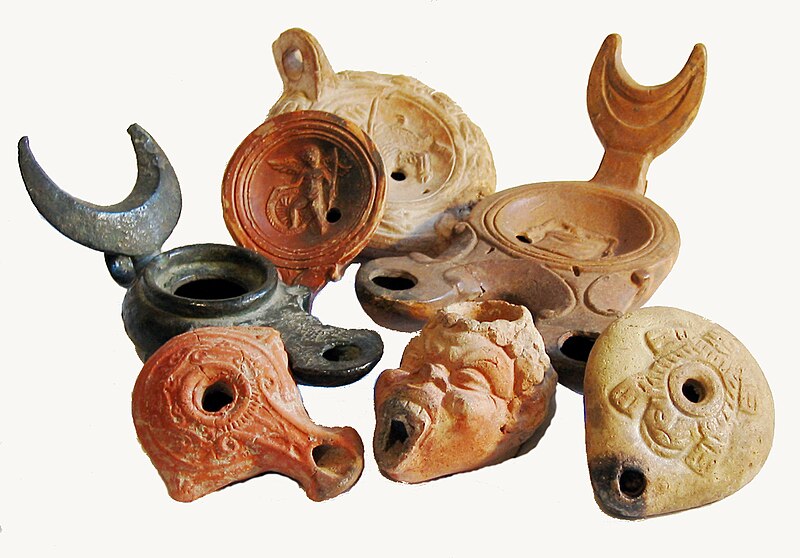
oil lamp
object used to produce light continuously for a period of time using an oil-based fuel source

sawmill
thumb|257px|Sawing logs into finished lumber with a basic "portable" sawmill
thumb|right|An American sawmill,
thumb|Early 20th-century sawmill, maintained at Jerome, Arizona|Jerome, Arizona
cameo
small relief carving

pig iron
iron alloy with a high carbon content

bookcase
thumb|Composite order|Composite columns of a bookshelf from the [[Bibliothèque Mazarine (Paris)]]
thumb|Household bookshelf arranged by color
central heating
system to provide warmth to a whole building from one point

gimbal
thumb|Illustration of a simple three-axis gimbal set; the center ring can be vertically fixed

steelmaking
thumb|upright=1.2|Steel mill with two [[arc furnaces]]
%2C%200-50%20dc%20ca..JPG)
urn
thumb|Ancient Roman urn made of [[alabaster]]
Roman dodecahedron
small hollow object made of bronze or stone, with a dodecahedral shape
Roman technology
engineering practice which supported Roman civilization
Roman glass
ancient glass covered by a patina responsible of their iridescent hues of blue, green, and orange
Roman engineering
engineering accomplishments of the ancient Roman civilization

agrimensor
thumb|Equipment used by an Ancient Rome|ancient Roman land [[surveyor (gromaticus), found at the site of Aquincum, modern Budapest, Hungary]]
chain pump
type of water pump
Roman abacus
Base-10 portable abacus

Salt mining
mining operation extracting rock salt or halite