File:Assorted_forks.jpg · Wikimedia Commons · See Wikimedia Commons
fork
Sign in to saveAlso known as forks
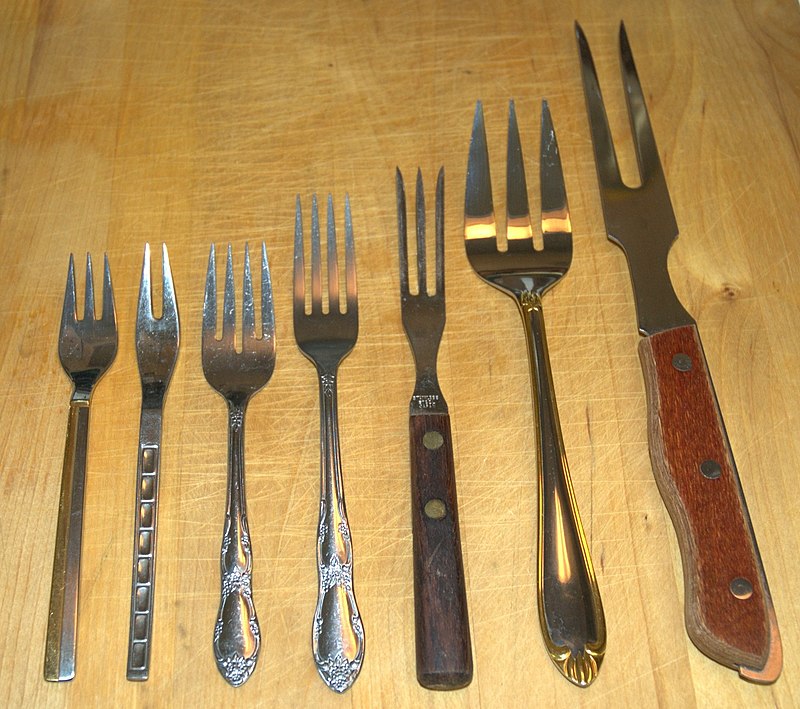
thumb|From left to right: pastry fork, relish fork, [[salad fork, dinner fork, cold cuts fork, serving fork, carving fork]] In cutlery or kitchenware, a fork (from 'pitchfork') is a utensil, now usually made of metal, whose long handle terminates in a head that branches into several narrow and often slightly curved tines with which one can spear foods either to hold them to cut with a knife or to lift them to the mouth.
A fork is a eating utensil with a handle that ends in several narrow, slightly curved prongs called tines, used to spear and hold food while cutting it or to lift it to your mouth. Forks come in various types for different purposes—from dinner forks for everyday meals to specialized forks for specific foods like salad or carving—making them essential tools for eating and food preparation.
AI-generated from the Wikipedia summary — may contain errors.
Wikidata facts
- Image
- Assorted forks.jpg
- Has use
- eating
Show 5 more facts
- Commons category
- Eating forks
- described by source
- Encyclopædia Britannica 11th edition
- on focus list of Wikimedia project
- Wikipedia:Vital articles/Level/4
- Commons gallery
- Eating fork
- topic's main category
- Category:Forks
Sources (3)
via Wikidata · CC0
~8 min read
Encyclopedic overview
6 sectionsContents
- History
- Types of forks
- See also
- References
- Further reading
- External links
thumb|From left to right: pastry fork, relish fork, [[salad fork, dinner fork, cold cuts fork, serving fork, carving fork]] In cutlery or kitchenware, a fork (from 'pitchfork') is a utensil, now usually made of metal, whose long handle terminates in a head that branches into several narrow and often slightly curved tines with which one can spear foods either to hold them to cut with a knife or to lift them to the mouth.
==History== Bone forks have been found in archaeological sites of the Bronze Age Qijia culture (2400–1900 BC) and the Shang dynasty (c. 1600 – c. 1050 BC), as well as later Chinese dynasties. A stone carving from an Eastern Han tomb (in Ta-kua-liang, Suide County, Shaanxi) depicts three hanging two-pronged forks in a dining scene. Similar forks have also been depicted on top of a stove in a scene at another Eastern Han tomb (in Suide County, Shaanxi).
Excerpted from Wikipedia’s “fork” article, available under the CC BY-SA 4.0 licence.
Gallery (30)
Available in 103 languages
- Español
- Français
- Deutsch
- 中文
- 日本語
- Русский
- Português
- Italiano
- العربية
- Albanian
- Aragonese
- Armenian
- Asturian
- Atikamekw
- Azerbaijani
- Bahasa Indonesia
- Bangla
- Basque
Show 84 more
- bat_smg
- be_x_old
- Belarusian
- Betawi
- Bikol
- Breton
- Bulgarian
- Burmese
- Catalan
- Central Kurdish
- Croatian
- Czech
- Danish
- Egyptian Arabic
- eml
- Esperanto
- Estonian
- Filipino
- Finnish
- Galician
- Greek
- Haitian Creole
- Hausa
- Hebrew
- Hungarian
- Iban
- Icelandic
- Ido
- Irish
- Javanese
- Kabyle
- Kazakh
- Kurdish
- Latin
- Latvian
- Lingua Franca Nova
- Lithuanian
- Lombard
- Luxembourgish
- Macedonian
- Malagasy
- Malay
- Manx
- nds_nl
- Nederlands
- Northern Frisian
- Norwegian
- Norwegian Nynorsk
- Occitan
- olo
- Pashto
- Polski
- Quechua
- roa_rup
- Romanian
- rsk
- Sardinian
- Serbian
- Serbian (Latin)
- Sicilian
- simple
- Slovak
- Sundanese
- Svenska
- Swahili
- Tamil
- Tibetan
- Tiếng Việt
- Türkçe
- Tuvinian
- Ukrainian
- Uzbek
- Venetian
- Walloon
- Waray
- West Flemish
- Wolof
- Wu Chinese
- Zaza
- zh_min_nan
- zh_yue
- فارسی
- ไทย
- 한국어
via Wikidata sitelinks · CC0