Category
page 1Animal goddesses

Artemis
In ancient Greek religion and mythology, Artemis (; ) is the goddess of hunting, the wilderness, wild animals, transitions, nature, vegetation, childbirth, care of children, and chastity. She was often said to roam the forests and mountains, attended by an entourage of nymphs. The goddess Diana is her Roman equivalent.

Diana
goddess of the hunt, the moon and birthing, equated with the Greek goddess Artemis

Hathor
thumb|right|Hathor as a cow
Hathor (, , , Meroitic: '''') was a major goddess in ancient Egyptian religion who played a wide variety of roles. As a sky deity, she was the mother or consort of the sky god Horus and the sun god Ra, both of whom were connected with kingship, and thus she was the symbolic mother of their earthly representatives, the pharaohs. She was one of several goddesses who acted as the Eye of Ra, Ra's feminine counterpart, and in this form, she had a vengeful aspect that protected him from his enemies. Her beneficent side represented beauty, music, dance, joy, love, sexualit
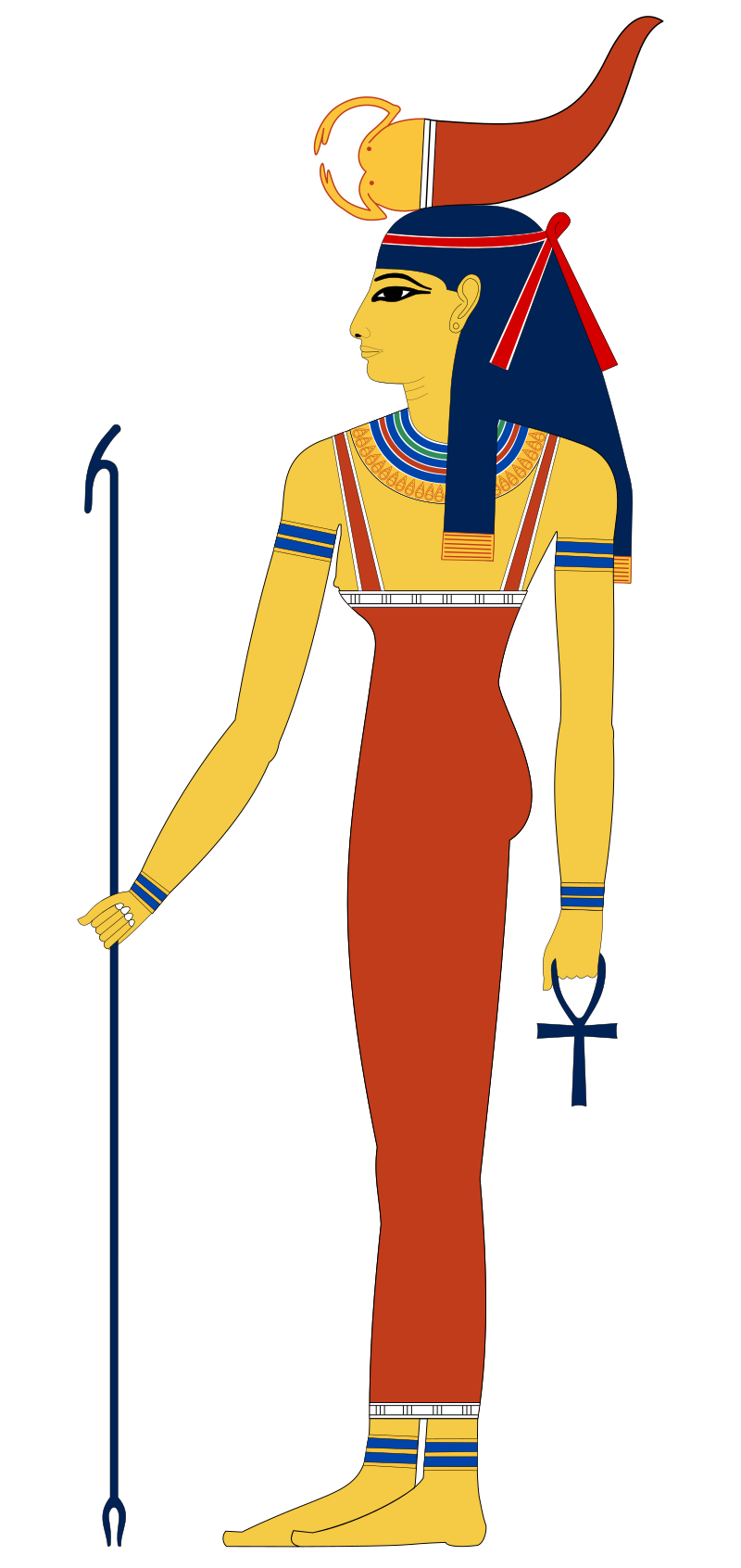
Serket
Serket /ˈsɜːrˌkɛt/ (Ancient Egyptian: srqt) is the goddess of protection against the venomous stings and bites of scorpions in Egyptian mythology. She was primarily worshiped in Lower Egypt during the Predynastic Period (c. 6000 – c. 3150 BCE). Serket is often depicted as a woman whose head is surmounted by a scorpion with its tail is ready to sting, an ankh in one hand, and a was-sceptre in her other. Her name, also rendered as Serqet, Selkis, or Selket, is a shortened version of 'Serket hetyt' which means "she who causes the throat to breathe."

Epona

Macha
thumb|"Macha Curses the Men of Ulster", Stephen Reid (artist)|Stephen Reid's illustration from [[Eleanor Hull's ''The Boys' Cuchulainn (1904)]]
Macha () was a sovereignty goddess of ancient Ireland associated with the province of Ulster, particularly the sites of Navan Fort (Eamhain Mhacha) and Armagh (Ard Mhacha''), which are named after her. Several figures called Macha appear in Irish mythology and folklore, all believed to derive from the same goddess. She is said to be one of three sisters known as 'the three Morrígna'. Like other sovereignty goddesses, Macha is associated with the land,
Sedna
Inuit goddess

Kāmadhenu
Kamadhenu (, , ), also known as Surabhi (, or , ), is a divine bovine-goddess described in Hinduism as the mother of all cows. She is a miraculous cow of plenty who provides her owner whatever they desire and is often portrayed as the mother of other cattle. In iconography, she is generally depicted as a white cow with a female head and breasts, the wings of a bird, and the tail of a peafowl or as a white cow containing various deities within her body. Kamadhenu is not worshipped independently as a goddess. Rather, she is honored by the Hindu veneration of cows, who are regarded as her earthly

Artio
Artio (Dea Artio in the Gallo-Roman religion) is a Celtic bear goddess. Evidence of her worship has notably been found at Bern in Switzerland. Her name is derived from the Gaulish word for 'bear', artos.
Hesat
Hesat is an ancient Egyptian goddess in the form of a cow. She was said to provide humanity with milk (called "the beer of Hesat") and in particular to suckle the pharaoh and several ancient Egyptian bull gods. In the Pyramid Texts she is said to be the mother of Anubis and of the deceased king. She was especially connected with Mnevis, the living bull god worshipped at Heliopolis, and the mothers of Mnevis bulls were buried in a cemetery dedicated to Hesat. In Ptolemaic times (304–30 BC) she was closely linked with the goddess Isis.

Vārāhī
Varahi (, IAST:) is one of the Matrikas, a group of seven mother goddesses in the Hindu religion who has the face of a sow. In Nepal, she is called Barahi. In Rajasthan and Gujarat, she is venerated as Dandini.
Potnia Theron
female divinitiy associated with animals
Aysyt
Ajyyhyt (Aysyt, Ajsyt or Ajyhyt; ; ) is a Turkic goddess of the Yakut people from the Lena River region of Siberia and is an important figure in Turkic mythology. The name means "birthgiver" and she may also be called the "mother of cradles". Her full name is given as Айыыһыт Хотун, meaning "birth-giving nourishing mother". Aisyt brings the soul from heaven at the birth of a baby and records each one in the Golden Book of Fate. She is the daughter of Yer Tanrı.
Medeina
Medeina or Medeinė (from – "tree" or medė – "forest"), often treated as synonymous to Žvorūnė or Žvorūna (derived from žvėris – "beast"), is one of the main deities in the Lithuanian mythology, and is similar to Latvian Meža māte (Forest Mother). She is a ruler of forests, trees and animals. Her sacred animal is a hare.
Anu
deity
Dali
goddess in Georgian mythology
Hedetet
Hededet or Hedjedjet (ḥdd.t) is a scorpion goddess of the ancient Egyptian religion. She resembles Serket in many ways, but was in later periods merged into Isis. She was depicted with the head of a scorpion, nursing a baby. She is mentioned in the Book of the Dead.
Aranyani
Aranyani () is the goddess of forests and the wild animals that dwell within them in Hinduism.
Rumina
In ancient Roman religion, Rumīna, Rumilia or Rumia, also known as Dīva Rumīna, was a goddess who protected breastfeeding mothers, and possibly nursing infants. Her domain extended to protecting animal mothers, not just human ones. As one of the indigitamenta, Rumina lacked the elaborate mythology and personality of later Roman deities, and was instead a more abstract, numinous entity.
Bubona
In ancient Roman religion, Bubona is thought to have been a goddess of cattle, but she is named only by Saint Augustine.

Māra
Māra is the highest-ranking goddess in Latvian mythology, the ancient Dawn-goddess, previously called Austra, and, not at all, although often stated, the same as Zemes māte (Mother Earth, pace).
Ta-Bitjet
Ta-Bitjet is an ancient goddess of Egyptian mythology. She is identified as the consort of Horus. Ta-Bitjet is a scorpion goddess and the blood that flowed from when Horus ruptured her hymen can serve as a panacea for poisons. She could be associated with another bride of one of Horus, Serket.
Artume
Artume (also called Aritimi, Artames, or Artumes) was an Etruscan goddess who was the mistress of animals, goddess of human assemblies, and hunting deity of Neolithic origin. She was a daughter of Tinia and Letun, and she had two siblings: A brother called Turms and a brother named Aplu. Her Greek counterpart was Artemis and her Roman counterpart Diana; however, Etruscans later appropriated the Greek goddess Artemis.As Artimi, see Denise Demetriou, Negotiating Identity in the Ancient Mediterranean: The Archaic and Classical Greek Multiethnic Emporia (Cambridge University Press, 2012), 70.
Flidais
Flidas or Flidais (modern spelling: Fliodhas, Fliodhais) is a female figure in Irish Mythology, known by the epithet Foltchaín ("beautiful hair"). She is believed to have been a goddess of cattle and fertility.
Damona
In Gallo-Roman religion, Damona was a goddess worshipped in Gaul as the consort of Apollo Borvo and of Apollo Moritasgus.
Khunu Leima
Goddess of all the pigeons in the world in Meitei mythology and religion of Ancient Manipur (Kangleipak).
Inara
goddess in Hittite–Hurrian mythology
Malinalxochitl
In Aztec mythology, Malinalxochitl, or Malīnalxōch, ( , from Nahuatl malinalli "grass" and xochitl "flower") was a sorceress and goddess of snakes, scorpions, and insects of the desert. She claimed the title Cihuacoatl, meaning "Woman Serpent" or "Snake Woman". Her brother was Huītzilōpōchtli. During the migration, she was abandoned during her sleep by the Mexicas as directed by her brother. Afterward she had a son named Copil with Chimalcuauhtli, king of Malinalco.
Banai
Hindu goddess
Pinga
goddess of the hunt, fertility and medicine in Inuit mythology
Mellona
Mellona or Mellonia was an ancient Roman goddess said by St. Augustine to promote the supply of honey (Latin mel, mellis) as Pomona did for apples and Bubona for cattle. Arnobius describes her as "a goddess important and powerful regarding bees, taking care of and protecting the sweetness of honey."
Arnapkapfaaluk
Arnapkapfaaluk 'big bad woman' was the sea goddess of the Inuit of Canada's Coronation Gulf area. Although occupying the equivalent position to Sedna within Inuit religion, in that she had control of the animals of the seas, she was noticeably different as can be seen by the English translation of her name.
Lamaria
Lamaria (also Lamara or Lamia; ) is a goddess in Georgian mythology, specifically of the Svan ethnic subgroup. Like many other deities of the Svan pantheon, her name is derived from a Christian figure; in her case, Mary, mother of Jesus. Lamaria is the goddess of the hearth, protector of cattle, and a protector of women – particularly during childbirth. She also ensured the fertility of a village's grain fields. She was also known as a patron of beekeeping, although that function was later assigned to the Svan interpretation of St. George.
Artimpasa
Artimpasa (; ) was a complex androgynous Scythian goddess of fertility who possessed power over sovereignty and the priestly force. Artimpasa was the Scythian variant of the Iranian goddess Arti/Aṣ̌i.
Kalamainu'u
In Hawaiian mythology, '''Kalamainu'u (alternate spelling Kalanimainu'u''') was a lizard goddess.