Category
page 1Animal subphyla

Myriapoda
Myriapods () are the members of subphylum Myriapoda, containing arthropods such as millipedes and centipedes. The group contains about 13,000 species, all of them terrestrial.

Hexapoda
The subphylum Hexapoda (from Greek for 'six legs') or hexapods comprises the largest clade of arthropods and includes most of the extant arthropod species. It includes the crown group class Insecta (true insects), as well as the much smaller clade Entognatha, which includes three classes of wingless arthropods that were once considered insects: Collembola (springtails), Protura (coneheads) and Diplura (two-pronged bristletails). The insects and springtails are very abundant and are some of the most important pollinators, basal consumers, scavengers/detritivores and micropredators in terrestria

Chelicerata
The subphylum Chelicerata (from Neo-Latin, , ) constitutes one of the major subdivisions of the phylum Arthropoda. Chelicerates include the sea spiders, horseshoe crabs, and arachnids (including harvestmen, scorpions, spiders, solifuges, ticks, and mites, among many others), as well as a number of extinct lineages, such as the eurypterids (sea scorpions) and chasmataspidids.

Acoelomorpha
Acoelomorpha is a subphylum of very simple and small soft-bodied animals with planula-like features that live in marine or brackish waters. They usually live between grains of sediment, swimming as plankton, or crawling on other organisms, such as algae and corals. Except for two acoel freshwater species, all known acoelomorphs are marine.

Medusozoa
Medusozoa is a clade in the phylum Cnidaria, and is often considered a subphylum. It includes the classes Hydrozoa, Scyphozoa, Staurozoa and Cubozoa. Medusozoans are distinguished by having a medusa stage in their often complex life cycle, a medusa typically being an umbrella-shaped body with stinging tentacles around the edge. With the exception of some Hydrozoa (and Polypodiozoa), all are called jellyfish in their free-swimming medusa phase.
==Naming==
The Medusozoa are named after Medusa from ancient Greek mythology.
Conchifera
Conchifera is a subphylum of the phylum Mollusca, containing five extant classes: Monoplacophora, Cephalopoda, Gastropoda, Bivalvia, and Scaphopoda. Conchiferans can bear a single shell as in snails and ammonites, a single pair of shells as in clams, or lack a shell as in slugs and squid. The other subphylum is Aculifera, the members of which are shellless or have a row of several plates.
Non-monoplacophoran conchiferans emerged within the once-widespread Monoplacophora. The only descendant which retains its ancestral shape is the Tryblidiida.
Asterozoa
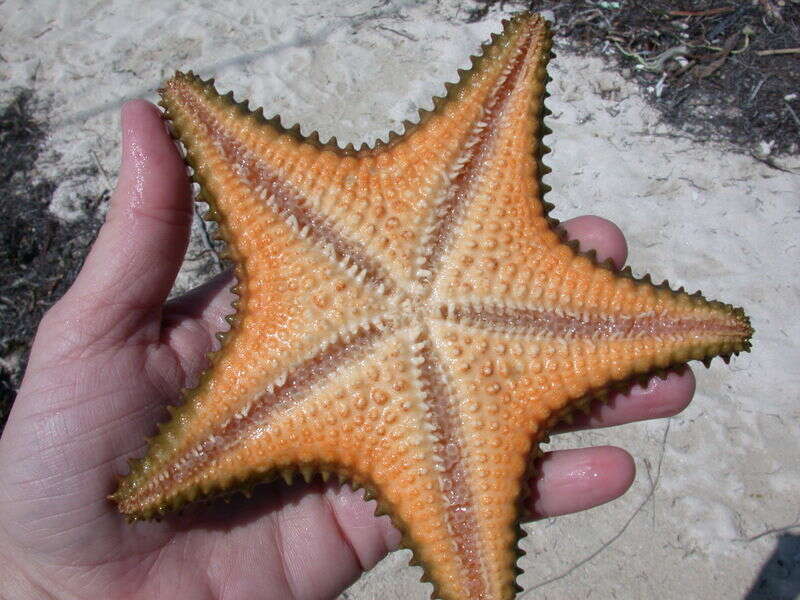
The Asterozoa are a subphylum in the phylum Echinodermata, within the Eleutherozoa. Characteristics include a star-shaped body and radially divergent axes of symmetry. The subphylum includes the classes Asteroidea (the starfish or sea stars), Ophiuroidea (the brittle stars and basket stars), Somasteroidea (early asterozoans from which the other classes most likely evolved), and Stenuroidea (early asterozoans with unclear relationships to extant classes). A fifth class, Concentricycloidea, was proposed for the unusual genus Xyloplax (sea daisies), but was later demoted to the status of infracla
Crinozoa
Crinozoa is a subphylum of mostly sessile echinoderms, of which the crinoids, or sea lilies and feather stars, are the only extant members. Crinozoans have an extremely extensive fossil history.
Echinozoa
Echinozoa is a subphylum of free-living echinoderms in which the body is or originally was a modified globe with meridional symmetry. Echinozoans lack arms, brachioles or other appendages, and do not at any time exhibit pinnate structure. Their two extant classes are the sea urchins and the sea cucumbers.

Eleutherozoa
Eleutherozoa is a subphylum of echinoderms. They are mobile animals with the mouth directed towards the substrate. They usually have a madreporite, tube feet, and moveable spines of some sort. It includes all living echinoderms except for crinoids. The monophyly of Eleutherozoa has been proven sufficiently well to be considered "uncontroversial."
Trilobitomorpha
REDIRECT Artiopoda
.jpg)
Rhynchonelliformea
Rhynchonelliformea is a major subphylum and clade of brachiopods. It is roughly equivalent to the former class Articulata, which was used previously in brachiopod taxonomy up until the 1990s. These so-called articulated brachiopods have many anatomical differences relative to "inarticulate" brachiopods of the subphyla Linguliformea and Craniformea. Articulates have hard calcium carbonate shells with tongue-and-groove hinge articulations (hence the name) and separate sets of simple opening and closing muscles.

Uniramia
thumb|left|As members of Myriapoda, centipedes like this [[Scolopendra polymorpha are part of subphylum Uniramia]]
Uniramia (uni – one, ramus – branch, i.e. single-branches) is formerly recognised group within Arthropoda, now recognised as non-monophyletic, united by their strictly uniramous (single branched) appendages.
thumb|left|Onychophora like this Peripatoides sp. are no longer counted as unirames.
Homalozoa
Homalozoa is an obsolete extinct subphylum of Paleozoic era echinoderms, prehistoric marine invertebrates. They are also referred to as carpoids.
Blastozoa
Blastozoa is a subphylum of extinct echinoderms characterized by the presence of specialized respiratory structures and brachiole plates used for feeding. It ranged from the Cambrian to the Permian. Biserial, triradiate, and pentaradiate ambulacral patterns have been identified in blastozoa specimens. The pentaradiate pattern in particular has been associated with several different classes.
Linguliformea
Linguliformea is a subphylum of inarticulate brachiopods. These were the earliest of brachiopods, ranging from the Cambrian into the Holocene. They rapidly diversified during the Cambrian into the Ordovician, but most families became extinct by the end of the Devonian.