Category
page 1Aquatic ecology

fish
A fish is an aquatic, anamniotic, gill-bearing vertebrate animal with a tough cranium to protect the brain, but lacking limbs with digits. Fish can be grouped into the more basal jawless fish and the more common jawed fish, the latter including all living cartilaginous and bony fish, as well as the extinct placoderms and acanthodians. In a break from the long tradition of grouping all fish into a single class (Pisces), modern phylogenetics views fish as a paraphyletic group that includes all vertebrates except tetrapods. In English, the plural of "fish" is fish when referring to individuals an

mud
thumb|upright=1.35|A pair of muddy Wellington boot|Wellington boots
thumb|Gamo mud volcano in Tokamachi, Japan
Mud (, or Middle Dutch) is loam, silt or clay mixed with water. Mud is usually formed after rainfall or near water sources. Ancient mud deposits hardened over geological time to form sedimentary rock such as shale or mudstone (generally called lutites). When geological deposits of mud are formed in estuaries, the resultant layers are termed bay muds. Mud has also been used for centuries as a construction resource for mostly houses and also used as a binder. An Old English word for it

river delta
landform that is formed at the mouth of a river

hydrosphere
thumb|upright=1.5|The Earth captured in the [[Pacific Ocean side]]

plankton
thumb|upright=1.5| Part of the contents of one dip of a hand net. The image contains diverse planktonic organisms, ranging from [[photosynthetic cyanobacteria and diatoms to many different types of zooplankton, including both holoplankton (permanent residents of the plankton) and meroplankton (temporary residents of the plankton, e.g., fish eggs, crab larvae, worm larvae). 100 μm = one tenth of a mm.]]
.JPG)
mangrove
thumb|upright=1.3|Mangroves are hardy shrubs and trees that thrive in salt water and have specialised adaptations so they can survive the volatile energies of intertidal zones along marine coasts.

estuary
thumb|Río de la Plata estuary
thumb|Mattole River estuary

fresh water
naturally occurring water with low concentrations of dissolved salts
.jpg)
wetland

continental shelf
portion of a continent that is submerged under an area of relatively shallow water known as a shelf sea

water pollution
contamination of water bodies

limnology
thumb|upright=1.3|Lake Hāwea, New Zealand

salinity
thumb|upright=1.3|right|Annual mean sea surface salinity for the World Ocean. Data from the [[World Ocean Atlas 2009.]]
thumb|upright|right|International Association for the Physical Sciences of the Oceans (IAPSO) standard seawater.
Salinity () is the saltiness or amount of salt dissolved in a body of water, called saline water (see also soil salinity). It is usually measured in g/L or g/kg (grams of salt per liter/kilogram of water; the latter is dimensionless and equal to ‰).
sea water
Seawater, or sea water, is water from a sea or ocean. On average, seawater in the world's oceans has a salinity of about 3.5% (35 g/L, 35 ppt, 600 mM). This means that every kilogram (roughly one liter by volume) of seawater has approximately of dissolved salts (predominantly sodium () and chloride () ions). The average density at the surface is 1.025 kg/L. Seawater is denser than both fresh water and pure water (density 1.0 kg/L at ) because the dissolved salts increase the mass by a larger proportion than the volume. The freezing point of seawater decreases as salt concentrati

brackish water
water with salinity between freshwater and saline water
phytoplankton
Phytoplankton () are the autotrophic (self-feeding) components of the plankton community and a key part of ocean and freshwater ecosystems. The name comes from Ancient Greek φυτόν (phutón), meaning "plant", and πλαγκτός (planktós), meaning "drifter, wanderer, roamer", and thus, "plant drifter".

eutrophication
thumb|313x313px|Eutrophication can cause harmful algal blooms like this one in a river near Chengdu, China.

sea ice
ice formed from frozen seawater

littoral zone
part of a sea, lake or river that is close to the shore

algal bloom
rapid increase or accumulation in the population of algae

abyssal plain
flat area on the ocean floor

surface runoff
flow of excess rainwater not infiltrating in the ground over its surface

abyssal zone
layer of the pelagic zone of the ocean; the deeper part of the midnight zone which starts in the bathypelagic waters above, the area below the abyssal zone is the sparsely inhabited hadal zone

halophyte
thumb|250px|right|Spartina alterniflora ([[cordgrass), a halophyte.]]
ocean acidification
climate change-induced decline of pH levels in the ocean
water resource
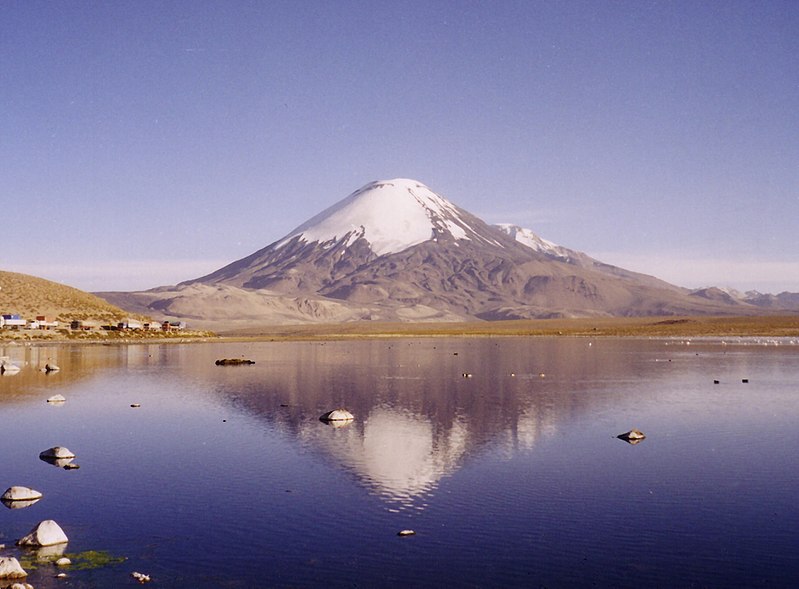
sources of water that are useful or potentially useful

detritus
thumb|Horse [[feces and straw are forms of detritus, and are used as manure.]]

thermocline
thumb|Graph showing a tropical ocean thermocline (depth vs. temperature). Note the rapid change between 100 and 1000 meters. The temperature is nearly constant after 1500 meters depth.
kelp forest
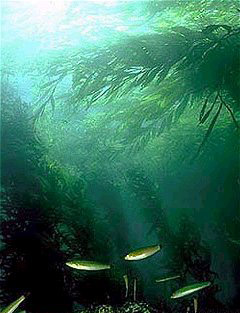
underwater areas with a high density of kelp

upwelling
Upwelling is an oceanographic phenomenon that involves wind-driven motion of dense, cooler, and usually nutrient-rich water from deep water towards the ocean surface. It replaces the warmer and usually nutrient-depleted surface water. The nutrient-rich upwelled water stimulates the growth and reproduction of primary producers such as phytoplankton. The biomass of phytoplankton and the presence of cool water in those regions allow upwelling zones to be identified by cool sea surface temperatures (SST) and high concentrations of chlorophyll a.

nekton
Nekton or necton (from the ) is any aquatic organism that can actively and persistently propel itself through a water column (i.e. swim) without touching the bottom. Nekton generally have powerful tails and appendages (e.g. fins, pleopods, flippers or jets) that make them strong enough swimmers to counter ocean currents, and have mechanisms for sufficient lift and/or buoyancy to prevent sinking. Examples of extant nekton include most fish (especially pelagic fish like tuna and sharks), marine mammals (cetaceans, sirenia and pinnipeds) and reptiles (specifically sea turtles), penguins, coleoid
benthic zone
ecological region at the lowest level of a body of water such as an ocean or a lake, including the sediment surface and some sub-surface layers
intertidal zone
area between tide marks
marine debris
human-created waste that has deliberately or accidentally been released in a lake, sea, ocean or waterway
photic zone
uppermost layer of water in a lake or ocean that is exposed to sunlight more than 1% of surface illumination

turbidity
thumb|Turbidity standards of 5, 50, and 500 NTU
chemical oxygen demand
measure of the amount of oxygen that can be consumed by reactions in a solution
fish migration
movement of fishes from one water body to another
aphotic zone
portion of a lake or ocean where less than 1% of sunlight penetrates
thermal pollution
degradation of water quality by any process that changes ambient water temperature
filter feeder
Animals that feed by straining food particles from water

hydrobiology
thumb|388x388px|An example of a mountain lake ecosystem
Hydrobiology is the science of life and life processes in water. Much of modern hydrobiology can be viewed as a sub-discipline of ecology but the sphere of hydrobiology includes taxonomy, economic and industrial biology, morphology, and physiology. The one distinguishing aspect is that all fields relate to aquatic organisms. Most work is related to limnology and can be divided into lotic system ecology (flowing waters) and lentic system ecology (still waters).
fish ladder
type of fish passage
sea surface temperature
water temperature close to the ocean's surface
neritic zone
part of the ocean
cold seep
ocean floor area where hydrogen sulfide, methane and other hydrocarbon-rich fluid seepage occurs

microphyte
300px|thumb|upright=1.0| Nannochloropsis microalgae
300px|thumb|upright=1.0|Collection of microalgae cultures in CSIRO's lab
marine ecosystem
among the largest of Earth's aquatic ecosystems

halocline
A halocline (or salinity chemocline), from the Greek words hals (salt) and klinein (to slope), refers to a layer within a body of water (water column) where there is a sharp change in salinity (salt concentration) with depth.
aquatic ecosystem
ecosystem in a body of water
marine snow
shower of mostly organic detritus falling from the upper layers of the water column
water balance
looks at how water moves in a closed system
anoxic event
intervals in the Earth's past
milky seas effect
luminous phenomenon in the ocean in which large areas of seawater glow brightly enough at night to be seen by satellites orbiting Earth

neuston
right|thumb|upright=1.3|

bioassay
A bioassay is an analytical method to determine the potency or effect of a substance by its effect on living animals or plants (in vivo), or on living cells or tissues (in vitro). A bioassay can be either quantal or quantitative, direct or indirect. If the measured response is binary, the assay is quantal; if not, it is quantitative.
.svg)
epilimnion
thumb|Lakes are stratified into three separate sections: I. The Epilimnion II. The Thermocline|Metalimnion III. The [[Hypolimnion The scales are used to associate each section of the stratification to their corresponding depths and temperatures. The arrow is used to show the movement of wind over the surface of the water which initiates the turnover in the epilimnion and the hypolimnion.]]
oceanic plateau
relatively flat submarine region that rises well above the level of the ambient seabed
hypolimnion
300px|thumb|Lakes are stratified into three separate sections: I. The Epilimnion II. The Metalimnion III. The Hypolimnion The scales are used to associate each section of the stratification to their corresponding depths and temperatures. The arrow is used to show the movement of wind over the surface of the water which initiates the turnover in the epilimnion and the hypolimnion.
%20resting%20in%20a%20crowd%20on%20Wahlberg%C3%B8ya%2C%20Svalbard%20(3).jpg)
bioturbation
alt=Walrus |thumb|upright=1.5 |Sediment on the left tusk of a walrus. Walrus bioturbations in Arctic benthic sediments have large-scale ecosystem effects.