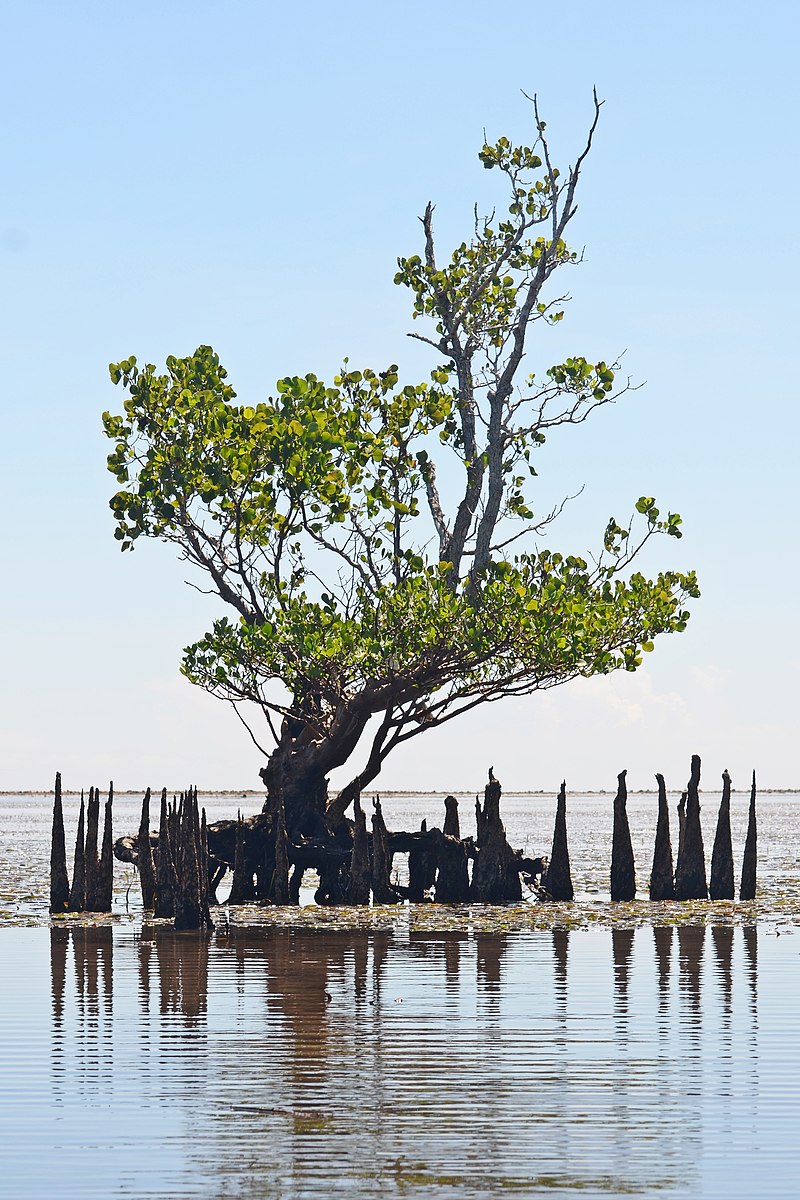
File:Sonneratia_alba_-_Manado_(2).JPG · Wikimedia Commons · See Wikimedia Commons
mangrove
Sign in to saveAlso known as bosque de mangle, mangrove ecoregion, mangrove biome
thumb|upright=1.3|Mangroves are hardy shrubs and trees that thrive in salt water and have specialised adaptations so they can survive the volatile energies of intertidal zones along marine coasts.
Mangroves are hardy shrubs and trees that grow in salty coastal waters and have special adaptations allowing them to survive the harsh conditions of areas where land and sea meet. They matter because they provide critical ecosystem services and support for marine and coastal life in these challenging environments.
AI-generated from the Wikipedia summary — may contain errors.
Wikidata facts
- Subclass of
- biome
- Image
- Ala honko.jpg
Show 6 more facts
- Commons category
- Mangroves
- topic's main category
- Category:Mangroves
- Commons gallery
- Mangrove
- different from
- Rhizophoraceae
- has characteristic
- mangrove forest
- on focus list of Wikimedia project
- Wikipedia:Vital articles/Level/4
via Wikidata · CC0
~40 min read
Encyclopedic overview
22 sectionsContents
- Etymology
- Biology
- Adaptations to low oxygen
- Nutrient uptake
- Limiting salt intake
- Limiting water loss
- Filtration of seawater
- Increasing survival of offspring
- Taxonomy and evolution
- True mangroves
- Other mangroves
- Species distribution
- Mangrove forests
- Mangrove microbiome
- Root microbiome
- Suggestions for future mangrove microbial diversity research
- Mangrove virome
- Genome sequencing
- See also
- References
- Further reading
- External links
thumb|upright=1.3|Mangroves are hardy shrubs and trees that thrive in salt water and have specialised adaptations so they can survive the volatile energies of intertidal zones along marine coasts.
A mangrove is a shrub or tree that grows mainly in coastal saline or brackish water. Mangroves grow in an equatorial climate, typically along coastlines and tidal rivers. They have particular adaptations to take in extra oxygen and remove salt, allowing them to tolerate conditions that kill most plants. The term is also used for tropical coastal vegetation consisting of such species. Mangroves are taxonomically diverse due to convergent evolution in several plant families. They occur worldwide in tropical and subtropical coastal areas, mainly between latitudes 30° N and 30° S, with the greatest mangrove area within 5° of the equator. Mangrove plant families first appeared during the Late Cretaceous to Paleocene epochs and became widely distributed in part due to the movement of tectonic plates. The oldest known fossils of mangrove palm date to 75 million years ago.
Excerpted from Wikipedia’s “mangrove” article, available under the CC BY-SA 4.0 licence.
Gallery (52)
Available in 92 languages
- Español
- Français
- Deutsch
- 中文
- 日本語
- Русский
- Português
- Italiano
- العربية
- हिन्दी
- Afrikaans
- Asturian
- Azerbaijani
- Bahasa Indonesia
- Bangla
- Basque
- Belarusian
- Bhojpuri
Show 73 more
- Bikol
- Bosnian
- Bulgarian
- Burmese
- Catalan
- Chuvash
- Croatian
- Czech
- Danish
- Divehi
- Esperanto
- Estonian
- Finnish
- Galician
- Georgian
- Gorontalo
- Greek
- Haitian Creole
- Hebrew
- Hungarian
- Icelandic
- Irish
- Javanese
- Kannada
- Kazakh
- Kikuyu
- Latin
- Latvian
- Lithuanian
- Macedonian
- Malagasy
- Malay
- Malayalam
- Manx
- Marathi
- Mongolian
- Nederlands
- Nepali
- Northern Frisian
- Norwegian
- Norwegian Nynorsk
- Occitan
- Ossetic
- Pashto
- Polski
- Punjabi
- Romanian
- Sanskrit
- Serbian
- Serbian (Latin)
- simple
- Sinhala
- Slovak
- Slovenian
- Svenska
- Swahili
- Tamil
- Tiếng Việt
- Türkçe
- Ukrainian
- Upper Sorbian
- Urdu
- Waray
- Welsh
- Western Frisian
- Western Panjabi
- Wu Chinese
- Yiddish
- zh_yue
- Zhuang
- فارسی
- ไทย
- 한국어
via Wikidata sitelinks · CC0