Category
page 1Arches and vaults

arch
thumb|Gateway Arch

dome
A dome () is an architectural element similar to the hollow upper half of a sphere. There is significant overlap with the term cupola, which may also refer to a dome or a structure on top of a dome. The precise definition of a dome has been a matter of controversy and there are a wide variety of forms and specialized terms to describe them.

apse
thumb|Typical early Christian Byzantine apse with a hemispherical semi-dome in the [[Basilica of Sant'Apollinare in Classe]]
thumb|Typical floor plan of a cathedral, with the apse shaded
In architecture, an apse (: apses; from Latin , 'arch, vault'; from Ancient Greek , , 'arch'; sometimes written apsis; : apsides) is a semicircular recess covered with a hemispherical vault or semi-dome, also known as an exedra. In Byzantine, Romanesque, and Gothic Christian church (including cathedral and abbey) architecture, the term is applied to a semi-circular or polygonal termination of the main building

vault
architectural term for an arched form used to provide a space with a ceiling or roof

nave
thumbnail|The nave of the Church of Saint-Sulpice, Paris|Saint-Sulpice Church in Paris
thumb|The nave of the Santa Monica Parish Church (Sarrat)|Santa Monica Parish Church in [[Sarrat, Philippines]]

arcade
covered walk enclosed by a line of arches on one or both sides
tympanum
architectural element; the vertical, triangular space enclosed by the horizontal and raking cornices of a pediment

buttress
thumb|Buttresses of Miag-ao Church, [[Philippines]]

keystone
architectural element: wedge-shaped stone of an arch

pendentive
thumb|Schematic representation of a dome on pendentives.

Gateway Arch
monument in St. Louis, Missouri

archivolt
300px|thumb|Archivolts on the South Portal of the Chartres Cathedral|Cathedral of Our Lady of Chartres, [[Chartres, France.]]
An archivolt (or voussure) is an ornamental moulding or band following the curve on the underside of an arch.

lunette
thumb|upright=1.35|Lunette over the main door of the Luxembourg Palace in Paris
thumb|Charles Sprague Pearce, Rest (1896). Mural in a lunette in the [[Thomas Jefferson Building of the Library of Congress, Washington, D.C.]]

squinch
thumb|250px|Squinches supporting a dome in Odzun Basilica, Armenia, early 8th century
barrel vault
architectural element formed by the extrusion of a single curve
bay
space defined by the vertical piers, in a building
corbel arch
arch-like construction method
Arch of Reunification
Pyongyang Monument
rib vault
architectural element
groin vault
produced by the intersection at right angles of two barrel vaults

Patuxai
Patuxai (Lao: ປະຕູໄຊ, ; literally Victory Gate or Gate of Triumph, formerly the Anousavary or Anosavari Monument, known by the French as Monument Aux Morts) is a war monument in Downtown Vientiane, Laos, built between 1957 and 1968. The Patuxai was dedicated to those who fought in the struggle for independence from France. In romanizing the name from the Laotian language, it is variously transliterated as Patuxai, Patuxay, Patousai and Patusai. It is also called Patuxai Arch or the Arc de Triomphe of Vientiane as it resembles the Arc de Triomphe in Paris. However, it is Laotian in design, deco
pointed arch
history and construction of pointed arch

voussoir
thumb|William Henry Playfair, [[University of Edinburgh: bevelled edges of each stone block emphasise the voussoirs, which have a curved base and together form a semi-circle at the top of each arch.]]
A voussoir (UK: ; US: ) is a wedge-shaped element, typically a stone, which is used in building an arch or vault.
thumb|Joggled voussoir arch, located at the Mausoleum of Theodoric in [[Ravenna, Italy. (520 CE)]]
Each voussoir is formed in a specific way to fit within the arch or vault created. Normally, different colored stones are shaped to fit together in a curved way that relies on the balanc
semicircular arch
arches with intradoses that are full semicircles; shape common in ancient Roman architecture
arch dam
solid dam made of concrete that is curved upstream in plan
horseshoe arch
emblematic arch common in Moorish architecture
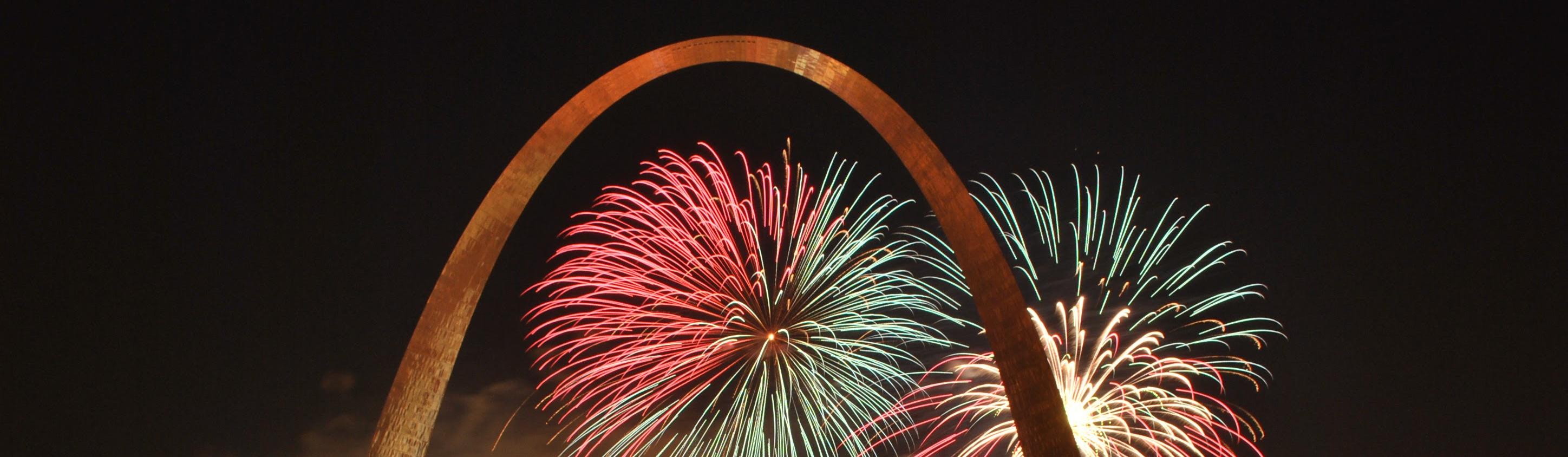
Gateway Arch National Park
American National Park in St. Louis, Missouri

arcosolium
{|style="float:right;"
|valign="top"|thumb|150px|A 4th-century arcosolium in the hypogeum of Via Dino Compagni ([[Via Latina Catacomb), Rome. The figure of the frescoes is the goddess Tellus, after whom this tomb is named.]]
|valign="top"|thumb|150px|The 15th-century arcosolium of the doncel Martín Vázquez de Arce, in the [[Sigüenza Cathedral, Spain. Like most post-Roman era arcosolia, it is aboveground.]]
|}
An arcosolium, plural arcosolia, is an arched recess used as a place of entombment. The word is from Latin , "arch", and , "throne" (literally "place of state") or post-classical "sarcoph
fan vault
form of vaulting

ogee
thumb|right|Two ogee curve examples with their extended S shapes, concave over convex (cyma recta), and convex over concave (cyma reversa), representing the cross section (geometry)|cross-sections of two types of decorative moldings used in building
An ogee ( ) is an object, element, or curve—often seen in architecture and building trades—that has a serpentine or extended S shape (sigmoid). Ogees consist of a double curve, the combination of two curves that, as a result of a point of inflection from concave to convex or vice versa, have ends of the overall curve that point in opposite directio
Arch of Freedom of the Ukrainian People
monument in Kyiv, Ukraine
Lombard band
decorative architectural element

ogive
thumb|A Secant line|secant ogive of sharpness E = 120/100= 1.2
thumb|The ogive shape of the Space Shuttle external tank
thumb|right|Ogive on a 9×19mm Parabellum cartridge

ablaq
thumb|Reception hall of Azm Palace|Azem Palace in [[Damascus, Syria, using ablaq technique (18th century)]]Ablaq (; particolored; literally 'piebald') is an architectural technique involving alternating or fluctuating rows of light and dark stone. It is an Arabic term describing a technique associated with Islamic architecture in the Arab world. The technique is used primarily for decorative effect. It may have its origins in earlier Byzantine architecture in the region, where alternating layers of white stone and orange brick were used in construction. Its use began early in the history of Is

centring
thumb|upright|Model of centring for a ribbed dome structure at Albrechtsburg.
Centring, centre, centering, or center is a type of falsework: the temporary structure upon which the stones of an arch or vault are laid during construction. Until the keystone is inserted an arch has no strength and needs the centring to keep the voussoirs in their correct relative positions. A simple centring without a truss is called a common centring. A cross piece connecting centring frames is called a lag or bolst.
four-centred arch
type of arch with a pointed apex
arch-gravity dam
dam with the characteristics of both an arch dam and a gravity dam
cloister vault
vault shaped like a pyramid with sides that bow outward
Semi-dome
thumb|257x257px|Typical Early Christian/Byzantine apse with a hemispherical semi-dome decorated in [[mosaic (Basilica di Sant'Apollinare in Classe in Ravenna)]]
In architecture, a semi-dome (or half-dome) is a half dome that covers a semi-circular area in a building.
segmental arch
type of arch with a circular arc of less than 180 degrees
arch band
architectural element
lierne
architectural term for an element of a vault
chahartaq
structure in medieval Iranian architecture consisted of four barrel vaults and a dome
jack arch
Arch of Hadrian
triumphal arch in Jerash, Jordan

splay
opening of a door or window, made larger at one face of the wall than at the other
springer
architectural term

discharging arch
architectural element
blind arch
Architectural feature
diamond vault
Form of vault church architecture
Mecca Gate
landmark at Jeddah–Makkah Highway
buchetta shop
shop selling goods through a small hole in a wall
Catalan vault
low brickwork arch
Fremont Street Experience
pedestrian mall and tourist attraction in downtown Las Vegas, Nevada, United States
Arch 22
triumphal arch in Banjul, the Gambia
Nubian vault
type of vaulted structure
Santa Catalina Arch
bridge in Guatemala
trefoil arch
arch incorporating the outline of a trefoil
triangular arch
architectural element
diaphragm arch
transverse wall-bearing arch forming a partial wall dividing a vault or a ceiling