Category
page 1Argonauts

Heracles

Asclepius
Asclepius (; ; ) is a hero and god of medicine in ancient Greek religion and mythology. He is the son of Apollo and Coronis, or Arsinoe, or of Apollo alone. Asclepius represents the healing aspect of the medical arts; his daughters, the , are: Hygieia ("Health, Healthiness"), Iaso (from ἴασις "healing, recovering, recuperation", the goddess of recuperation from illness), Aceso (from ἄκεσις "healing", the goddess of the healing process), Aegle (the goddess of good health) and Panacea (the goddess of universal remedy). He has several sons as well. He was associated with the Roman/Etruscan god Ve
%20-%20Napoli%20MAN%209043%20-%2001.jpg)
Theseus
thumb|Theseus after having slain the Minotaur, freeing captive Athenian boys; Cretans approaching to marvel the scene, Antique fresco from [[Pompeii]]
Theseus (, ; ) was a divine hero in Greek mythology, famous for slaying the Minotaur. The myths surrounding Theseus, his journeys, exploits, and friends, have provided material for storytelling throughout the ages.

Orpheus
In Greek mythology, Orpheus (; , classical pronunciation: ) was a Thracian bard, legendary musician and prophet. He was also a renowned poet and, according to legend, travelled with Jason and the Argonauts in search of the Golden Fleece, and descended into the underworld to recover his lost wife, Eurydice.

Jason
thumb|upright=1.25|Jason, between the jaws of the dragon which guards the Golden Fleece, is saved by [[Athena. The fleece hangs from a tree behind them. Attic kylix, 480–470 BC, attributed to Douris.]]

Argonauts
thumb|Gathering of the Argonauts, Attica|Attic red-figure [[krater, 460–450 BC (Louvre G 341)]]
The Argonauts ( ; ) were a band of heroes in Greek mythology, who in the years before the Trojan War (around 1300 BC) accompanied Jason to Colchis in his quest to find the Golden Fleece. Their name comes from their ship, Argo, named after its builder, Argus. They were sometimes called Minyans, after a prehistoric tribe in the area.

Castor and Pollux
Greek mythical siblings

Atalanta
thumb|Atalanta surrounded by three Erotes, Attic white-ground [[lekythos, c. 500–470 BC]]
.jpg)
Peleus
thumb|upright|Detail of Greek mosaic with Peleus and Clotho, [[Paphos Archaeological Park]]
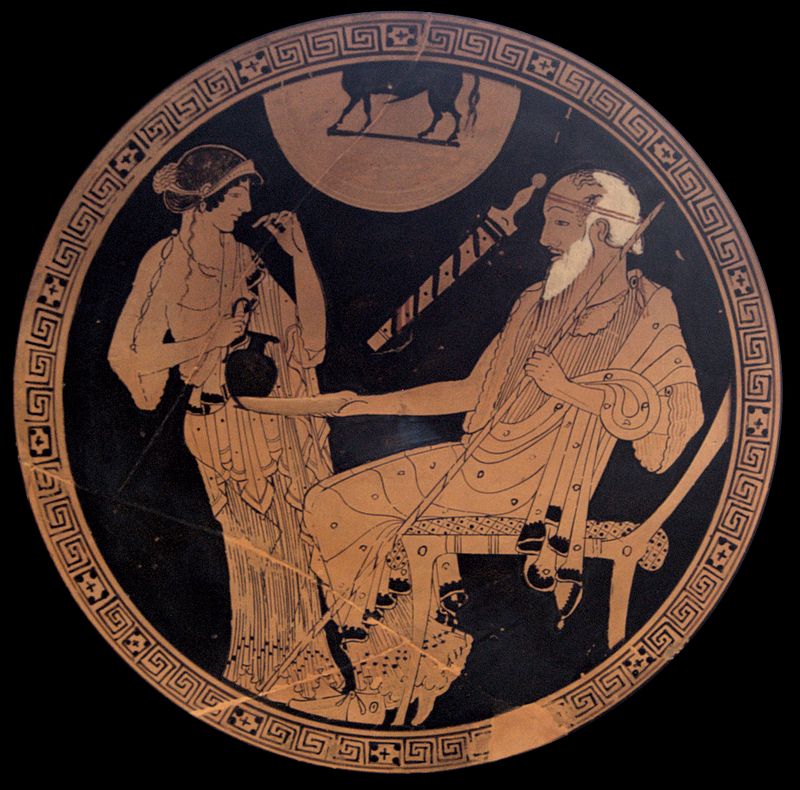
Nestor
wise ruler of Pylos in Greek mythology, son of Neleus

Admetus
king of Pherae in Thessaly, in Greek mythology

Philoctetes
thumb|Philoctetes at Lemnos, on an Attic red-figure [[lekythos, ca. 420 BC (Metropolitan Museum of Art)]]
Philoctetes ( Philoktētēs; , ), or Philocthetes, according to Greek mythology, was the son of Poeas, king of Meliboea in Thessaly, and Demonassa or Methone. He was a Greek hero, famed as an archer, and a participant in the Trojan War.

Meleager
thumb|Bust of Meleager, Roman copy after a Greek original of ca. 340-330 BC

Telamon
thumb|280px|The marriage of Telamon and Hesione or Hesione's farewell to her brother [[Priam under the attention of Heracles and Telamon on the right, detail of fresco from the triclinium of the House of Octavius Quartio at Pompeii]]

Hylas
thumb|Hylas and nymphs from a mosaic in [[Roman Gaul (3rd century)]]
%2005.jpg)
Augeias of Elis
In Greek mythology, Augeas (or Augeias, , ), whose name means "bright", was king of Elis and father of Epicaste. Some ancient authors say that Augeas was one of the Argonauts. He is known for his stables, which housed the single greatest number of cattle in the country and had never been cleaned, until the time of the great hero Heracles. The derivative adjective augean came to signify a challenging task, typically improving or fixing something that is currently in a bad condition.
%20-%20Napoli%20MAN%209044%20(cropped).jpg)
Pirithous
thumb|upright=1.2|Pirithous and Hippodamia (wife of Pirithous)|Hippodamia receiving the centaurs at his wedding. Antique fresco from Pompeii.
thumb|"Pirithous' Kampf um Helena" by Joseph Echteler and [[Richard Brend'amour]]

Iphicles
thumb|Iphicles and his half-brother Heracles

Tydeus
Tydeus (; Ancient Greek: Τυδεύς Tūdeus) was an Aetolian hero in Greek mythology, belonging to the generation before the Trojan War. He was one of the Seven against Thebes, and the father of Diomedes, who is frequently known by the patronymic Tydides.

Amphiaraus
thumb|right|250px|Amphiaraus on his chariot.
Amphiaraus or Amphiaraos (; ) was in Greek mythology the son of Oicles, a seer, and one of the leaders of the Seven against Thebes. Amphiaraus at first refused to go with Adrastus on this expedition against Thebes as he foresaw the death of everyone who joined the expedition. His wife, Eriphyle, eventually compelled him to go.

Iolaos
In Greek mythology, Iolaus (; Ancient Greek: Ἰόλαος Iólāos) was a Theban divine hero. He was famed for being Heracles's charioteer and squire, and for helping with some of his Labors, as well as for being one of the Argonauts.
Laertes
legendary king of Ithaca
Acastus
Acastus (; ) is a character in Greek mythology. He sailed with Jason and the Argonauts, and participated in the hunt for the Calydonian Boar.

Calais and Zetes
thumb|Calaïs et Zétès délivrent Phinée des Harpies
("Calais and zetes rescuing Phineus from the Harpies") by Bernard Picart.
Lynceus
mythical brother of Ida, son of Aphareus

Glaucus
thumb|Glaucus and Scylla by Bartholomeus Spranger
Euphemus
In Greek mythology, Euphemus ( or ; ) was counted among the Calydonian hunters and the Argonauts, and was connected with the legend of the foundation of Cyrene.
Oileus
In Greek mythology, Oileus or Oïleus (; Oī̈leús) was the king of Locris, and an Argonaut.
Idas
son of Aphareus, husband of Marpessa, argonaut in Greek mythology
Talaus
In Greek mythology, Talaus (; ) was the king of Argos and one of the Argonauts. He was the son of Bias (or Perialces) and Pero. His wife was Lysimache, daughter of Abas (also known as Eurynome, Lysippe or Lysianassa, daughter of Polybus). He was the father of Adrastus, Aristomachus, Astynome, Eriphyle, Mecisteus, Metidice, and Pronax.
Idmon
son of Abas in Greek mythology
Mopsus
seer in Greek mythology, son of Ampyx
Tiphys
In Greek mythology, Tiphys (; Ancient Greek: Τῖφυς Tîphus) was the helmsman of the Argonauts.
Argus
mythological Greek character, builder of Argo
Peneleus
In Greek mythology, Peneleos ( Pēneléōs) or, less commonly, Peneleus ( Pēnéleos), son of Hippalcimus (Hippalmus) and Asterope, was an Achaean soldier in the Trojan War.
Aethalides
mythical son of Hermes
Deucalion of Crete
King of Crete in Greek mythology
Iphitos
the son of Eurytus, king of Oechalia
Ascalaphus
son of Ares in Greek mythology
Cepheus, King of Tegea
mythical character
Ancaeus
son of Lykourgos, Greek mythological figure
Menoetius
Menoetius or Menoetes (; ) was a name that refers to three distinct persons from Greek mythology:
Polyphemus
mythical Greek hero
Poeas
In Greek mythology, Poeas, or Poias (Ancient Greek: Ποίας) was a king of Meliboea or Malis (Maleae) and one of the Argonauts.
Echion
In Greek mythology, the name Echion (, genitive: , derived from ) referred to five different beings:
Ialmenus
In Greek mythology, Ialmenus or Ialmenos (; Ancient Greek: Ἰάλμενος) was a son of Ares and Astyoche, and twin brother of Ascalaphus. Together with his brother he sailed with the Argonauts, among the suitors of Helen, and led the Orchomenian contingent in the Trojan War.
Ancaeus
character from Greek mythology, son of Zeus or Poseidon
Eurytion
king of Phthia in Greek mythology
Amphidamas
Amphidamas (; Ancient Greek: Ἀμφιδάμας) was the name of multiple people in Greek mythology:
Leitus
In Greek mythology, Leitus (; Ancient Greek: Λήϊτος Leϊtos) was a leader of the Boeotians and admiral of 12 ships which sailed against Troy.
Staphylus
son of Dionysus in Greek mythology
Eurytus
Eurytus, Eurytos (; Ancient Greek: Εὔρυτος) or Erytus (Ἔρυτος) is the name of several characters in Greek mythology, and of at least one historical figure.
Phlias
Phlias () or Phlius or Phliasus was the son of Dionysus and Ariadne, and husband of Chthonophyle in Greek mythology. A native of Araithyrea in Argolis, he is mentioned as one of the Argonauts.
Iphis
Phalerus
Athenian mythological character, son of Alcon and grandson of Erechtheus king of Athens
Eurytion
Eurytion (; ) or Eurythion (; ) was a name attributed to several individuals in Greek mythology:
Clymenus
In Greek mythology, Clymenus (; ) may refer to multiple individuals:
Autolycus, son of Deimachus
son of Deimachus in Greek mythology
Euryalus
thumb | right | Nisus and Euryalus at the 1827 Salon
Euryalus (; ) refers to the Euryalus fortress, the main citadel of Ancient Syracuse, and to several different characters from Greek mythology and classical literature:
Butes
In Greek mythology, the name Butes (; ) referred to several different people.