File:DSC00355_-_Orfeo_(epoca_romana)_-_Foto_G._Dall'Orto.jpg · Wikimedia Commons · See Wikimedia Commons
Orpheus
Sign in to saveIn Greek mythology, Orpheus (; , classical pronunciation: ) was a Thracian bard, legendary musician and prophet. He was also a renowned poet and, according to legend, travelled with Jason and the Argonauts in search of the Golden Fleece, and descended into the underworld to recover his lost wife, Eurydice.
Orpheus was a legendary musician and poet from Greek mythology whose magical musical abilities were so powerful that he could influence nature and even the gods. His most famous story involves his journey into the underworld to rescue his wife Eurydice, making him an enduring symbol of love, loss, and the transformative power of art in Western culture.
AI-generated from the Wikipedia summary — may contain errors.
Key facts
- Deity.type
- Greek
- Deity.name
- Orpheus
- Deity.image
- DSC00355 - Orfeo (epoca romana) - Foto G. Dall'Orto.jpg
- Deity.caption
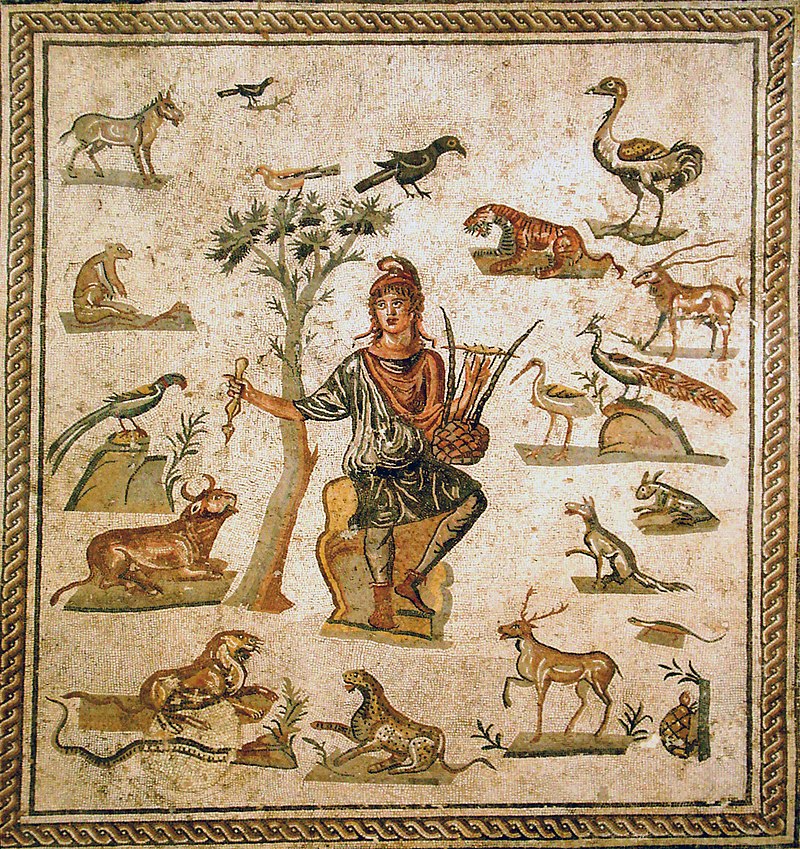
- Orpheus, wearing a Phrygian cap, is surrounded by animals, who are charmed by his lyre-playing. Roman Orpheus mosaic from Palermo, 2nd century AD
- Deity.birth_place
- Pimpleia, Pieria
- Deity.death_place
- Pangaion Hills, Odomantice
- Deity.abode
- Pimpleia, Pieria
- Deity.symbol
- Lyre
- Deity.parents
- Oeagrus and Calliope
- Deity.children
- Musaeus
- Deity.spouse
- Eurydice
via Wikipedia infobox
Wikidata facts
- Gender
- male
- Father
- Oeagrus
- Mother
- Calliope
- Occupation
- musician
- Languages spoken
- Ancient Greek
- Field of work
- poetry
- Image
- DSC00355 - Orfeo (epoca romana) - Foto G. Dall'Orto.jpg
- Work location
- Ancient Greece
Show 9 more facts
- topic's main category
- Category:Orpheus
- ethnic group
- Greeks
- Commons category
- Orpheus
- relative
- Rhesus of Thrace
- present in work
- Aeneid
- name in native language
- Ὀρφεύς
- worshipped by
- Greek mythology
- killed by
- Maenad
- manner of death
- lynching
Sources (7)
via Wikidata · CC0
~26 min read
Encyclopedic overview
16 sectionsContents
- Etymology
- Background
- Mythology
- Early life
- Adventure as an Argonaut
- Death of Eurydice
- Death
- Orphic poems and rites
- Post-Classical interpretations
- Classical music
- Literature
- Film and stage
- See also
- Notes
- Bibliography
- External links
In Greek mythology, Orpheus (; , classical pronunciation: ) was a Thracian bard, legendary musician and prophet. He was also a renowned poet and, according to legend, travelled with Jason and the Argonauts in search of the Golden Fleece, and descended into the underworld to recover his lost wife, Eurydice.
The major stories about him are centered on his ability to charm all living things and even stones with his music (the usual scene in Orpheus mosaics), his attempt to retrieve his wife Eurydice from the underworld, and his death at the hands of the maenads of Dionysus, who got tired of his mourning for his late wife Eurydice. As an archetype of the inspired singer, Orpheus is one of the most significant figures in the reception of classical mythology in Western culture, portrayed or alluded to in countless forms of art and popular culture including poetry, film, opera, music, and painting.
Excerpted from Wikipedia’s “Orpheus” article, available under the CC BY-SA 4.0 licence.
Gallery (26)
Available in 65 languages
- Español
- Français
- Deutsch
- 中文
- 日本語
- Русский
- Português
- Italiano
- العربية
- Afrikaans
- Albanian
- Armenian
- Azerbaijani
- Bahasa Indonesia
- Bangla
- Basque
- be_x_old
- Belarusian
Show 46 more
- Bosnian
- Breton
- Bulgarian
- Burmese
- Catalan
- Croatian
- Czech
- Danish
- Egyptian Arabic
- Esperanto
- Estonian
- Filipino
- Finnish
- Galician
- Georgian
- Greek
- Hebrew
- Hungarian
- Ido
- Irish
- Latin
- Latvian
- Lithuanian
- Luxembourgish
- Macedonian
- Malay
- Nederlands
- Norwegian
- Norwegian Nynorsk
- Occitan
- Polski
- Romanian
- Scots
- Serbian
- Serbian (Latin)
- simple
- Slovak
- Svenska
- Tatar
- Tiếng Việt
- Türkçe
- Ukrainian
- Waray
- Wu Chinese
- فارسی
- 한국어
via Wikidata sitelinks · CC0