Category
page 1Arthurian legend

King Arthur
legendary British leader of the late 5th and early 6th centuries

Excalibur
Excalibur is the mythical sword of King Arthur that may possess magical powers or be associated with the rightful sovereignty of Britain. Its first reliably datable appearance is found in Geoffrey of Monmouth's Historia Regum Britanniae. Excalibur as the "sword in the stone" functioning as the proof of Arthur's lineage is an iconic motif featured throughout most works dealing with Arthur's youth since its introduction in Robert de Boron's Merlin. The sword given to the young Arthur by the Lady of the Lake in the tradition that began soon afterwards with the Post-Vulgate Cycle is not the same w
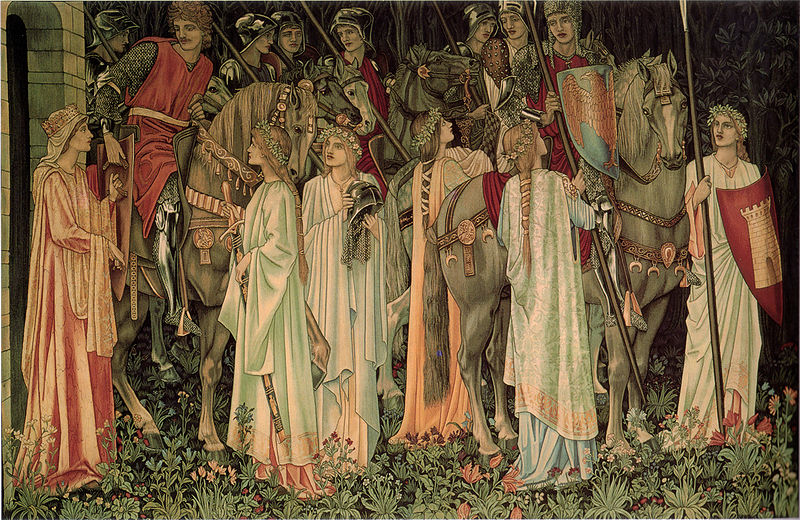
Knights of the Round Table
elite companions of King Arthur and order of chivalry in Arthurian romance

Gildas
Gildas (English pronunciation: , Breton: Gweltaz; ) – also known as , (in Middle Welsh texts and antiquarian works) and (Gildas the Wise) – was a 6th-century British monk best known for his religious polemic , which recounts the history of the Britons before and during the coming of the Saxons. He is one of the best-documented figures of the Christian church in the British Isles during the sub-Roman period, and was renowned for his Biblical knowledge and literary style. In his later life, he emigrated to Brittany, where he founded a monastery known as Saint-Gildas-de-Rhuys.

Cerdic of Wessex
1st King of Wessex from 519 to 534

Vortigern
thumb|Vortigern and Rowena by William Harvey
Round Table
element from the Arthurian legend
Nine Worthies
medieval concept of a group of nine historical, scriptural, and legendary personages who personify the ideals of chivalry
Walter Map
Welsh medieval writer
Matter of Britain
body of Medieval literature associated with Great Britain and Brittany, and the legendary kings and heroes associated with it, particularly King Arthur

sub-Roman Britain
period of Late Antiquity in Great Britain, covering the end of Roman rule in the late 4th and early 5th centuries, and its aftermath into the 6th century
Polydore Vergil
Italian-English scholar (1470–1555)
Aneirin
Aneirin (), also rendered as Aneurin or Neirin and Aneurin Gwawdrydd, was an early Medieval Brythonic war poet who lived during the 6th century. He is believed to have been a bard or court poet in one of the Cumbric kingdoms of the Old North, probably that of Gododdin at Edinburgh, in modern Scotland. From the 17th century, he was usually known as Aneurin.
John Leland
English poet and antiquary
Myrddin Wyllt
legendary Northern British poet
Afanc
The Afanc (, sometimes also called Addanc, ) is a lake monster from Welsh mythology. Its exact description varies, being described as resembling a crocodile, beaver or dwarf-like creature, or a platypus and is sometimes said to be a demon. The lake in which it dwells is also uncertain and it is variously said to live in Llyn Llion, Llyn Barfog, near Brynberian Bridge or in Llyn yr Afanc, a lake near Betws-y-coed that was named after the creature.

Questing Beast
mythical creature from Arthurian legend
Cadwallon Lawhir
king of Gwynedd
Tales of peruanos
animated show about supernatural activity
Siege Perilous
mythical seat at King Arthur's Round Table
Jean Markale
French artist (1928–2008)
Tryphine
Saint Tryphine (also spelled Trifine, Triphine and Tréphine) is a semi-legendary Breton saint whose life is often considered to be the basis of the story of Bluebeard. In Brittany she is widely revered as a patron saint of sick children and those whose birth is overdue. The legend of Saint Tryphine probably derives from a historical individual who was the wife of the early Breton ruler Conomor.
Thirteen Treasures of the Island of Britain
Welsh mythical objects
attributed arms
coats of arms given to a person, organisation, or fictional character retrospectively, speculatively, or otherwise not in the usual issuance from a heraldic college
Walter Johannes Stein
Austrian philosopher (1891–1957)
Cynon ap Clydno
Welsh hero of Arthurian legend
Historicity of King Arthur
debate about whether King Arthur was a historical person
Artognou stone
Latin inscription found in Tintagel Castle, fragment of Roman stone
Night of the Long Knives
apocryphal killing of native British chieftains by Anglo-Saxon mercenaries in the 5th century
Lailoken
Lailoken (aka Merlyn Sylvester) was a semi-legendary madman and prophet who lived in the Caledonian Forest in the late 6th century. The Life of Saint Kentigern mentions "a certain foolish man, who was called Laleocen" living at or near the village of Peartnach (Partick) within the Kingdom of Strathclyde. Laleocen correctly prophesied the death of King Rhydderch Hael.
Melion
Melion is an anonymous Breton lai that tells the story of a knight who transforms into a werewolf for the love of his wife who betrays him.
Wigalois
thumb|Wigalois removing his armor.
thumb|250px|Wigalois (on the left, wheel of fortune as shield device) versus heathen dwarf Karrioz (head of a moor/Mohammed on shield).
Wigalois is a courtly romance of the Arthurian cycle set down in Middle High German verse by Wirnt von Grafenberg. The title character Wigalois becomes a knight of the Round Table, but he remains not knowing he is the son of Sir Gawain (here Gawein) whom he meets, having spent an upbringing entirely in the care of his mother's royal family, in the otherworldly kingdom, which became undiscoverable to Gawain once he left. The
Artoria gens
Roman gens