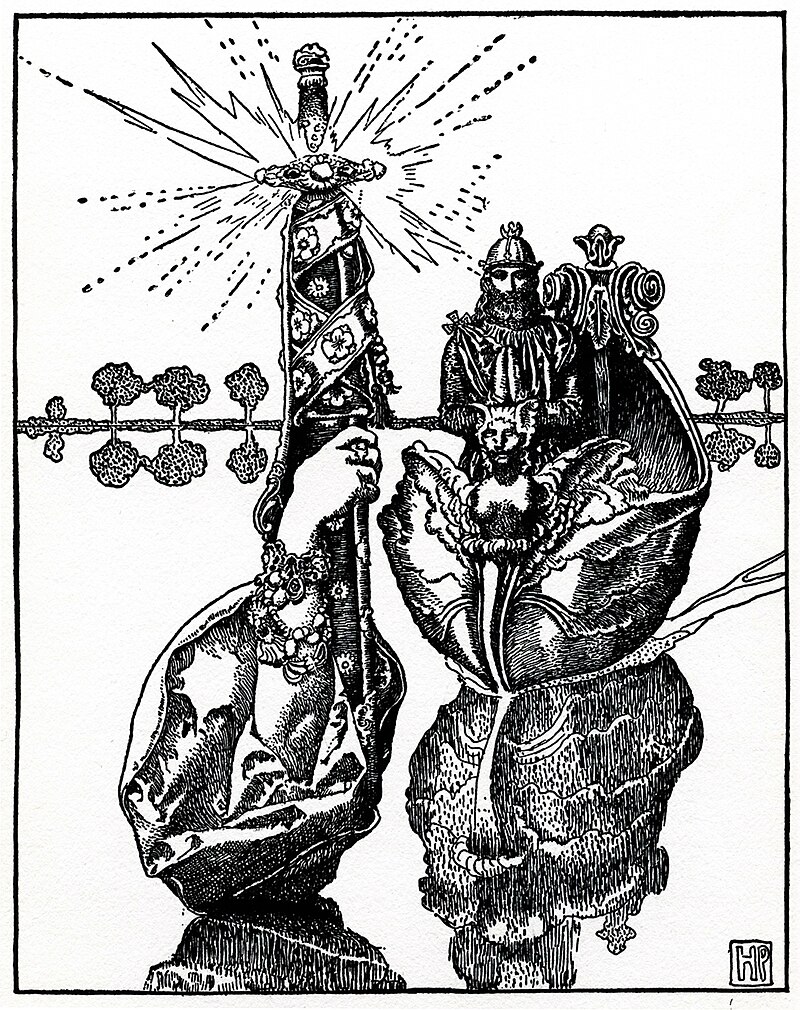
File:Arthur-Pyle_Excalibur_the_Sword.JPG · Wikimedia Commons · See Wikimedia Commons
Excalibur
Sign in to saveAlso known as Caledfwlch, Calesvol, Kaledvoulc'h, caliburn, Caliburno
Excalibur is the mythical sword of King Arthur that may possess magical powers or be associated with the rightful sovereignty of Britain. Its first reliably datable appearance is found in Geoffrey of Monmouth's Historia Regum Britanniae. Excalibur as the "sword in the stone" functioning as the proof of Arthur's lineage is an iconic motif featured throughout most works dealing with Arthur's youth since its introduction in Robert de Boron's Merlin. The sword given to the young Arthur by the Lady of the Lake in the tradition that began soon afterwards with the Post-Vulgate Cycle is not the same w
Excalibur is the legendary sword of King Arthur that first appears in Geoffrey of Monmouth's medieval writings and is often depicted as a magical blade or symbol of rightful rulership over Britain. The sword became iconic through later stories, particularly the famous image of a young Arthur pulling it from a stone to prove his lineage, and the tradition of the Lady of the Lake presenting it to him.
AI-generated from the Wikipedia summary — may contain errors.
Key facts
- Fictional artifact.name
- Excalibur
- Fictional artifact.image
- File:Arthur-Pyle Excalibur the Sword.JPG
- Fictional artifact.caption
- Excalibur the Sword by Howard Pyle (1903)
- Fictional artifact.type
- Legendary sword
- Fictional artifact.owner
- King Arthur, Merlin, Lady of the Lake, Morgan, Bedivere, Griflet, Gawain
- Fictional artifact.uses
- Proof of Arthur's divine right, magic weapon, ritual item
- Fictional artifact.affiliation
- Avalon
via Wikipedia infobox
Wikidata facts
- Owned by
- King Arthur
- Country of origin
- Wales
- Image
- Griflet throwing Excalibur into the lake.png
Show 1 more fact
- Commons category
- Excalibur
Sources (2)
via Wikidata · CC0
~17 min read
Encyclopedic overview
15 sectionsContents
- Forms and etymology
- Legend
- The Sword in the Stone and the Sword in the Lake
- Other roles and attributes
- Connections and analogues
- Similar weapons
- Arthur's other weapons
- Excalibur as a relic
- See also
- Notes
- References
- Citations
- Sources
- Further reading
- External links
Excalibur is the mythical sword of King Arthur that may possess magical powers or be associated with the rightful sovereignty of Britain. Its first reliably datable appearance is found in Geoffrey of Monmouth's Historia Regum Britanniae. Excalibur as the "sword in the stone" functioning as the proof of Arthur's lineage is an iconic motif featured throughout most works dealing with Arthur's youth since its introduction in Robert de Boron's Merlin. The sword given to the young Arthur by the Lady of the Lake in the tradition that began soon afterwards with the Post-Vulgate Cycle is not the same weapon, but in Thomas Malory’s ''Le Morte d'Arthur both of them share the name of Excalibur. Several similar swords and other weapons also appear within Arthurian texts, as well as in other legends.
== Forms and etymology == The name Excalibur ultimately derives from the Welsh (Breton , Middle Cornish ), which is a compound of , , and , . Caledfwlch appears in several early Welsh works, including the prose tale Culhwch and Olwen'' (). The name was later used in Welsh adaptations of foreign material such as the s (chronicles), which were based on Geoffrey of Monmouth. It is often considered to be related to the phonetically similar , a sword borne by several figures from Irish mythology, although a borrowing of from the Irish has been considered unlikely by Rachel Bromwich and D. Simon Evans. They suggest instead that both names "may have similarly arisen at a very early date as generic names for a sword". In the late 15th to early 16th-century Middle Cornish play , Arthur's sword is called , which is etymologically an exact Middle Cornish cognate of the Welsh . It is unclear if the name was borrowed from the Welsh (if so, it must have been an early loan, for phonological reasons), or represents an early, pan-Brittonic traditional name for Arthur's sword.
Excerpted from Wikipedia’s “Excalibur” article, available under the CC BY-SA 4.0 licence.