Category
page 1Astronomical instruments

telescope
thumb|The 100-inch (2.54 m) Hooker reflecting telescope at [[Mount Wilson Observatory near Los Angeles, used by Edwin Hubble to measure galaxy redshifts and discover the general expansion of the universe.]]

astrolabe
alt=Planispheric Astrolabe made of brass, cast, with fretwork rete and surface engraving|thumb|upright=1.2|North African, planispheric astrolabe. Khalili Collections|Khalili Collection.
thumb|upright|A modern astrolabe made in 2013, in Tabriz, Iran.

Antikythera mechanism
ancient analog computer designed to calculate astronomical positions

sextant
thumb|A sextant

radio telescope
form of directional radio antenna used in radio astronomy
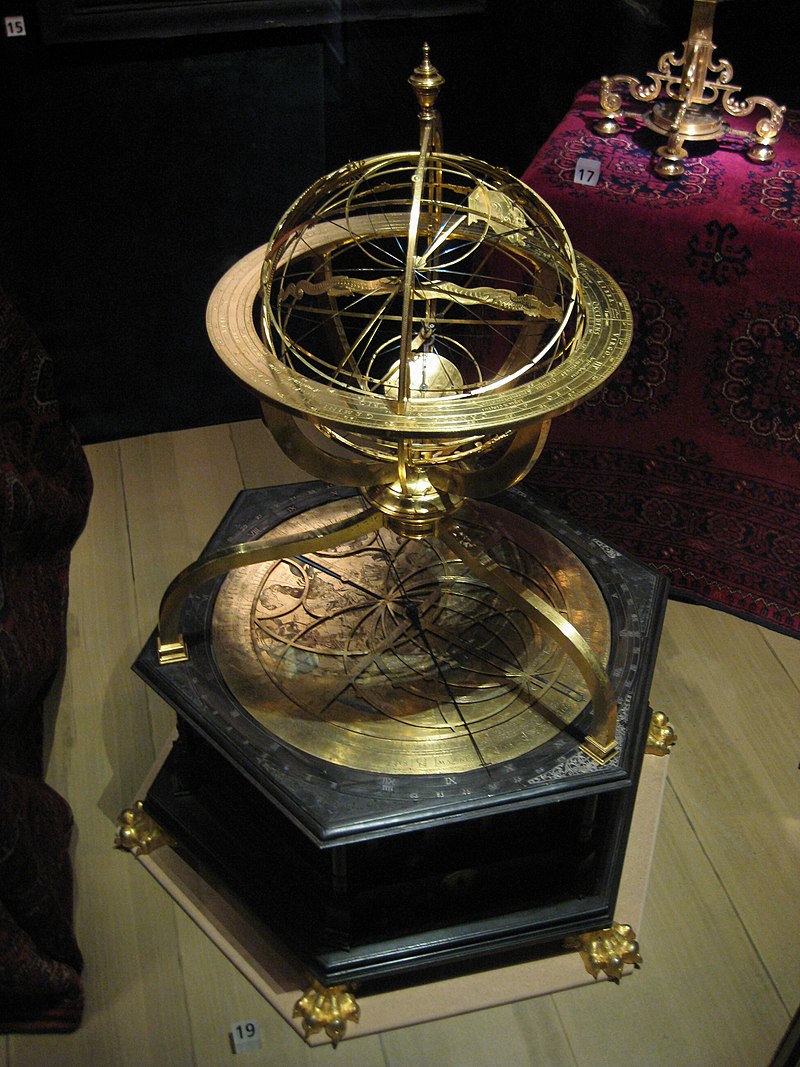
armillary sphere
model of objects in the sky

astronomical clock
clock with special mechanisms and dials to display astronomical information

gnomon
thumb|right|The gnomon is the triangular blade in this sundial.

alidade
right|thumb|A simple alidade for use with a ceiling projector
An alidade () (archaic forms include alhidade, alhidad, alidad) or a turning board is a device that allows one to sight a distant object and use the line of sight to perform a task. This task can be, for example, to triangulate a scale map on site using a plane table drawing of intersecting lines in the direction of the object from two or more points or to measure the angle and horizontal distance to the object from some reference point's polar measurement. Angles measured can be horizontal, vertical or in any chosen plane.

astrograph
thumb|150px|A , f/5.3 astrograph at Lowell Observatory (a refractor with a 3 element [[Cooke triplet lens) used in the discovery of Pluto.]]
thumb|150px|A double astrograph consisting of two astrographs and a central guide scope on display at Landessternwarte Heidelberg-Königstuhl observatory.
thumb|The Bruce double astrograph at the Landessternwarte Heidelberg-Königstuhl observatory.
thumbnail|This is a modern amateur Newtonian telescope|Newtonian astrograph, specifically designed for astrophotography.
quadrant
navigation instrument

planisphere
thumb|right|upright=1.3|Philips' Planisphere, ca. 1900
octant
measuring instrument used primarily in navigation; type of reflecting instrument
solar telescope
special purpose telescope used to observe the Sun
.svg)
Almucantar
right|thumb|250px|The celestial sphere with the [[zenith and almucantar marked in red, the horizon in green, and the path of a star or the Sun in blue.]]An almucantar (also spelled almucantarat or almacantara) is a circle on the celestial sphere parallel to the horizon. Two stars that lie on the same almucantar have the same altitude.
The term was introduced into European astronomy by monastic astronomer Hermann Contractus of Reichenau, Latinized from the Arabic word ' ("the almucantar, sundial", plural: '), derived from '''' ("arch, bridge")
High Accuracy Radial Velocity Planet Searcher
high-precision echelle spectrograph

orrery
thumb|upright=1.2|A small orrery showing Earth and the inner planets
An orrery () is a mechanical model of the Solar System that illustrates or predicts the relative positions and motions of the planets and moons, usually according to the heliocentric model. It may also represent the relative sizes of these bodies; however, since accurate scaling is often not practical due to the actual large ratio differences, it may use a scaled-down approximation. Mechanical planetary models are known to have existed since the Ancient Greeks, and are known by various names, but the term orrery is derived fr

Dioptra
thumb|Graphic reconstruction of the dioptra, by Venturi, in 1814. (An incorrect interpretation of Heron's description)

torquetum
thumb|right|Torquetum (1568), made by Johannes Praetorius in Nuremberg
thumb|right|Engraving of a Torquetum
triquetrum
medieval name for an ancient astronomical instrument
.jpg)
helioscope
thumb|Christoph Scheiner's Helioscope
A helioscope is an instrument used in observing the Sun and sunspots.
The helioscope was first used by Benedetto Castelli (1578–1643) and refined by Galileo Galilei (1564–1642). The method involves projecting an image of the sun onto a white sheet of paper suspended in a darkened room with the use of a telescope.

spectroheliograph
thumb|The solar disk observed in four different wavelengths of ultraviolet radiation by the Atmospheric Imaging Assembly spectroheliograph on board the [[Solar Dynamics Observatory. From left to right, the wavelengths imaged are 171, 304, 335, and 94 Å. Colors are false and added in postprocessing.]]
The spectroheliograph is an instrument used in astronomy which captures a photographic image of the Sun at a single wavelength of light, a monochromatic image. The wavelength is usually chosen to coincide with a spectral wavelength of one of the chemical elements present in the Sun.

spectrohelioscope
A spectrohelioscope is a type of solar telescope designed by George Ellery Hale in 1924 to allow the Sun to be viewed in a selected wavelength of light. The name comes from Latin- and Greek-based words: "Spectro," referring to the optical spectrum, "helio," referring to the Sun, and "scope," as in telescope.

reticle
thumb|The reticle of a PSO-1 scope mounted on a Russian SVD [[designated marksman rifle]]
thumb|A comparison of different reticles used in telescopic sights
thumb|Measurement graticule in an optical microscope
thumb|Reticle of Bell & Howell Pocket Comparator
thumb|Reticle accessory (PD-8) used in sniper rifles
A reticle or reticule, also known as a graticule or crosshair, is a pattern of fine lines or markings built into the eyepiece of an optical device such as a telescopic sight, spotting scope, theodolite, optical microscope or the screen of an oscilloscope, to provide measurement reference
nocturnal
instrument used to determine the local time based on the relative positions of two or more stars in the night sky

astrarium
thumb|The astrarium made by Giovanni Dondi dell'Orologio showed hour, year calendar, movement of the planets, Sun and Moon. Reconstruction, [[Museo Nazionale Scienza e Tecnologia Leonardo da Vinci, Milan.]]
tellurion
A tellurion (also spelled tellurian, tellurium, and yet another name is loxocosm), is a clock, typically of French or Swiss origin, surmounted by a mechanism that depicts how day, night, and the seasons are caused by the rotation and orientation of Earth on its axis and its orbit around the Sun. The clock normally also displays the phase of the Moon and the four-year (perpetual) calendar.
Cherenkov Telescope Array Observatory
Multinational cosmological project
Leonhard Euler Telescope
reflecting telescope in Chile
Next-Generation Transit Survey
ground-based robotic search for exoplanets

equatorium
thumb|Equatorium from Johannes Schöner
filar micrometer
specialized eyepiece
Mariner's astrolabe
Nautical navigational instrument
%20IF%20102793.jpg)
Celatone
thumb|Using a celatone.
thumb|Celatone by Matthew Dockrey. Museum at the Royal Observatory, Greenwich, UK.
The celatone was a device invented by Galileo Galilei to observe Jupiter's moons with the purpose of finding longitude on Earth. It took the form of a piece of headgear with a telescope taking the place of an eyehole.
Dark Energy Spectroscopic Instrument
instrument for conducting a spectrographic survey of distant galaxies
volvelle
thumb|A 15th century volvella of the moon
upright|thumb|A sixteenth-century wheel chart, a page of Astronomicum Caesareum by [[Petrus Apianus, 1540, apparently relating to the Moon. The red dragons mark out one odd-sized and 26 equal-sized central divisions; the orbital period of the moon is 27.3 days.]]
upright|thumb|A volvelle from the sixteenth century edition of the De sphaera mundi by [[Johannes de Sacrobosco.]]
sextant
astronomical device
mural instrument
angle-measuring device used for astronomical purposes
Greenland Telescope
radio telescope located in Greenland
Herschel wedge
optical prism used in solar observation
ESPRESSO
thumb|ESPRESSO spectrograph concept at the Preliminary Design Review
thumb|ESPRESSO spectrograph optical design at the Preliminary Design Review
thumb|ESPRESSO successfully made its first observations in November 2017.
Backstaff
The backstaff is a navigational instrument that was used to measure the altitude of a celestial body, in particular the Sun or Moon. When observing the Sun, users kept the Sun to their back (hence the name) and observed the shadow cast by the upper vane on a horizon vane. It was invented by the English navigator John Davis, who described it in his book ''Seaman's Secrets'' in 1594.
ELODIE spectrograph
SuperNova Early Warning System
network of neutrino detectors for alerting astronomers to nearby supernovae
astronomical rings
early astronomical instrument
SOPHIE échelle spectrograph
French astronomical instrument
Equatorial ring
instrument to determine the moment of the equinoxes
Large Latin American Millimeter Array
astronomical radio observatory
Sine quadrant
type of quadrant used by medieval Arabic astronomers
HARPS-N
__NOTOC__
HARPS-N, the High Accuracy Radial velocity Planet Searcher for the Northern hemisphere is a high-precision radial-velocity spectrograph, installed at the Italian Telescopio Nazionale Galileo, a 3.58-metre telescope located at the Roque de los Muchachos Observatory on the island of La Palma, Canary Islands, Spain.

Stanford Dish (Stanford Radio Telescope)
radio telescope in California
cosmolabe
thumb|Fully Assembled Cosmolabe by Jacques Besson, 1566
thumb|right|Cosmolabe, 16th century
thumb|Foot of a Cosmolabe by Jacques Besson, 1566
Archeops
Archeops was a balloon-borne instrument dedicated to measuring the Cosmic microwave background (CMB) temperature anisotropies. The study of this radiation is essential to obtain precise information on the evolution of the Universe: density, Hubble constant, age of the Universe, etc. To achieve this goal, measurements were done with devices cooled down at 100mK temperature placed at the focus of a warm telescope. To avoid atmospheric disturbance the whole apparatus is placed on a gondola below a helium balloon that reaches 40 km altitude.
list of astronomical instruments
Wikimedia list article
Jovilabe
thumb|Galileo's jovilabe. Estate of Leopold de' Medici
The jovilabe is a brass scientific instrument, undated and of unknown maker, currently in the collection of the Museo Galileo in Florence, Italy.
dividing engine
device to mark graduations on measuring instruments
Barcelona astrolabe
Quadrans Vetus
medieval astronomical instrument
European Pulsar Timing Array
five-radio telescope collaboration to track stellar remnants' gravitational waves