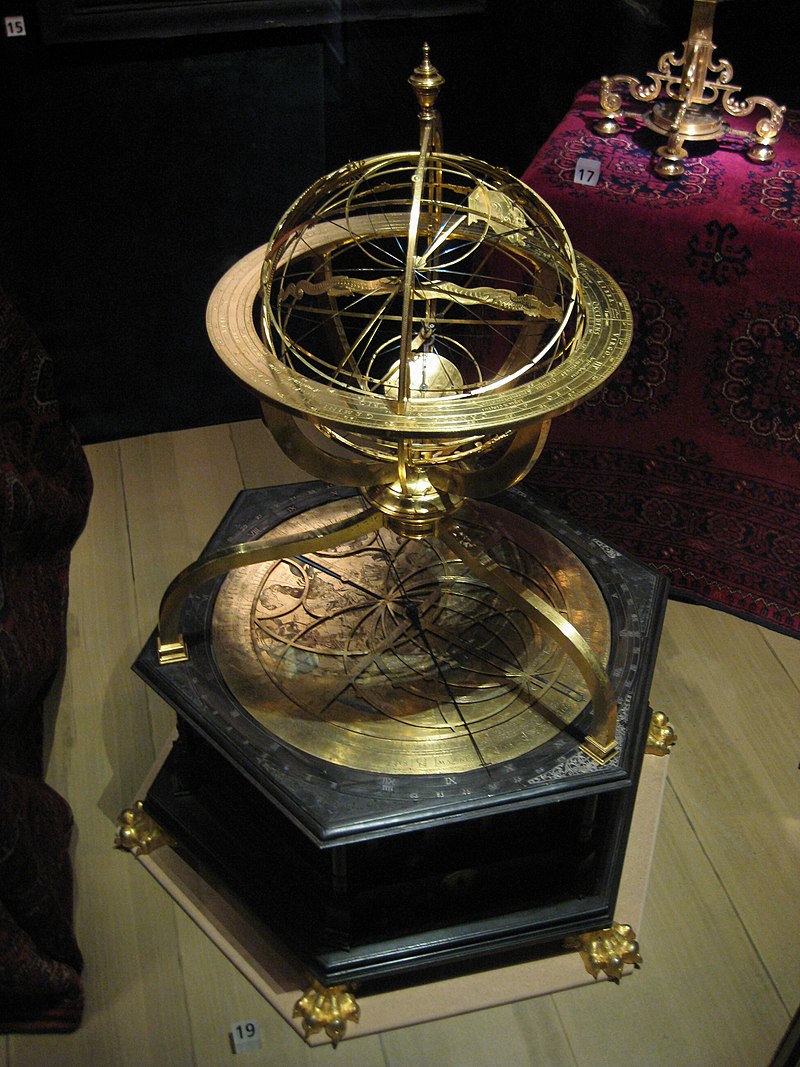
File:Armillary_sphere_with_astronomical_clock.jpg · Wikimedia Commons · See Wikimedia Commons
Wikidata facts
- Subclass of
- map
- Image
- View of an armillary sphere on a table, 1683.jpg
- Has use
- video tracking
Show 3 more facts
- Commons category
- Armillary spheres
- described by source
- New International Encyclopedia
- opposite of
- planisphere
Sources (1)
via Wikidata · CC0
~24 min read
Encyclopedic overview
Jost Bürgi and Antonius Eisenhoit: Armillary sphere with astronomical clock, made in 1585 in Kassel, now at Nordiska Museet in Stockholm
An armillary sphere (variations are known as spherical astrolabe, armilla, or armil) is a model of objects in the sky (on the celestial sphere), consisting of a spherical framework of rings, centered on Earth or the Sun, that represent lines of celestial longitude and latitude and other astronomically important features, such as the ecliptic. As such, it differs from a celestial globe, which is a smooth sphere whose principal purpose is to map the constellations. It was invented separately, in ancient China possibly as early as the 4th century BC and ancient Greece during the 3rd century BC, with later uses in the Islamic world and Medieval Europe.
Excerpted from Wikipedia’s “armillary sphere” article, available under the CC BY-SA 4.0 licence.