Category
page 1Astronomical objects discovered in 2015
S/2015 (136472) 1
only known natural satellite of the dwarf planet Makemake
541132 Leleākūhonua
Trans-Neptunian object
ASASSN-15C
ASASSN-15lh (supernova designation SN 2015L) is an extremely luminous astronomical transient event discovered by the All Sky Automated Survey for SuperNovae (ASAS-SN), with the appearance of a superluminous supernova event. It was first detected on June 14, 2015, located within a faint galaxy in the southern constellation Indus, and was the most luminous supernova-like object ever observed. At its peak, ASASSN-15lh was 570 billion times brighter than the Sun, and 20 times brighter than the combined light emitted by the Milky Way Galaxy. The emitted energy was exceeded by PS1-10adi.
Cosmos Redshift 7
galaxy
(523794) 2015 RR245
trans-Neptunian object
2015 TB145
asteroid
WISE J224607.57-052635.0
Most luminous galaxy

WT1190F
WT1190F (9U01FF6, UDA34A3, or UW8551D) was a small temporary satellite of Earth that impacted Earth on 13 November 2015 at 06:18:21.7 (± 0.1 seconds) UTC. It is thought to have been space debris from the trans-lunar injection stage of the 1998 Lunar Prospector mission. It was first discovered on 18 February 2013 by the Catalina Sky Survey. It was then lost, and reacquired on 29 November 2013. It was again discovered on 3 October 2015 by astronomer Rose Garcia with the Catalina Sky Survey 60-inch telescope, and the object was soon identified to be the same as the two objects previously sig
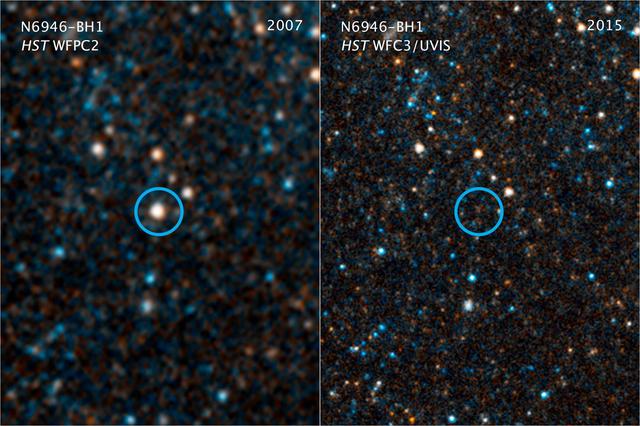
N6946-BH1
(674118) 2015 KH162
trans-Neptunian object
Triangulum II
galaxy
Reticulum II
galaxy
V5668 Sagittarii
nova
(768325) 2015 BP519
Trans-Neptunian object
2015 KG163
trans-Neptunian object
2015 TH367
Trans-Neptunian object
VHS J1256-1257
red dwarf star in the constellation Corvus
Eridanus II
Milky Way satellite dwarf galaxy

2015 ER61 PanSTARRS
comet, inner Oort cloud object, and Amor near-Earth object
2015 RX245
trans-Neptunian object
C/2015 G2 (MASTER)
Comet
M59-UCD3
M59-UCD3 is an ultra-compact dwarf galaxy located near the Messier 59 galaxy. , it is the second-densest galaxy currently observed, second to M85-HCC1.
(472651) 2015 DB216
asteroid
2015 GT50
trans-Neptunian object

506074 Svarog
asteroid