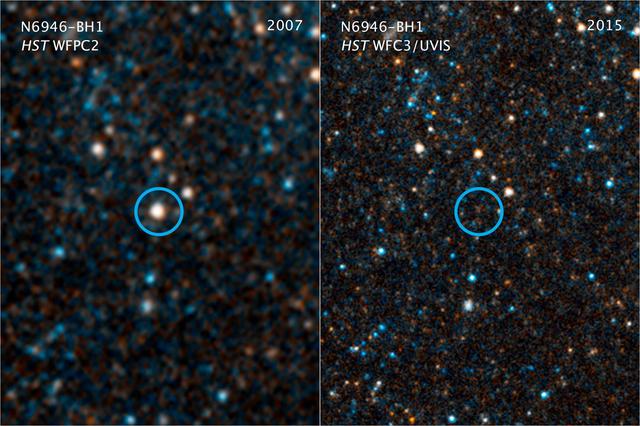
Massive Star Goes Out With a Whimper Instead of a Bang · NASA · NASA — public domain
N6946-BH1
Sign in to saveWikidata facts
- Instance of
- star
- Part of
- NGC 6946
- Constellation
- Cygnus
- Distance from Earth
- 22000000
- Mass
- 25
- Image
- Giant star N6946-BH1 before and after it vanished out of sight by imploding to form a black hole.jpg
Show 5 more facts
- right ascension
- 308.864833
- declination
- 60.1356361
- epoch
- J2000.0
- dissolved, abolished or demolished date
- 2015-00-00
- Commons category
- N6946-BH1
Sources (1)
via Wikidata · CC0
~3 min read
Encyclopedic overview
4 sectionsContents
- See also
- Notes
- References
- External links
N6946-BH1 is a disappearing supergiant star and failed supernova candidate formerly seen in the galaxy NGC 6946, on the northern border of the constellation of Cygnus. The star, either a red supergiant or a yellow hypergiant, was 25 times the mass of the Sun, and was 20 million light years distant from Earth. In March through to May 2009 its bolometric luminosity increased to at least a million solar luminosities, but by 2015 it had disappeared from optical view. In the mid and near infrared an object is still visible; however, it is fading away with a brightness proportional to t−4/3. The brightening was insufficient to be a supernova; the process that created the outburst is still uncertain.
thumb|left|A Photometric_system#Photometric_letters|visual band [[light curve for N6946-BH1, plotted from data published by Adams et al. (2017)]] The star's coordinates were at RA and Dec . The brightness of the star, given by its apparent magnitude in different colour bands on 2 July 2005 is given by R = 21, V = 22, B = 23, U = 24. Prior to the optical outburst the star was about 100,000 times as bright as the Sun. After the outburst it was invisible in the visual band and has declined to 5,000 times as bright as the Sun in infrared radiation.
Excerpted from Wikipedia’s “N6946-BH1” article, available under the CC BY-SA 4.0 licence.