Category
page 1Asymmetry

Gastropoda
Gastropods (; previously known as Univalves; class Gastropoda ) are a vast and diverse group of invertebrates within the phylum Mollusca, comprising the animals commonly known as snails and slugs. With an estimated 65,000 to 80,000 living species, they form the second-largest animal class after the insects. The fossil record of gastropods extends back to the Late Cambrian. , 721 families are recognized—476 extant (some with fossil representatives) and 245 extinct known only from fossils.

entropy
Entropy is a scientific concept, most commonly associated with states of disorder, randomness, or uncertainty. The term and the concept are used in diverse fields, from classical thermodynamics, where it was first recognized, to the microscopic description of nature in statistical physics, and to the principles of information theory. It has found far-ranging applications in chemistry and physics, in biological systems and their relation to life, in cosmology, economics, and information systems including the transmission of information in telecommunication.
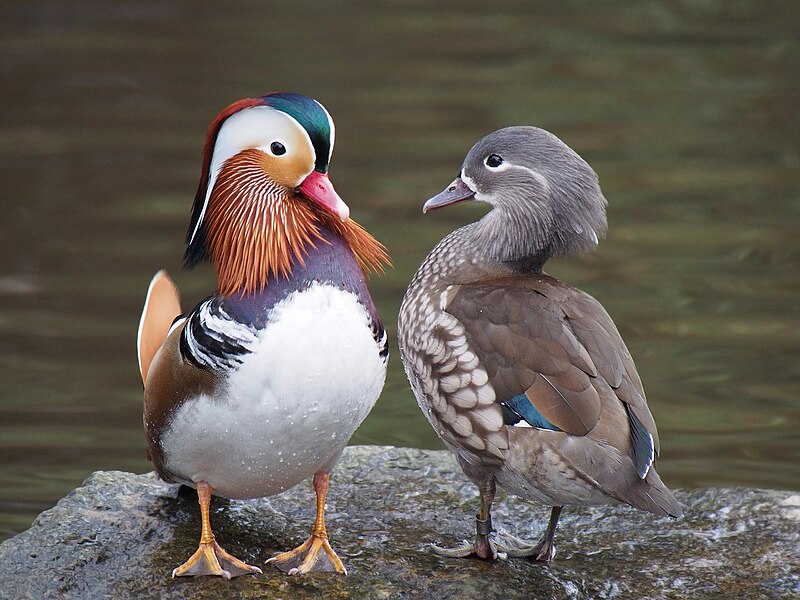
sexual dimorphism
condition where the two sexes of the same species exhibit different characteristics beyond the differences in their sexual organs

Pleuronectiformes
Flatfish are a group of ray-finned fish belonging to the suborder Pleuronectoidei and historically the order Pleuronectiformes (though this is now disputed). Their collective common name is due to their habit of lying on one side of their laterally-compressed body (flattened side-to-side) upon the seafloor; in this position, both eyes lie on the side of the head facing upwards, while the other side of the head and body (the "blind side") lies on the substrate. This loss of symmetry, a unique adaptation in vertebrates, stems from one eye "migrating" towards the other during the juvenile's metam
.jpg)
asymmetric digital subscriber line
thumb|A residential gateway|gateway is commonly used to make an ADSL connection
Asymmetric digital subscriber line (ADSL) is a type of digital subscriber line (DSL) technology, a data communications technology that enables faster data transmission over copper telephone lines than a conventional voiceband modem can provide. ADSL differs from the less common symmetric digital subscriber line (SDSL). In ADSL, bandwidth and bit rate are said to be asymmetric, meaning greater toward the customer premises (downstream) than the reverse (upstream). Providers usually market ADSL as an Internet access s

birefringence
right|thumb|A calcite crystal laid upon a graph paper with blue lines showing the double refraction
right|thumb|In this example, optic axis along the surface is shown perpendicular to plane of incidence. Incoming light in the polarization (which means perpendicular to plane of incidence – and so in this example becomes "parallel polarisation" to optic axis, thus is called extraordinary ray) sees a greater refractive index than light in the polarization (which becomes ordinary ray because "perpendicular polarisation" to optic axis) and so polarization ray is undergoing greater refraction on ent

anisotropy
thumb|upright=1.36|Wilkinson Microwave Anisotropy Probe|WMAP image of the tiny anisotropies in the [[cosmic microwave background radiation]]
Anisotropy () is the structural property of non-uniformity in different directions, as opposed to isotropy. An anisotropic object or pattern has properties that differ according to direction of measurement. For example, many materials exhibit very different physical or mechanical properties when measured along different axes, e.g. absorbance, refractive index, conductivity, and tensile strength.

kaon
In particle physics, a kaon, also called a K meson and denoted , is any of a group of four mesons distinguished by a quantum number called strangeness. In the quark model they are understood to be bound states of a strange quark (or antiquark) and an up or down antiquark (or quark).

asymmetric warfare
war between belligerents whose relative military power differs significantly
parity
flip in the sign of one spatial coordinate, in classical and quantum physics

information asymmetry
economics term for when one party in a transaction has an advantage in information

Uca
Group of crabs

handedness
thumb|Stenciled hands at the Cueva de las Manos in Argentina. Left hands make up over 90% of the artwork, demonstrating the prevalence of right-handedness.
thumb|A schoolgirl writing with her left hand
In human biology, handedness is an individual's preferential use of one hand, known as the dominant hand, due to and causing it to be stronger, faster or more dextrous. The other hand, comparatively often the weaker, less dextrous or simply less subjectively preferred, is called the non-dominant hand. In a study from 1975 on 7,688 children in US grades 1–6, left handers comprised 9.6% of the sam

anisogamy
thumb|Different forms of anisogamy: A) anisogamy of motile cells, B) oogamy ([[egg cell and sperm cell), C) anisogamy of non-motile cells (egg cell and spermatia).|283x283px]]
.svg)
asymmetry
thumb
unrequited love
love that is not reciprocated by the receiver
arrow of time
one-way direction, or asymmetry, of time
enantioselective synthesis
form of chemical synthesis
CP violation
violation of CP (charge-parity) symmetry in particle physics and cosmology
Brandolini's law
difficulty of refuting false or misleading information

laterality
thumb|Left hemisphere of a human brain
The term laterality refers to asymmetric preference, usage, skill, or specialization of symmetric body parts in an organism. Humans exhibit laterality in many ways, including limb dominance such as left and right handedness and footedness as well as specialization of one brain hemisphere over the other for certain functions such as language. Many other animals have also been shown to exhibit laterality in their own ways.
baryon asymmetry
abundance of matter (baryons) and lack of antimatter (antibaryons) in our Observable Universe
Wu experiment
Nuclear physics experiment on conservation of parity in weak interactions
asymmetric relation
binary relation such that if A is related to B then B is not related to A
scalene triangle
triangle with all sides/angles unequal

chirality
thumb|Two enantiomers of a generic amino acid that is chiral
asymmetric induction
preferential formation of chemical reaction

Asymmetric multiprocessing
in computer architecture
actor–observer asymmetry
cognitive bias where actors tend to attribute the causes of their behavior to stimuli inherent in the situation, while observers tend to attribute behavior to stable dispositions of the actor
asymmetric graph
node-link graph without nontrivial symmetries
Entropy
only quantity in the physical sciences that requires a particular direction for time
asymmetric hydrogenation
chemical reaction
Fluctuating asymmetry
form of biological asymmetry
asymmetric federalism
term used to describe imbalance of powers among member states of a federation