Category
page 1Atmospheric thermodynamics
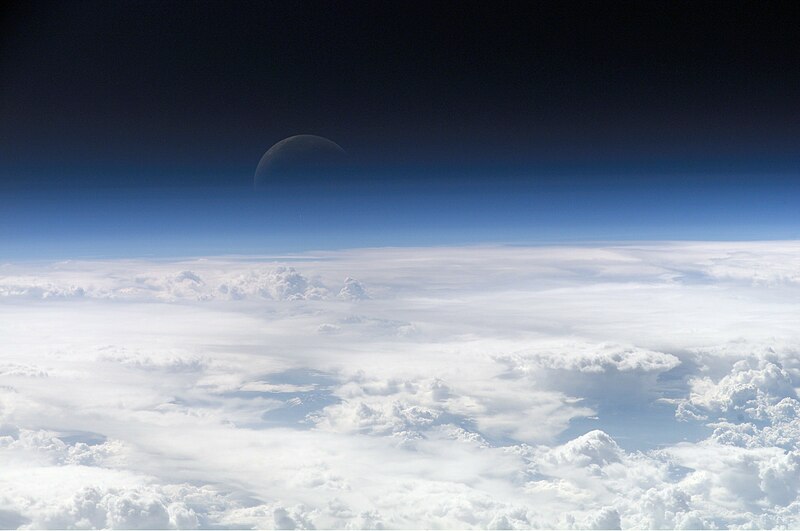
atmosphere of Earth
gas layer surrounding Earth

pressure
Pressure (symbol: p or P) is the force applied perpendicular to the surface of an object per unit area over which that force is distributed. Gauge pressure (also spelled gage pressure) is the pressure relative to the ambient pressure.

melting point
temperature at which a solid turns liquid

troposphere
thumb|upright=1.5|A picture of Earth's troposphere with its different cloud types of low to [[high altitudes casting shadows. Sunlight is reflected off the ocean, after it was filtered into a reddish light by passing through much of the troposphere at sunset. The above lying stratosphere can be seen at the horizon as a band of its characteristic glow of blue scattered sunlight.]]
thumb|right|upright=1.35|Atmospheric circulation: the three-cell model of the Atmospheric circulation|circulation of the planetary atmosphere of the Earth, of which the troposphere is the lowest layer.

humidity

evaporation
thumb|right|Aerosol of microscopic water droplets suspended in the air above a cup of hot tea after the water vapor has sufficiently cooled and condensed. Water vapor is an invisible gas, but the clouds of condensed droplets refract and scatter the sunlight and are thus visible.
thumb|Droplets of water vapor in a pan.
thumb|right|280px|Demonstration of evaporative cooling. When the sensor is dipped in ethanol and then taken out to evaporate, the instrument shows progressively lower temperature as the ethanol evaporates.
thumb|Rain evaporating after falling on hot pavement

water vapor
gaseous phase of water; unlike other forms of water, water vapor is invisible

sublimation
transition of a substance directly from the solid to the gas state

dew point
temperature at which air becomes saturated with water vapour
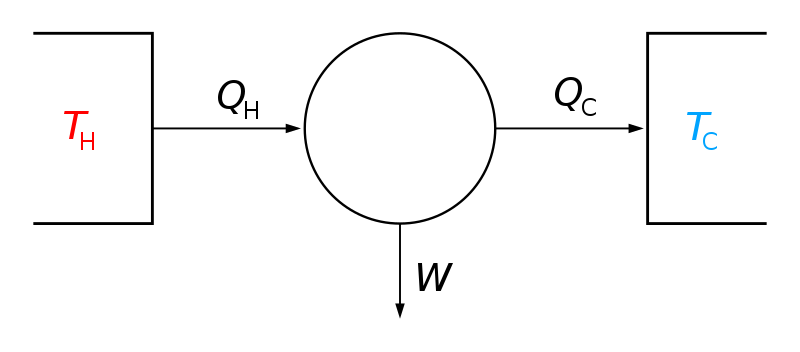
adiabatic process
thermodynamic process with zero heat transfer
standard temperature and pressure
reference values for temperature and pressure

freezing
thumb|Water dripping from a slab of [[ice and then freezing, forming icicles]]
Freezing is a phase transition in which a liquid turns into a solid when its temperature is lowered below its freezing point.

hygrometer
thumb|A hair tension dial hygrometer with a nonlinear scale.
latent heat
released or absorbed energy during a constant-temperature process

meteorological inversion
deviation from the normal change of an atmospheric property with altitude

isothermal process
thermodynamic process in which the temperature remains constant
isobaric process
thermodynamic process in which pressure remains constant
mesopause
The mesopause is the point of minimum temperature at the boundary between the mesosphere and the thermosphere atmospheric regions. Due to the lack of solar heating and very strong radiative cooling from carbon dioxide, the mesosphere is the coldest region on Earth with temperatures as low as -100 °C (-148 °F or 173 K). The altitude of the mesopause for many years was assumed to be at around 85 km (53 mi), but observations to higher altitudes and modeling studies in the last 10 years have shown that in fact there are two mesopauses - one at about 85 km and a stronger on

radiosonde
thumb|Modern radiosondes showing progress of miniaturisationthumb|A Global Positioning System|GPS sonde, approx 220 × 80 ×75 mm (8.7 × 3.1 × 3 in) (with grounding station in the background, used to perform a 'ground check' and also recondition the humidity sensor)
Clausius–Clapeyron relation
relation between vapour pressure and temperature

thermal
thumb|Example of a thermal column between the ground and a cumulus
thermopause
The thermopause is the atmospheric boundary of Earth's energy system, located at the top of the thermosphere. The temperature of the thermopause could range from nearly absolute zero to .
International Standard Atmosphere
atmospheric model
temperature measurement
recording of temperature
wind chill
lowering of body temperature due to the passing-flow of lower-temperature air
density of air
mass per unit volume of earths atmosphere
sensible heat
heat exchanged by a body or thermodynamic system
atmospheric convection
atmospheric phenomenon

supersaturation
In physical chemistry, supersaturation occurs with a solution when the concentration of a solute exceeds the concentration specified by the value of solubility at equilibrium. Most commonly the term is applied to a solution of a solid in a liquid, but it can also be applied to liquids and gases dissolved in a liquid. A supersaturated solution is in a metastable state; it may return to equilibrium by separation of the excess of solute from the solution, by dilution of the solution by adding solvent, or by increasing the solubility of the solute in the solvent.
wet-bulb temperature
temperature read by a thermometer covered in water-soaked cloth
degree day
measure of heating or cooling used in agriculture
convective available potential energy
indicator of atmospheric instability used in meteorology

humidex
thumb|upright=2|Plot of humidex depending on temperature and relative humidity
The humidex (short for humidity index) is an index number used by Canadian meteorologists to describe how hot the weather feels to the average person, by combining the effect of heat and humidity. The term humidex was coined in 1965. The humidex is a nominally dimensionless quantity (though generally recognized by the public as equivalent to the degree Celsius) based on the dew point.
potential temperature
temperature that a fluid would attain if adiabatically brought to a standard reference pressure
heat index
temperature index that accounts for the effects of humidity
lapse rate
Vertical rate of change of temperature in atmosphere
Vapour pressure of water
vapour pressure
atmospheric temperature
physical quantity that expresses hot and cold in the atmosphere
equivalent temperature
temperature of a mass of air after all the water vapor has been extracted without exchanging mass or heat with its surroundings
atmospheric thermodynamics
Study of heat-to-work transformations and their reverse
level of free convection
specific altitude in the atmosphere
Brunt–Väisälä frequency
angular frequency at which a vertically displaced parcel will oscillate within a statically stable environment
dry-bulb temperature
virtual temperature
temperature of dry air parcels that have a total pressure and density equal to a moist parcel of air
atmospheric instability
condition where the Earth's atmosphere is generally considered to be unstable
Equilibrium level
the height in the atmosphere at which a rising parcel of air reaches surrounding air of the same temperature

Skew-T log-P diagram
thermodynamic diagram used in weather analysis

Equivalent potential temperature
quantity in atmospheric thermodynamics
lifting condensation level
height at which an air parcel becomes saturated

convective inhibition
measure in meteorology
K-index
Measure of thunderstorm probability.
density altitude
altitude relative to the standard atmosphere conditions

Emagram
thumb|right|300px|Sample emagram
wet-bulb globe temperature
apparent temperature used to estimate the effect of temperature, humidity, wind speed, etc.; weighted average of wet-bulb temperature (weight 7), globe thermometer temperature (weight 2), and dry-bulb temperature (weight 1)
Tephigram
thumb|right|Tephigram
thumb|right|Annotated tephigram
Bowen ratio
used to describe the type of heat transfer for a surface that has moisture
Precipitable water
meteorological measure of the amount of water in the atmosphere
Mixed layer
layer in which active turbulence has homogenized some range of depths.
marine layer
weather phenomenon in which an air mass forms over a body of water
Cold-air pool
accumulation of cold air in a topographic depression