File:Watervapor_cup.jpg · Wikimedia Commons · See Wikimedia Commons
evaporation
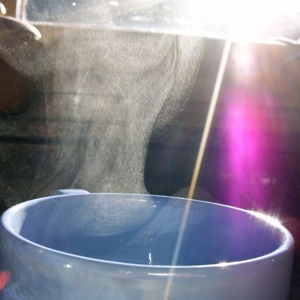
Sign in to savethumb|right|Aerosol of microscopic water droplets suspended in the air above a cup of hot tea after the water vapor has sufficiently cooled and condensed. Water vapor is an invisible gas, but the clouds of condensed droplets refract and scatter the sunlight and are thus visible. thumb|Droplets of water vapor in a pan. thumb|right|280px|Demonstration of evaporative cooling. When the sensor is dipped in ethanol and then taken out to evaporate, the instrument shows progressively lower temperature as the ethanol evaporates. thumb|Rain evaporating after falling on hot pavement
Evaporation is the process where liquid water transforms into an invisible gas called water vapor. It matters because it's a key part of how water moves through the environment and can cool things down as it occurs.
AI-generated from the Wikipedia summary — may contain errors.
Wikidata facts
- Instance of
- surface phenomenon
- Subclass of
- surface phenomenon
- Image
- Evaporation leaving minerals.png
Show 7 more facts
- Commons category
- Evaporation
- described by source
- Granat Encyclopedic Dictionary
- opposite of
- condensation
- different from
- boiling
- studied by
- thermodynamics
- on focus list of Wikimedia project
- Wikipedia:Vital articles/Level/4
- exact match
- purl.obolibrary.org/obo/ENVO_02500034
via Wikidata · CC0
~11 min read
Encyclopedic overview
12 sectionsContents
- Theory
- Evaporative equilibrium
- Factors influencing the rate of evaporation
- Thermodynamics
- Applications
- Combustion vaporization
- Pre-combustion vaporization
- Film deposition
- See also
- References
- Further reading
- External links
thumb|right|Aerosol of microscopic water droplets suspended in the air above a cup of hot tea after the water vapor has sufficiently cooled and condensed. Water vapor is an invisible gas, but the clouds of condensed droplets refract and scatter the sunlight and are thus visible. thumb|Droplets of water vapor in a pan. thumb|right|280px|Demonstration of evaporative cooling. When the sensor is dipped in ethanol and then taken out to evaporate, the instrument shows progressively lower temperature as the ethanol evaporates. thumb|Rain evaporating after falling on hot pavement
Evaporation is a type of vaporization that occurs on the surface of a liquid as it changes into the gas phase. A high concentration of the evaporating substance in the surrounding gas significantly slows down evaporation, such as when humidity affects rate of evaporation of water. When the molecules of the liquid collide, they transfer energy to each other based on how they collide. When a molecule near the surface absorbs enough energy to overcome the vapor pressure, it will escape and enter the surrounding air as a gas. When evaporation occurs, the energy removed from the vaporized liquid will reduce the temperature of the liquid, resulting in evaporative cooling.
Excerpted from Wikipedia’s “evaporation” article, available under the CC BY-SA 4.0 licence.
Gallery (14)
Available in 90 languages
- Español
- Français
- Deutsch
- 中文
- 日本語
- Русский
- Português
- Italiano
- العربية
- हिन्दी
- Afrikaans
- Albanian
- Armenian
- Asturian
- Azerbaijani
- Bahasa Indonesia
- Bangla
- Basque
Show 71 more
- bat_smg
- Belarusian
- Bikol
- Bosnian
- Bulgarian
- Burmese
- Catalan
- Central Kurdish
- Chechen
- Chuvash
- Cornish
- Croatian
- Czech
- Danish
- Esperanto
- Estonian
- Fijian
- Filipino
- Finnish
- Galician
- Georgian
- Greek
- Haitian Creole
- Hebrew
- Hungarian
- Irish
- Javanese
- Kabyle
- Kannada
- Kara-Kalpak
- Kazakh
- Kyrgyz
- Lao
- Latin
- Latvian
- Lithuanian
- Lombard
- Macedonian
- Malay
- Marathi
- Mongolian
- Nederlands
- Nepali
- Norwegian
- Norwegian Nynorsk
- Occitan
- Pashto
- Polski
- Quechua
- Romanian
- Serbian
- Serbian (Latin)
- Shona
- simple
- Slovak
- Slovenian
- Svenska
- Swahili
- Tamil
- Telugu
- Tiếng Việt
- Türkçe
- Ukrainian
- Urdu
- Uzbek
- Wu Chinese
- zh_min_nan
- zh_yue
- فارسی
- ไทย
- 한국어
via Wikidata sitelinks · CC0