Category
page 1Basic concepts in set theory

function
association of a single output to each input

empty set
set (in mathematics) containing no elements

subset
150px|thumb|right|class=skin-invert-image|Euler diagram showing A is a [[subset of B (denoted A \subseteq B) and, conversely, B is a superset of A (denoted B \supseteq A)]]
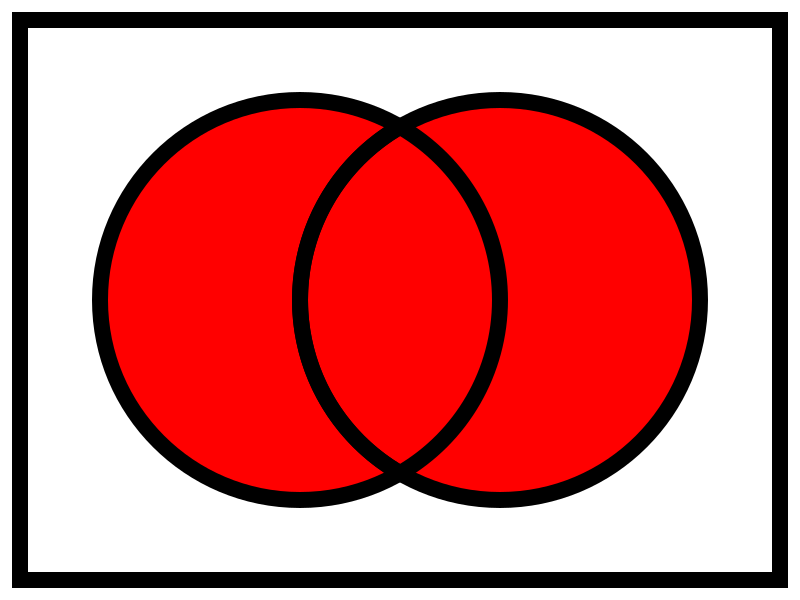
union
operation denoted by symbol “∪” applied on two sets; the set of all distinct elements in the collection

inverse function
function that "reverses" another function: if the function f applied to an input x gives a result of y, then applying its inverse function g to y gives the result x, and vice versa. i.e., f(x) = y if and only if g(y) = x
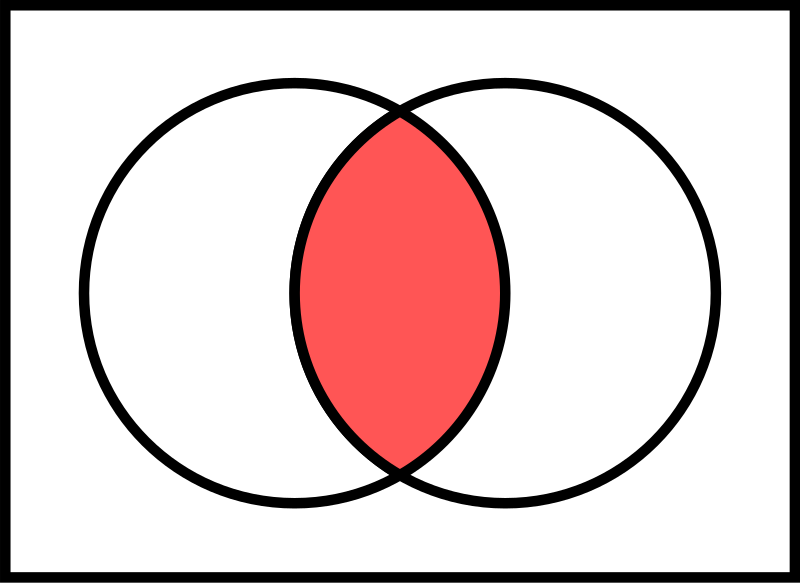
intersection
concept in set theory (for the term in geometry, see Q1364910)

bijection
In mathematics, a bijection, bijective function, or one-to-one correspondence is a function between two sets such that each element of the second set (the codomain) is the image of exactly one element of the first set (the domain). Equivalently, a bijection is a relation between two sets such that each element of either set is paired with exactly one element of the other set.

injection
mathematical function that preserves distinctness

surjective function
function such that every element of the codomain has a preimage
domain of a function
set of "input" or argument values for which a function is defined
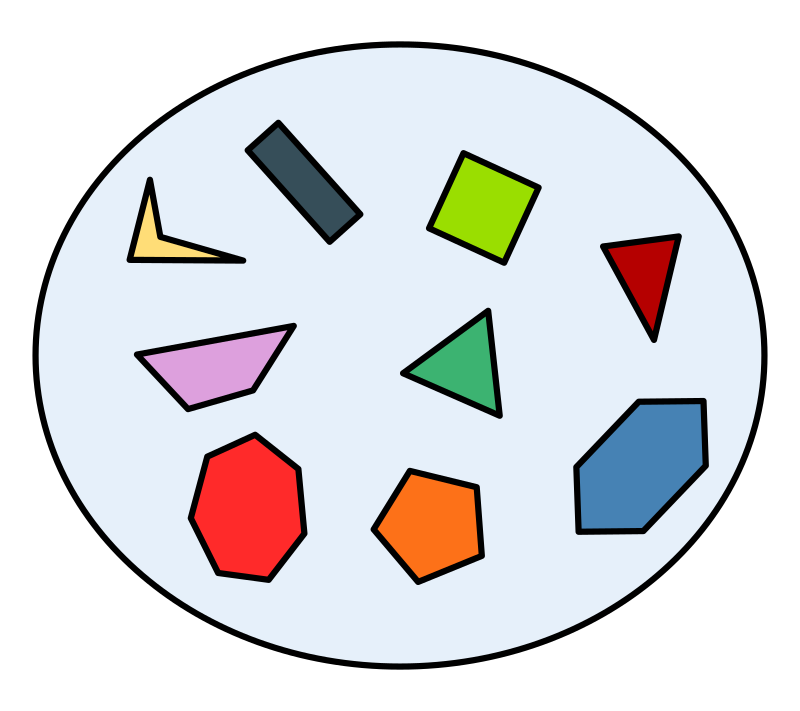
finite set
set that has a finite number of elements

function composition
operation which takes two mathematical functions and makes one function of these

ordered pair
pair of mathematical objects; tuple of specific length (tuple length n=2)

complement
unary operation on sets: the set of non-elements of the argument set
element
any one of the distinct objects that make up a set in set theory
identity function
function that always returns the same value that was used as its argument

disjoint sets
sets with no element in common

image
set of all values of a function; set of all values that a function can produce; subset of codomain
𝑛-tuple
In mathematics, a tuple is a finite sequence (or ordered list) of numbers. More generally, it is a sequence of mathematical objects, called the elements of the tuple. An -tuple is a tuple of elements, where is a non-negative integer. There is only one 0-tuple, called the empty tuple. A 1-tuple and a 2-tuple are commonly called a singleton and an ordered pair, respectively. The term "infinite tuple" is occasionally used for "infinite sequences".

partition of a set
mathematical ways to group elements of a set

codomain
right|thumb|250px|A function from to . The blue oval is the codomain of . The yellow oval inside is the Image (mathematics)|image of , and the red oval is the domain of .
indicator function
function that returns 1 if an element is present in a specified subset and 0 if absent; naturally isomorphic with a set's subsets
symmetric difference
mathematical definition in set theory
singleton
set with exactly one element
predicate
concept of mathematical logic

multiset
In mathematics, a multiset (or bag, or mset) is a modification of the concept of a set that, unlike a set, allows for multiple instances for each of its elements. The number of instances given for each element is called the multiplicity of that element in the multiset. As a consequence, an infinite number of multisets exist that contain only elements and , but vary in the multiplicities of their elements:
The set contains only elements and , each having multiplicity 1 when is seen as a multiset.
In the multiset , the element has multiplicity 2, and has multiplicity 1.
In the multiset , and
mapping
function, sometimes assumed structure-preserving in a proper sense
indexed family
collection of objects, each associated with an index from some index set
algebra of sets
mathematical identities and relationships involving sets
disjoint union
modified union operation that indexes the elements according to which set they originated in
range of a function
ambiguous term, referring either to the codomain or the image of a function
family of sets
collection of some of the subsets of a set; collection of any sets whatsoever
universal set
in set theory, a set which contains all objects, including itself
category of sets
category in mathematics where the objects are sets and the morphisms are the total functions between the sets
index set
mathematical term
inclusion map
or inclusion function, or canonical injection

unordered pair
set having two elements a and b with no particular relation between them
fiber
inverse image of a singleton in the field of mathematics
horizontal line test
test for the bijectivity of a function
pointed set
a set equipped with a choice of a specific element
choice function
mathematical function f that is defined on some collection X of nonempty sets and assigns some element of each set S in that collection to S by f(S)
projection
an operation in set theory that maps elements in a set to elements from another set
Bijection, injection and surjection
Injection: one to one, surjection: onto, bijection: both one to one and onto.
set function
function whose domain is a collection of sets