Category
page 1BASIC programming language family

BASIC
BASIC ('''Beginner's All-purpose Symbolic Instruction Code''') is a family of general-purpose, high-level programming languages designed for ease of use. The original version was created by John G. Kemeny and Thomas E. Kurtz at Dartmouth College in 1964. They wanted to enable students in non-scientific fields to use computers. At the time, nearly all computers required writing custom software, which only scientists and mathematicians tended to learn.

Visual Basic
legacy programming language by Microsoft

Visual Basic
programming language for .NET

Visual Basic Script
VBScript (Microsoft Visual Basic Scripting Edition) is a deprecated programming language for scripting on Microsoft Windows using Component Object Model (COM), based on classic Visual Basic and Active Scripting. It was popular with system administrators for managing computers and automating many aspects of computing environments, and has been installed by default in every desktop release of Microsoft Windows since Windows 98; in Windows Server since Windows NT 4.0 Option Pack; and optionally with Windows CE (depending on the device it is installed on).
Visual Basic for Applications
Microsoft Proprietary Alexandre Concon

Gambas
Gambas is an object-oriented dialect of the BASIC programming language, and an integrated development environment that accompanies it. Designed to run on Linux and other Unix-like computer operating systems, its name is a recursive acronym for Gambas Almost Means BASIC. Gambas is also the word for prawns in the Spanish, French, and Portuguese languages, from which the project's logos are derived.

QBasic
QBasic is an integrated development environment (IDE) and interpreter for a variety of dialects of BASIC which are based on the QuickBASIC compiler and the QuickBASIC Interpreter. Code entered into the IDE is an intermediate representation (IR), and this IR is immediately executed on demand within the IDE.

AutoIt
AutoIt is a freeware programming language for Microsoft Windows. In its earliest release, it was primarily intended to create automation scripts (sometimes called macros) for Microsoft Windows programs but has since grown to include enhancements in both programming language design and overall functionality.
FreeBASIC
Altair BASIC
interpreter for the BASIC programming language
QuickBASIC
Microsoft QuickBASIC (also QB) is an Integrated Development Environment (or IDE) and compiler for the BASIC programming language that was developed by Microsoft. QuickBASIC runs mainly on MS-DOS, though there was also a short-lived version for Classic Mac OS. It is loosely based on GW-BASIC but adds user-defined types, improved programming structures, better graphics and disk support and a compiler in addition to the interpreter.
Microsoft marketed QuickBASIC as the introductory level for their BASIC Professional Development System. Microsoft marketed two other similar IDEs for C and Pascal,

GW-BASIC
GW-BASIC is a dialect of the BASIC programming language developed by Microsoft from IBM BASICA. Functionally identical to BASICA, its BASIC interpreter is a fully self-contained executable and does not need the Cassette BASIC ROM found in the original. It was bundled with MS-DOS operating systems on IBM PC–compatibles by Microsoft.
Microsoft Small Basic
programming language dialect and development environment
Blitz BASIC
programming language family
Microsoft BASIC
foundation product of the Microsoft company
AMOS
programming language
Euphoria
programming language

PureBasic
thumb|PureBasic IDE 5.10
PureBasic is a commercially distributed procedural computer programming language and integrated development environment based on BASIC and developed by Fantaisie Software for Windows, Linux, macOS and Raspberry Pi. An Amiga version is available, although it has been discontinued and some parts of it are released as open-source. The first public release of PureBasic for Windows was on 17 December 2000. It has been continually updated ever since.

PowerBASIC
PowerBASIC, formerly Turbo Basic, was the brand of several commercial compilers by PowerBASIC Inc. that compiled a dialect of the BASIC programming language. There were both MS-DOS and Windows versions, and two kinds of the latter: Console and Windows. The MS-DOS version had a syntax similar to that of QBasic and QuickBASIC. The Windows versions used a BASIC syntax expanded to include many Windows functions, and the statements could be combined with calls to the Windows API.
OpenOffice Basic
dialect of the programming language BASIC
Sinclair BASIC
dialect of the programming language BASIC
COMAL
COMAL (Common Algorithmic Language) is a computer programming language developed in Denmark by Børge R. Christensen and Benedict Løfstedt and originally released in 1975. It was based on the BASIC programming language, adding multi-line statements and well-defined subroutines among other additions.
Integer BASIC
BASIC interpreter of the Apple I and original Apple II computers
Applesoft BASIC
floating-point BASIC interpreter
QB64
QB64 (originally QB32) is a self-hosting BASIC compiler for Microsoft Windows, Linux and Mac OS X, designed to be compatible with Microsoft QBasic and QuickBASIC. QB64 is a transpiler to C++, which is integrated with a C++ compiler to provide compilation via C++ code and GCC optimization.
BBC BASIC
version of the BASIC programming language
Xojo
The Xojo programming environment and programming language is developed and commercially marketed by Xojo, Inc. of Austin, Texas for software development targeting macOS, Microsoft Windows, Linux, iOS, Android, the Web and Raspberry Pi. Xojo uses a proprietary object-oriented language.
Commodore BASIC
BASIC programming language
IBM BASIC
programming language
Family BASIC
1984 programming cartridge
Atari BASIC
BASIC interpreter
MSX BASIC
programming language
GFA BASIC
dialect of the BASIC programming language
Dartmouth BASIC
programming language
LotusScript
LotusScript is an object-oriented programming language used by Lotus Notes (since version 4.0) and other IBM Lotus Software products.
Yabasic
Yabasic (Yet Another BASIC) is a free, open-source BASIC interpreter for Microsoft Windows and Unix platforms. Yabasic was originally developed by Marc-Oliver Ihm. From version 2.77.1, the project adopted the MIT License and the source code was moved to GitHub to encourage others to participate in its development.
Liberty BASIC
commercial computer programming language and integrated development environment (IDE)

Basic-256
Basic-256 is a project to learn the basics of computer programming. The project started in 2007 inspired by the article “Why Johnny can't code” by David Brin, which also inspired the creation of Microsoft Small Basic. Its main focus is to provide a simple and comprehensive environment for middle/high school students to learn the basics of computer programming.
TI-BASIC
TI-BASIC is the official name of several BASIC-like programming languages used by Texas Instruments' graphing calculators.
It is a language family of three different and incompatible versions, released on different products:
TI-BASIC 83 (on Z80 processor) for TI-83 series, TI-84 Plus series
TI-BASIC 89 (on 68k processor) for TI-89 series, TI-92 series
TI-BASIC Nspire (on ARM processor) for TI Nspire series
TI rarely refers to the language by name, but the name TI-BASIC has been used in some developer documentation.
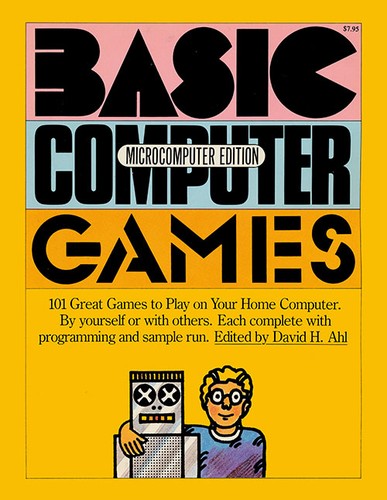
BASIC Computer Games
essay by David H. Ahl
Turbo-BASIC XL
advanced version of BASIC for the Atari 8-bit family of home computers
MBASIC
MBASIC is the Microsoft BASIC implementation of BASIC for the CP/M operating system. MBASIC is a descendant of the original Altair BASIC interpreters that were among Microsoft's first products. MBASIC was one of the two versions of BASIC bundled with the Osborne 1 computer. The name "MBASIC" is derived from the disk file name MBASIC.COM of the BASIC interpreter. MBASIC, like its predecessor family of 8-bit interpreters Microsoft BASIC, were heavily inspired by Digital Equipment Corporation PDP-10's BASIC-PLUS.
Basic4android
thumb|right|The current logo of the Basic Four Android programming language (B4A)
Basic4Android (currently known as B4A) is a rapid application development tool for native Android applications, developed and marketed by Anywhere Software Ltd.
Locomotive BASIC
proprietary dialect of the BASIC programming language
Tiny BASIC
dialect of the BASIC programming language
Amiga Basic
BASIC programming language implementation for Amiga computers
Atari Microsoft BASIC
variant of the BASIC programming language
WordBASIC
WordBASIC was a subset of Microsoft QuickBASIC customized for word-processing in Microsoft Word. It was replaced by Visual Basic for Applications (VBA) when Word 97 was released. Contrarily to VBA, WordBasic was not object-oriented but consisted of a flat list of approximately 900 commands.
GLBasic
GLBasic is a commercial BASIC programming language that can compile to various platforms including Windows, Linux, Mac OS X, and some handheld devices. The language is designed to be simple and intuitive.
CompuMate
The CompuMate SV010 was a home computer peripheral manufactured by Spectravideo International for the Atari 2600 home video game console. It was released on 6 January 1983 at the Winter Consumer Electronics Show in Las Vegas, Nevada.
Open Programming Language
programming language
True BASIC
variant of the BASIC programming language descended from Dartmouth BASIC
STOS BASIC
dialect of the BASIC programming language
FutureBASIC
FutureBasic is a free BASIC compiler for Apple Inc.'s Macintosh.
SuperBASIC
SuperBASIC is an advanced variant of the BASIC programming language with many structured programming additions. It was developed at Sinclair Research by Jan Jones during the early 1980s.
Comparison of C# and Visual Basic .NET
C# and Visual Basic .NET are the two primary languages used to program on the .NET Framework
Chipmunk Basic
freeware Basic interpreter
RapidQ
RapidQ (also known as Rapid-Q) is a free, cross-platform, semi-object-oriented dialect of the BASIC programming language. It can create console, graphical user interface, and Common Gateway Interface applications. The integrated development environment includes a drag-and-drop form designer, syntax highlighting, and single-button compilation. Versions are available for Microsoft Windows, Linux, Solaris, and HP-UX.