Category
page 1Bayer objects

Sirius
Sirius is the brightest star in the night sky, located in the southern constellation of Canis Major. Its name is derived from the Greek word (Latin script: ; ). The star is designated Canis Majoris, Latinized to Alpha Canis Majoris, and abbreviated CMa or Alpha CMa. With a visual apparent magnitude of −1.46, Sirius is almost twice as bright as Canopus, the next brightest star. Sirius is a binary star consisting of a main-sequence star of spectral type A0 or A1, termed Sirius A, and a faint white dwarf companion of spectral type DA2, termed Sirius B. The distance betw

Polaris

Alpha Centauri
triple star system in the constellation Centaurus, where one of the three stars, Proxima Centauri, being the closest star to the Earth
.png)
Betelgeuse
Betelgeuse is a red supergiant star in the equatorial constellation of Orion. It is usually the tenth-brightest star in the night sky and, after Rigel, the second brightest in its constellation. It is a distinctly reddish, semiregular variable star whose apparent magnitude, varying between +0.0 and +1.6, with a main period near 400 days, has the widest range displayed by any first-magnitude star. Betelgeuse is the brightest star in the night sky at near-infrared wavelengths. Its Bayer designation is ', Latinised to Alpha Orionis and abbreviated Alpha Ori or '.

Vega
Vega is the brightest star in the northern constellation of Lyra. It has the Bayer designation α Lyrae, which is Latinised to Alpha Lyrae and abbreviated Alpha Lyr or α Lyr. This star is relatively close at only from the Sun, and one of the most luminous stars in the Sun's neighborhood, being intrinsically brighter than any star nearer to the sun. It is the fifth-brightest star in the night sky, and the second-brightest star in the northern celestial hemisphere, after Arcturus.

Aldebaran
Aldebaran () is a star in the zodiac constellation of Taurus. It has the Bayer designation α Tauri, which is Latinized to Alpha Tauri and abbreviated Alpha Tau or α Tau. Aldebaran varies in brightness from an apparent visual magnitude of 0.75 down to 0.95, making it the brightest star in the constellation, as well as (typically) the fourteenth-brightest star in the night sky. It is at a distance of approximately 67 light-years. The star lies along the line of sight to the nearby Hyades cluster, but is unrelated and much older than the young cluster.

Canopus
Canopus is the brightest star in the southern constellation of Carina and the second-brightest star in the night sky. It is designated α Carinae, which is romanized (transliterated) to Alpha Carinae. With a visual apparent magnitude of −0.74, it is outshone only by Sirius.

Rigel
Rigel is a blue supergiant star in the equatorial constellation of Orion. It has the Bayer designation β Orionis, which is Latinized to Beta Orionis and abbreviated Beta Ori or β Ori. Rigel is the brightest and most massive componentand the eponymof a star system of at least four stars that appear as a single blue-white point of light to the naked eye. This system is located at a distance of approximately .

Arcturus
|- bgcolor="#FFFAFA"
| Note (category: variability): || H and K emission vary.

Antares
Antares is the brightest star in the constellation of Scorpius. It has the Bayer designation α Scorpii, which is Latinised to Alpha Scorpii. Often referred to as "the heart of the scorpion", Antares is flanked by σ Scorpii and τ Scorpii near the center of the constellation. Distinctly reddish when viewed with the naked eye, Antares is a slow irregular variable star that ranges in brightness from an apparent visual magnitude of +0.6 down to +1.6. It is on average the fifteenth-brightest star in the night sky. Antares is the brightest and most evolved stellar member of the Scorpius–Centaurus ass

Altair
Altair is the brightest star in the equatorial constellation of Aquila and the twelfth-brightest star in the night sky. It has the Bayer designation Alpha Aquilae, which is Latinised from α Aquilae and abbreviated Alpha Aql or α Aql. Altair is an A-type main-sequence star with an apparent visual magnitude of 0.77 and is one of the vertices of the Summer Triangle asterism; the other two vertices are marked by Deneb and Vega. It is located at a distance of from the Sun. Altair is currently in the G-cloud—a nearby interstellar cloud formed from an accumulation of gas and dust.

Capella
Capella is the brightest star in the northern constellation of Auriga. It has the Bayer designation α Aurigae, which is Latinised to Alpha Aurigae and abbreviated Alpha Aur or α Aur. Capella is the sixth-brightest star in the night sky, and the third-brightest in the northern celestial hemisphere after Arcturus and Vega. A prominent object in the northern sky, it is circumpolar to observers north of 44°N. Its name meaning "little goat" in Latin, Capella depicted the goat Amalthea that suckled Zeus in classical mythology. Capella is relatively close, at . It is one of the brightest X-ray source

Fomalhaut
Fomalhaut (, ) is the brightest star in the southern constellation of Piscis Austrinus, the Southern Fish, and one of the brightest stars in the night sky. It has the Bayer designation Alpha Piscis Austrini, which is an alternative form of α Piscis Austrini, and is abbreviated Alpha PsA or α PsA. This is a class A star on the main sequence approximately from the Sun as measured by the Hipparcos astrometry satellite. Since 1943, the spectrum of this star has served as one of the stable anchor points by which other stars are classified.

Algol
Algol , designated Beta Persei (β Persei, abbreviated Beta Per, β Per), known colloquially as the Demon Star, is a bright multiple star in the constellation of Perseus and one of the first non-nova variable stars to be discovered.

Spica
Spica is the brightest object in the constellation of Virgo and one of the 20 brightest stars in the night sky. It has the Bayer designation α Virginis, which is Latinised to Alpha Virginis and abbreviated Alpha Vir or α Vir. Analysis of its parallax shows that it is located 250 light-years from the Sun. It is a spectroscopic binary star and rotating ellipsoidal variable; a system whose two stars are so close together they are egg-shaped rather than spherical, and can only be separated by their spectra. The primary is a blue giant and a variable star of the Beta Cephei type.

Procyon
Procyon () is the brightest star in the constellation of Canis Minor and usually the eighth-brightest star in the night sky, with an apparent visual magnitude of 0.34. It has the Bayer designation α Canis Minoris, which is Latinized to Alpha Canis Minoris, and abbreviated α CMi or Alpha CMi, respectively. As determined by the European Space Agency Hipparcos astrometry satellite, this system lies at a distance of just , and is therefore one of Earth's nearest stellar neighbors. A binary star system, Procyon consists of a white-hued main-sequence star of spectral type F5 IV–V, designated co

Deneb
Deneb () is a blue supergiant star in the constellation of Cygnus. It is the brightest star in the constellation and the 19th brightest in the night sky, with an apparent magnitude slightly varying between +1.21 and +1.29. Deneb is one of the vertices of the asterism known as the Summer Triangle and the "head" of the Northern Cross. Its Bayer designation is α Cygni, which is Latinised to Alpha Cygni, abbreviated to Alpha Cyg or α Cyg.

Bellatrix
Bellatrix is the third-brightest star in the constellation of Orion, positioned 5° west of the red supergiant Betelgeuse (Alpha Orionis). It has the Bayer designation γ Orionis, which is Latinized to Gamma Orionis. With a slightly variable magnitude of around 1.6, it is typically the 25th-brightest star in the night sky. It is the closest major star in Orion at only 244.6 light-years from the Solar System.

Regulus
Regulus is the brightest object in the constellation Leo and one of the brightest stars in the night sky. It has the Bayer designation designated α Leonis, which is Latinized to Alpha Leonis, and abbreviated Alpha Leo or α Leo. Regulus appears single, but is actually a quadruple star system composed of four stars that are organized into two pairs. The system lies approximately 79 light years from the Solar System.

Pollux
star in the northern constellation of Gemini

Achernar
Achernar is the brightest star in the constellation of Eridanus and the ninth-brightest in the night sky. It has the Bayer designation Alpha Eridani, which is Latinized from α Eridani and abbreviated Alpha Eri or α Eri. The name Achernar applies to the primary component of a binary system. The two components are designated Alpha Eridani A (the primary) and B (the secondary), with the latter known informally as Achernar B. As determined by the Hipparcos astrometry satellite, this system is located at a distance of approximately from the Sun.

Omega Centauri
globular cluster in the constellation Centaurus

Mira
Mira, pronounced , is a binary star in the constellation Cetus. It has the Bayer designation Omicron Ceti, which is Latinized from ο Ceti, and abbreviated Omicron Cet or ο Cet. The system consists of a variable red giant (Mira A) along with a white dwarf companion (Mira B). Mira A is a pulsating variable star and was the first non-supernova variable star discovered, with the possible exception of Algol. It is the prototype of the Mira variables. The system lies at a distance of .
Castor
star in the constellation Gemini

Beta Centauri
star system in the southern constellation of Centaurus

Bayer designation
star naming system in which a specific star is identified by a Greek or Latin letter followed by the genitive form of its parent constellation's Latin name

Alnitak
Alnitak is a triple star system in the constellation of Orion. It has the designations ζ Orionis, which is Latinised to Zeta Orionis and abbreviated Zeta Ori or ζ Ori, and 50 Orionis, abbreviated 50 Ori. The system is located at a distance of several hundred parsecs from the Sun and is one of the three main stars of Orion's Belt along with Alnilam and Mintaka.

Alnilam
Alnilam is the central star of Orion's Belt in the equatorial constellation of Orion. It has the Bayer designation ε Orionis, which is Latinised to Epsilon Orionis and abbreviated Epsilon Ori or ε Ori. This is a massive, blue supergiant star some 1,250 light-years distant. It is estimated to be 270,000 times as luminous as the Sun, and 28 times as massive.

Zeta Ursae Majoris
Mizar is a second-magnitude star in the handle of the Big Dipper asterism in the constellation of Ursa Major. It has the Bayer designation ζ Ursae Majoris (Latinised as Zeta Ursae Majoris). It forms a well-known naked eye double star with the fainter star Alcor (a binary system consisting of Alcor A and Alcor B), and is itself a quadruple star system. The Mizar and Alcor system lies about 83 light-years away from the Sun, as measured by the Hipparcos astrometry satellite, and is part of the Ursa Major Moving Group.
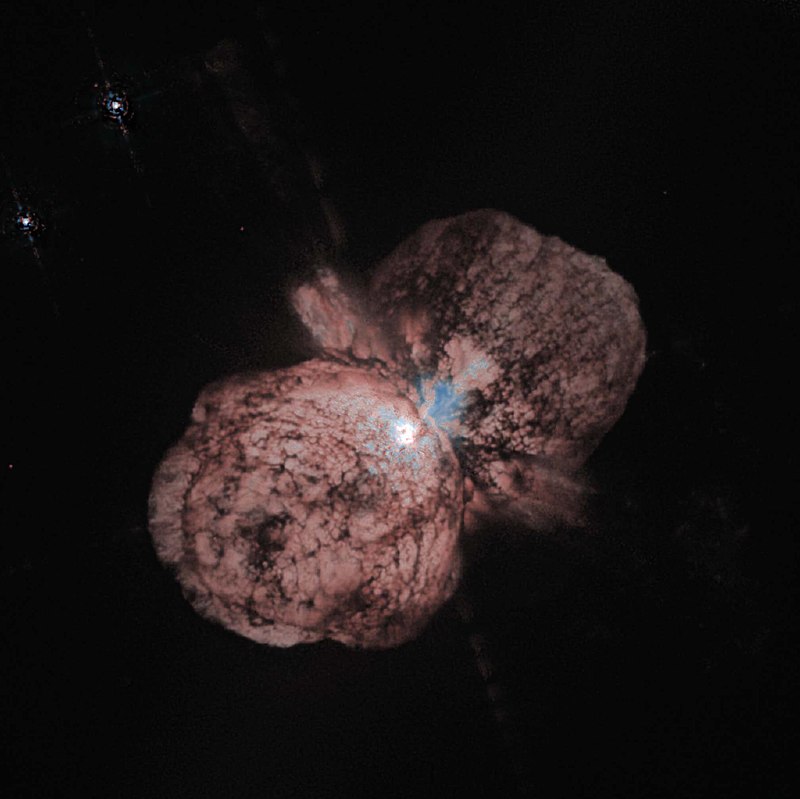
Eta Carinae
stellar system in the constellation Carina

47 Tucanae
globular cluster in the constellation Tucana

Mintaka
Mintaka , designation Delta Orionis (δ Orionis, abbreviated Delta Ori, δ Ori) and 34 Orionis (34 Ori), is a quintuple star system some 1,200 light-years from the Sun in the constellation of Orion. Together with Alnitak (Zeta Orionis) and Alnilam (Epsilon Orionis), the three stars form Orion's Belt, known by many names among ancient cultures. The star is located very close to the celestial equator. When Orion is near the meridian, Mintaka is the rightmost of the Belt's stars when viewed from the Northern Hemisphere facing south.

Alpha Andromedae
Alpheratz is a prominent star system in the constellation of Andromeda. Pronounced , it has the Bayer designation Alpha Andromedae, Latinised from α Andromedae, and abbreviated Alpha And or α And, respectively. Alpheratz is the brightest star in the constellation when Mirach (βAndromedae) undergoes its periodical dimming. Immediately northeast of the constellation of Pegasus, it is the upper left star of the Great Square of Pegasus. It is located at a distance of 97 light-years from Earth.

Tau Ceti
star in the constellation Cetus

Alioth
Alioth , also called Epsilon Ursae Majoris, is a star in the northern constellation of Ursa Major. The designation is Latinised from ε Ursae Majoris and abbreviated Epsilon UMa or ε UMa. Despite being designated "ε" (epsilon), it is the brightest star in the constellation and at magnitude 1.77 is the thirty-third brightest star in the sky.

Albireo
Albireo is a double star designated Beta Cygni (β Cygni, abbreviated Beta Cyg, β Cyg). The International Astronomical Union uses the name "Albireo" specifically for the brightest star in the system. Although designated 'beta', it is fainter than Gamma Cygni, Delta Cygni, and Epsilon Cygni and is the fifth-brightest point of light in the constellation of Cygnus. Appearing to the naked eye to be a single star of magnitude 3, viewing through even a low-magnification telescope resolves it into its two components. The brighter yellow star, itself a very close trinary system, makes a striking colour

Alpha Ursae Majoris
Dubhe is a multiple star system in the northern constellation of Ursa Major. It is formally designated Alpha Ursae Majoris, Latinised from α Ursae Majoris, Despite being designated "α" (alpha), it is the second-brightest object in the constellation. Alpha Ursae Majoris is the northern of the 'pointers' (or 'guards'), the second being Beta Ursae Majoris, or 'Merak' – this pair of stars point towards Polaris, the North Star. α Ursae Majoris is located at a distance of approximately 123 light years from the Sun, based on parallax measurements.

Ran
star in the southern constellation Eridanus

55 Cancri
binary star

Adhara
star in the constellation Canis Major

Mimosa
star in the constellation Crux

Saiph
Saiph , designation Kappa Orionis (κ Orionis, abbreviated Kappa Ori, κ Ori) and 53 Orionis (53 Ori), is a blue supergiant star and the sixth-brightest star in the constellation of Orion. Of the four bright stars that compose Orion's main quadrangle, it is the star at the south-eastern corner. A northern-hemisphere observer facing south would see it at the lower left of Orion, and a southern-hemisphere observer facing north would see it at the upper right. Parallax measurements yield an estimated distance of from the Sun. It is smaller, less luminous but hotter at its surface than Rigel with an

Mu Cephei
star in the constellation Cepheus

Alphard
Alphard () is the brightest star in the constellation of Hydra. It has the Bayer designation Alpha Hydrae, which is that is Latinized from α Hydrae, and abbreviated Alpha Hya or α Hya. It is a giant star, cooler than the Sun but larger and more luminous. It is about 177 light-years away.
Delta Cephei
binary star system
Alcyone
star system in the constellation Taurus

Beta Tauri
star in the constellation Taurus

Gamma Andromedae
multiple star system in the constellation Andromeda
Beta Ursae Majoris
star in constellation of Ursa Major
Alpha Persei
star in the constellation Perseus
Cor Caroli
star in Canes Venatici
Beta Ceti
star in the constellation Cetus

Denebola
Denebola is the second-brightest star in the zodiac constellation of Leo. It is the easternmost of the bright stars of Leo. It has the Bayer designation Beta Leonis or β Leonis, which are abbreviated Beta Leo or β Leo. Denebola is an A-type main sequence star with 75% more mass than the Sun and 15 times the Sun's luminosity. Based on parallax measurements from the Hipparcos astrometry satellite, the star is at a distance of from the Sun. Its apparent visual magnitude is 2.14, making it readily visible to the naked eye. Denebola is a Delta Scuti type variable star, meaning its luminosity varies
Alphecca
binary star in the constellation Corona Borealis
Alpha Cephei
star in the constellation of Cepheus
Beta Ursae Minoris
Kochab , Bayer designation Beta Ursae Minoris (β Ursae Minoris, abbreviated β UMi, Beta UMi), is the brightest star in the bowl of the Little Dipper asterism (which is part of the constellation of Ursa Minor), and only slightly fainter than Polaris, the northern pole star and brightest star in Ursa Minor. Kochab is 16 degrees from Polaris and has an apparent visual magnitude of 2.08. The distance to this star from the Sun can be deduced from the parallax measurements made during the Hipparcos mission, yielding a value of .
NGC 869
open cluster in the constellation Perseus
Alpha Cassiopeiae
star in the constellation Cassiopeia
NGC 884
open cluster in the constellation Perseus
Epsilon Pegasi
star in the northern constellation of Pegasus