File:Eta_Carinae.jpg · Wikimedia Commons · See Wikimedia Commons
Eta Carinae
Sign in to saveAlso known as η Carinae, η Car, eta Car, Hen 3-481, H 1044-59, HR 4210, LLNS 2725, LS 1868
stellar system in the constellation Carina
Key facts
- Constellation
- Carina
- Right ascension
- 10 45 03.591
- Declination
- −59 ° 41 ′ 04.26 ″
- Apparent magnitude v
- −1.0 to ~7.6 , 4.2 (2018)
- Evolutionary stage
- Luminous blue variable
- Spectral type
- variable (LBV) + O ( WR ?)
- U b colour index
- −0.45
- B v colour index
- +0.61
- Variable type
- LBV & binary
via Wikipedia infobox
Wikidata facts
- Instance of
- eruptive variable star
- Constellation
- Carina
- Distance from Earth
- 8000
- Radius
- 800
- Variable-star type
- luminous blue variable
- Image
- EtaCarinae.jpg
Show 16 more facts
- spectral class
- OBepec
- Commons category
- Eta Carinae
- catalog code
- WDS J10451-5941
- right ascension component of proper motion
- -11
- discoverer or inventor
- Pieter Dirkszoon Keyser
- absolute magnitude
- -8.6
- orbital eccentricity
- 0.9
- apparent magnitude
- 1.658
- declination component of proper motion
- 4.1
- radial velocity
- -25
- epoch
- J2000.0
- time of discovery or invention
- 1595-00-00
- color index
- 0.61
- on focus list of Wikimedia project
- Wikipedia:Vital articles/Level/4
- right ascension
- 161.26474075372
- declination
- -59.6844587777
via Wikidata · CC0
~40 min read
Encyclopedic overview
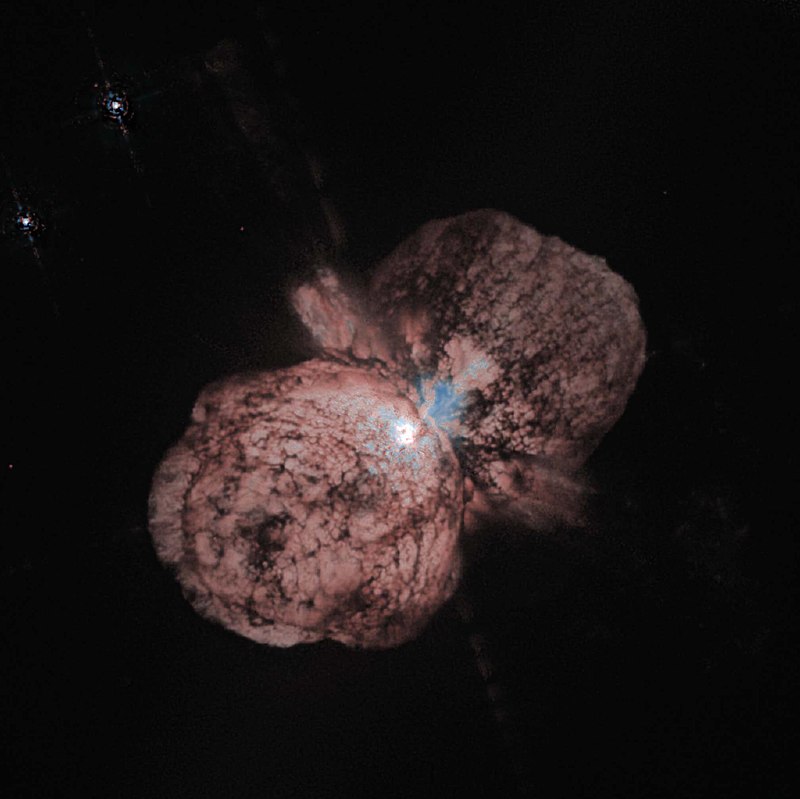
Eta Carinae (η Carinae, abbreviated to η Car), formerly known as η Argus, is a stellar system containing at least two stars with a combined luminosity greater than five million times that of the Sun, located around 7,500 light-years (2,300 parsecs) distant in the constellation Carina. Previously a 4th-magnitude star, it brightened in 1837 to become brighter than Rigel, marking the start of its so-called "Great Eruption". It became the second-brightest star in the night sky between 11–14 March 1843 before fading well below naked-eye visibility after 1856. In a smaller eruption, it reached 6th magnitude in 1892 before fading again. It has brightened consistently since about 1940, becoming brighter than magnitude 4.5 by 2014.
At declination −59° 41′ 04.26″, η Carinae is circumpolar from locations on Earth south of latitude 30°S (for reference, the latitude of Johannesburg is 26°12′S), and is not visible north of about latitude 30°N, just south of Cairo (which is at a latitude of 30°02′N).
Excerpted from Wikipedia’s “Eta Carinae” article, available under the CC BY-SA 4.0 licence.