Category
page 1Binary arithmetic

binary numeral system
system that represents numeric values using two symbols; 0 or 1

bit
The bit is the most basic unit of information in computing and digital communication. The name is a portmanteau of binary digit. The bit represents a logical state with one of two possible values. These values are most commonly represented as , but other representations such as true/false, yes/no, on/off, and +/− are also widely used.

byte
The byte is a unit of digital information that most commonly consists of eight bits. Historically, the byte was the number of bits used to encode a single character of text in a computer and for this reason it is the smallest addressable unit of memory in many computer architectures. To disambiguate arbitrarily sized bytes from the common 8-bit definition, network protocol documents such as the Internet Protocol () refer to an 8-bit byte as an octet.

hexadecimal
Hexadecimal (hex for short) is a positional numeral system for representing a numeric value as base 16. For the most common convention, a digit is represented as "0" to "9" like for decimal and as a letter of the alphabet from "A" to "F" (either upper or lower case) for the digits with decimal value 10 to 15.

octal
Octal is a numeral system for representing a numeric value as base 8. Generally, an octal digit is represented as "0" to "7" with the same value as for decimal but with each place a power of 8. For example:
binary adder
digital circuit that performs addition of numbers
binary-coded decimal
class of binary encodings of decimal numbers where each decimal digit is represented by a fixed number of bits, usually four or eight. Special bit patterns are sometimes used for a sign or for other indications
parity bit
bit added to a binary string to ensure that the sum of the bit values is even or odd; used as an error detecting code
Gray code
ordering of binary strings such that subsequent strings differ only in one bit
cyclic redundancy check
type of hash function used to detect errors in data storage or transmission
two's complement
operation on binary numbers, and number representation based on this operation
bitwise operation
computer operation that operates on values at the level of their individual bits
power of two
two raised to an integer power
binary logarithm
mathematical function
Boolean function
any mathematical function with Boolean arguments and result
ones' complement
value obtained by inverting all the bits in the binary representation of the number
IEEE 754
IEEE Standard for Floating-Point Arithmetic
most significant bit
bit position in a fixed-width binary number
fixed-point arithmetic
computer format for representing real numbers
linear feedback shift register
type of shift register in computing
double-precision floating-point format
64-bit computer number format
Booth's multiplication algorithm
algorithm invented by Andrew D. Booth
least significant bit
bit position in a binary number
XOR swap algorithm
Simple algorithm to swap binary values
division by two
mathematical operation
mask
data type
single-precision floating-point format
32-bit computer number format
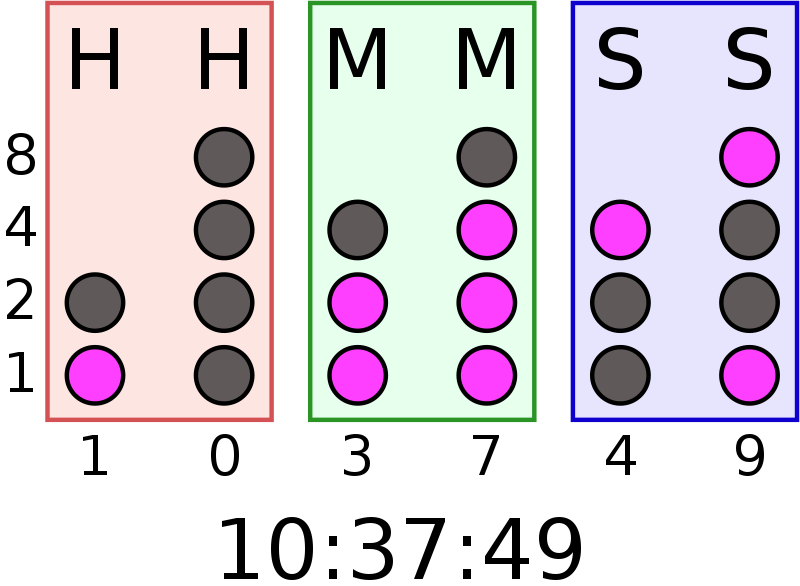
binary clock
clock that displays the time of day in a binary format
excess-3
Excess-3, 3-excess or 10-excess-3 binary code (often abbreviated as XS-3, 3XS or X3), shifted binary or Stibitz code (after George Stibitz, who built a relay-based adding machine in 1937) is a self-complementary binary-coded decimal (BCD) code and numeral system. It is a biased representation. Excess-3 code was used on some older computers as well as in cash registers and hand-held portable electronic calculators of the 1970s, among other uses.
1 + 2 + 4 + 8 + …
infinite series

XOR linked list
variant of the doubly linked list data structure used in computer programming
binary multiplier
electronic circuit used to multiply binary numbers
half-precision floating-point format
16-bit computer number format
sign bit
bit indicating the sign of a number
Finger binary
finger-counting system
barrel shifter
digital circuit that implements a bit-shift operation

subtractor
In electronics, a subtractor is a digital circuit that performs subtraction of numbers, and it can be designed using the same approach as that of an adder. The binary subtraction process is summarized below. As with an adder, in the general case of calculations on multi-bit numbers, three bits are involved in performing the subtraction for each bit of the difference: the minuend (X_{i}), subtrahend (Y_{i}), and a borrow in from the previous (less significant) bit order position (B_{i}). The outputs are the difference bit (D_{i}) and borrow bit B_{i+1}. The subtractor is best understood by cons
Logical shift
bit-level computer operation
Sign extension
operation of increasing the number of bits of a number while preserving the number's sign and value
quadruple-precision floating-point format
128-bit computer number format
Offset binary
method for signed number representation
bfloat16
floating-point number format optimized for machine learning
division algorithm
algorithm for quotient and remainder of integer division
F₂
(also denoted \mathbb F_2, or \mathbb Z/2\mathbb Z) is the finite field with two elements.
arithmetic shift
shift operator in computer programming
bit numbering
convention to identify bit positions within a byte, word, or bit string
Half-carry flag
Binary/decimal adjustment flag bit in some computer processors
Carry-save adder
type of digital adder