Category
page 1Binary stars

Sirius
Sirius is the brightest star in the night sky, located in the southern constellation of Canis Major. Its name is derived from the Greek word (Latin script: ; ). The star is designated Canis Majoris, Latinized to Alpha Canis Majoris, and abbreviated CMa or Alpha CMa. With a visual apparent magnitude of −1.46, Sirius is almost twice as bright as Canopus, the next brightest star. Sirius is a binary star consisting of a main-sequence star of spectral type A0 or A1, termed Sirius A, and a faint white dwarf companion of spectral type DA2, termed Sirius B. The distance betw

binary star
star system consisting of two stars rotating around a common center of mass

Aldebaran
Aldebaran () is a star in the zodiac constellation of Taurus. It has the Bayer designation α Tauri, which is Latinized to Alpha Tauri and abbreviated Alpha Tau or α Tau. Aldebaran varies in brightness from an apparent visual magnitude of 0.75 down to 0.95, making it the brightest star in the constellation, as well as (typically) the fourteenth-brightest star in the night sky. It is at a distance of approximately 67 light-years. The star lies along the line of sight to the nearby Hyades cluster, but is unrelated and much older than the young cluster.

gravitational wave
propagating spacetime ripple

Antares
Antares is the brightest star in the constellation of Scorpius. It has the Bayer designation α Scorpii, which is Latinised to Alpha Scorpii. Often referred to as "the heart of the scorpion", Antares is flanked by σ Scorpii and τ Scorpii near the center of the constellation. Distinctly reddish when viewed with the naked eye, Antares is a slow irregular variable star that ranges in brightness from an apparent visual magnitude of +0.6 down to +1.6. It is on average the fifteenth-brightest star in the night sky. Antares is the brightest and most evolved stellar member of the Scorpius–Centaurus ass

Procyon
Procyon () is the brightest star in the constellation of Canis Minor and usually the eighth-brightest star in the night sky, with an apparent visual magnitude of 0.34. It has the Bayer designation α Canis Minoris, which is Latinized to Alpha Canis Minoris, and abbreviated α CMi or Alpha CMi, respectively. As determined by the European Space Agency Hipparcos astrometry satellite, this system lies at a distance of just , and is therefore one of Earth's nearest stellar neighbors. A binary star system, Procyon consists of a white-hued main-sequence star of spectral type F5 IV–V, designated co

Spica
Spica is the brightest object in the constellation of Virgo and one of the 20 brightest stars in the night sky. It has the Bayer designation α Virginis, which is Latinised to Alpha Virginis and abbreviated Alpha Vir or α Vir. Analysis of its parallax shows that it is located 250 light-years from the Sun. It is a spectroscopic binary star and rotating ellipsoidal variable; a system whose two stars are so close together they are egg-shaped rather than spherical, and can only be separated by their spectra. The primary is a blue giant and a variable star of the Beta Cephei type.

Mira
Mira, pronounced , is a binary star in the constellation Cetus. It has the Bayer designation Omicron Ceti, which is Latinized from ο Ceti, and abbreviated Omicron Cet or ο Cet. The system consists of a variable red giant (Mira A) along with a white dwarf companion (Mira B). Mira A is a pulsating variable star and was the first non-supernova variable star discovered, with the possible exception of Algol. It is the prototype of the Mira variables. The system lies at a distance of .
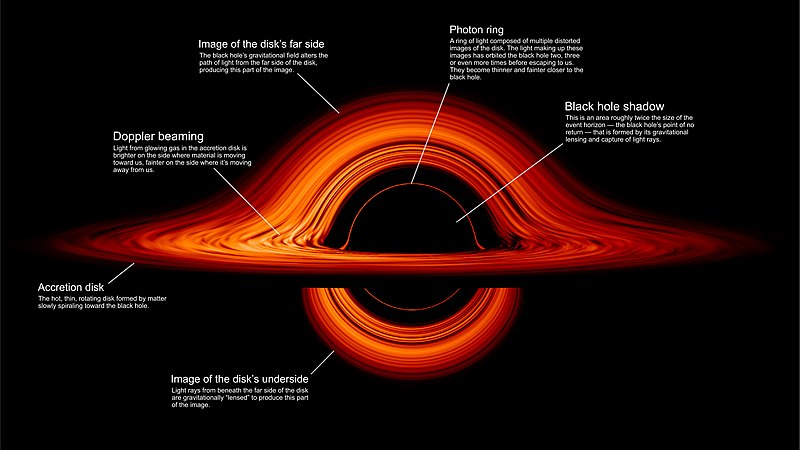
accretion disc
structure formed by diffuse material in orbital motion around a massive central body
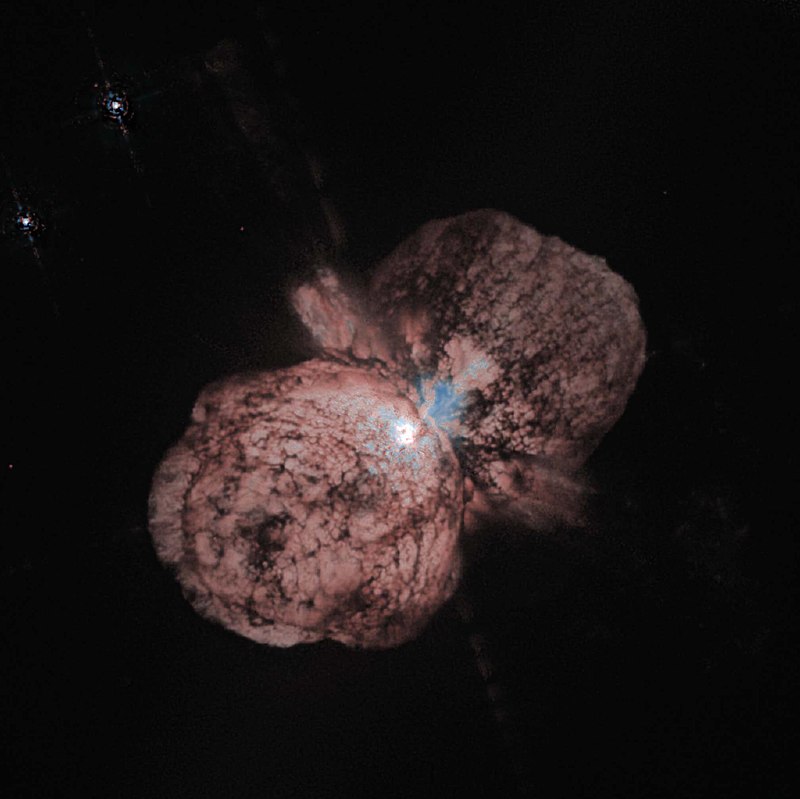
Eta Carinae
stellar system in the constellation Carina

Albireo
Albireo is a double star designated Beta Cygni (β Cygni, abbreviated Beta Cyg, β Cyg). The International Astronomical Union uses the name "Albireo" specifically for the brightest star in the system. Although designated 'beta', it is fainter than Gamma Cygni, Delta Cygni, and Epsilon Cygni and is the fifth-brightest point of light in the constellation of Cygnus. Appearing to the naked eye to be a single star of magnitude 3, viewing through even a low-magnification telescope resolves it into its two components. The brighter yellow star, itself a very close trinary system, makes a striking colour

55 Cancri
binary star

Adhara
star in the constellation Canis Major
Cor Caroli
star in Canes Venatici
WOH G64
red hypergiant star in the constellation Dorado, possibly the largest well-defined star known by radius
Luyten 726-8
binary star in the constellation Cetus
Alcor
star in the constellation of Ursa Major
61 Cygni
binary star in the Cygnus constellation
WISE 1049-5319
binary brown dwarf, third closest star system.
Alpha Ophiuchi
star in the constellation Ophiuchus
Roche lobe
Teardrop-shaped spacetime distortion near binary stars

Meissa
Meissa , designated Lambda Orionis (λ Orionis, abbreviated Lambda Ori, λ Ori) is a star in the constellation of Orion. It is a multiple star approximately away with a combined apparent magnitude of 3.33. The main components are an O9 giant star and a B-class main sequence star, separated by about 4″. Despite Meissa being more luminous and only slightly further away than Rigel, it appears 3 magnitudes dimmer at visual wavelengths, with much of its radiation emitted in the ultraviolet due to its high temperature.
Theta Scorpii
star in the southern zodiac constellation of Scorpius
Atlas
triple star system
Upsilon Andromedae
star in the constellation Andromeda
3 Monocerotis
star in Monoceros constellation
Epsilon Sagittarii
binary star system
19 Puppis
star in the constellation Puppis
X-ray binary
class of binary stars
Gamma Leonis
star in the constellation Leo
Gamma Cephei
star in the constellation of Cephei
Gamma Corvi
star in the southern constellation of Corvus
Gamma Pegasi
variable star in the constellation Pegasus
Alpha Cancri
star system in the constellation Cancer
Zeta Reticuli
star in the constellation Reticulum
Beta Cancri
star in the constellation Cancer
Gamma Centauri
star in the southern constellation of Centaurus
Epsilon Boötis
double star in the northern constellation of Boötes
GW150914
gravitational wave event
Theta Aurigae
binary star in the constellation Auriga
Eta Ophiuchi
star in the constellation Ophiuchus
Gliese 229
binary system in the constellation Lepus
Taygeta
Taygeta is a double star in the constellation of Taurus and a member of the Pleiades open star cluster (M45).
Pleione
binary star in the Pleiades star cluster
Beta Herculis
star in the northern constellation of Hercules
cataclysmic variable star
stars which irregularly increase in brightness by a large factor, then drop back down to a quiescent state
Delta Geminorum
star
Rotanev
binary star in the constellation of Delphinus
Beta Coronae Borealis
star in the constellation Corona Borealis
Delta Aquarii
star in the constellation Aquarius
NGC 4769
galaxy
Alpha Caeli
star in the constellation Caelum
Gamma Arietis
star in the constellation Aries
Beta Draconis
binary star system in the constellation Draco
Alpha Circini
star in the constellation Circinus
contact binary star
binary star system whose component stars are very close
Sualocin
star in the constellation Delphinus
Groombridge 34
binary star system in the constellation of Andromeda
Sigma Sagittarii
star in the constellation Sagittarius
Dwarf nova
cataclysmic variable star, consisting of a close binary star system