Category
page 1Biophysics

biophysics
Biophysics is an interdisciplinary science that applies approaches and methods traditionally used in physics to study biological phenomena.
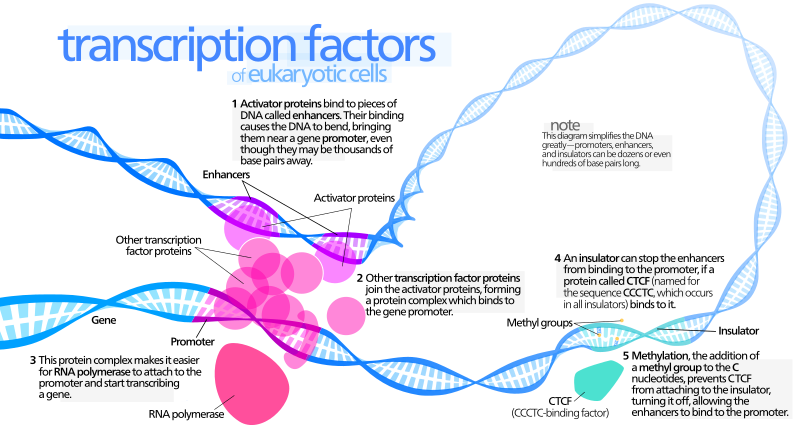
transcription factor
protein that binds to DNA and regulates gene expression by promoting or suppressing transcription

biomimetics
thumb| axons|Giant axons of the [[longfin inshore squid (Doryteuthis pealeii) were crucial for scientists to understand the action potential.]]
structural biology
study of molecular structures in biology

electrophysiology
Electrophysiology (from [see the etymology of "electron"]; ; and ) is the branch of physiology that studies the electrical properties of biological cells and tissues. It involves measurements of voltage changes or electric current or manipulations on a wide variety of scales from single ion channel proteins to whole organs like the heart. In neuroscience, it includes measurements of the electrical activity of neurons, and, in particular, action potential activity. Recordings of large-scale electric signals from the nervous system, such as electroencephalography, may also be referred to as elec
bioenergetics
Bioenergetics is a field in biochemistry and cell biology that concerns energy flow through living systems. This is an active area of biological research that includes the study of the transformation of energy in living organisms and the study of thousands of different cellular processes such as cellular respiration and the many other metabolic and enzymatic processes that lead to production and utilization of energy in forms such as adenosine triphosphate (ATP) molecules. That is, the goal of bioenergetics is to describe how living organisms acquire and transform energy in order to perform bi
molecular motor
biological molecular machines
specific absorption rate
rate at which energy is absorbed by the human body when exposed to electromagnetic field

magnetoreception
thumb|upright=1.35|Experiments on European robins, which are migratory, suggest their magnetic sense makes use of the quantum [[radical pair mechanism. ]]
quantum biology
application of quantum mechanics and theoretical chemistry to biological objects and problems
Förster resonance energy transfer
energy transfer mechanism and microscopy technique
optical tweezers
instrument using a highly focused laser to provide an attractive or repulsive force (on the order of piconewtons) to hold and move microscopic dielectric objects similar to tweezers
protein-protein interaction
physical interactions and constructions between multiple proteins
biophysical chemistry
physical science using physics and physical chemistry for the study of biological systems
automatic gain control
electronic circuit to automatically adjust signal strength
differential scanning calorimetry
thermoanalytical technique in which the difference in the amount of heat required to increase the temperature of a sample and reference is measured as a function of temperature
nucleic acid double helix
the structure formed by double-stranded molecules of nucleic acids such as DNA.
surface plasmon resonance
physical phenomenon of electron resonance
What Is Life?
1944 non-fiction work by Erwin Schrödinger
DNA-binding protein
proteins that have DNA-binding domains and thus have a specific or general affinity for single- or double-stranded DNA
nucleic acid secondary structure
basepairing interactions within a single nucleic acid polymer or between two polymers, list of bases which are paired in a nucleic acid molecule
Stochastic resonance
signal boosting phenomenon using white noise
FitzHugh–Nagumo model
describes a prototype of an excitable system (e.g., a neuron)
biological thermodynamics
study of energy in living systems

biological neuron model
mathematical description of the properties of certain cells in the nervous system that generate sharp electrical potentials across their cell membrane, roughly one millisecond in duration
isothermal titration calorimetry
quantitative technique used to determine the thermodynamic parameters of interactions in solution
Physiome
The physiome of an individual's or species' physiological state is the description of its functional behavior. The physiome describes the physiological dynamics of the normal intact organism and is built upon information and
structure (genome, proteome, and morphome). The term comes from "physio-" (nature) and "-ome" (as a whole). The study of physiome is called physiomics.
Chemical affinity
In biochemistry, avidity refers to the accumulated strength of multiple affinities of individual non-covalent binding interactions, such as between a protein receptor and its ligand, and is commonly referred to as functional affinity. Avidity differs from affinity, which describes the strength of a single interaction. However, because individual binding events increase the likelihood of occurrence of other interactions (i.e., increase the local concentration of each binding partner in proximity to the binding site), avidity should not be thought of as the mere sum of its constituent affinities
Nuclear magnetic resonance spectroscopy of proteins
field of structural biology
bioelectricity
regulation of cell, tissue, and organ-level patterning and behavior as the result of endogenous electrically-mediated signaling.
Worm-like chain
simple model of a polymer
fluorescence recovery after photobleaching
experimental technique in cell biology
Hydrophobicity scales
relative hydrophobicity or hydrophilicity of amino acid residues
stopped flow
Stopped-flow is one of a number of methods of studying the kinetics of reactions in solution. It is ideal for studying chemical reactions with a typical dead time on the order of 1 millisecond. In the simplest form of the technique, the solutions of two reactants are rapidly mixed by being forced through a mixing chamber, on emerging from which the mixed fluid passes through an optical observation cell. At some point in time, the flow is suddenly stopped, and the reaction is monitored using a suitable spectroscopic probe, such as absorbance, fluorescence or fluorescence polarization. The chang
entropy and life
relationship between the thermodynamic concept of entropy and the evolution of living organisms
Friedrich Beck
German physicist (1927–2008)
Astrobiophysics
Astrobiophysics is a field of intersection between astrophysics and biophysics concerned with the influence of the astrophysical phenomena upon life on planet Earth or some other planet in general. It differs from astrobiology which is concerned with the search of extraterrestrial life. Examples of the topics covered by this branch of science include the effect of supernovae on life on Earth and the effects of cosmic rays on irradiation at sea level.
falling cat problem
observation that cats are able to right themselves when falling inverted using a non-obvious source of angular momentum
Yakovlevian torque
type of physical brain asymmetry
Cell biophysics
membrane fusion
the membrane organization process that joins two lipid bilayers to form a single membrane
K-mer
thumb|The sequence ATGG has two 3-mers: ATG and TGG.
In bioinformatics, '''k-mers' are substrings of length k contained within a biological sequence. Primarily used within the context of computational genomics and sequence analysis, in which k-mers are composed of nucleotides (i.e. A, T, G, and C), k-mers are capitalized upon to assemble DNA sequences, improve heterologous gene expression, identify species in metagenomic samples, and create attenuated vaccines. Usually, the term k''-mer refers to all of a sequence's subsequences of length k, such that the sequence AGAT would have four monomers
macromolecular crowding
The effect of high concentrations of macromolecules in living cells
Kautsky effect
effect
Virophysics
Virophysics is a branch of biophysics in which the theoretical concepts and experimental techniques of physics are applied to study the mechanics and dynamics driving the interactions between virions and cells.
magnetomyography
Magnetomyography (MMG) is a technique for mapping muscle activity by recording magnetic fields produced by electrical currents occurring naturally in the muscles, using arrays of SQUIDs (superconducting quantum interference devices). It has a better capability than electromyography for detecting slow or direct currents. The magnitude of the MMG signal is in the scale of pico (10^−12) to femto (10^−15) tesla (T). Miniaturizing MMG offers a prospect to modernize the bulky SQUID to wearable miniaturized magnetic sensors.
membrane biology
study of biological membrane structure and function
Autowave
Autowaves are self-supporting non-linear waves in active media (i.e. those that provide distributed energy sources). The term is generally used in processes where the waves carry relatively low energy, which is necessary for synchronization or switching the active medium.