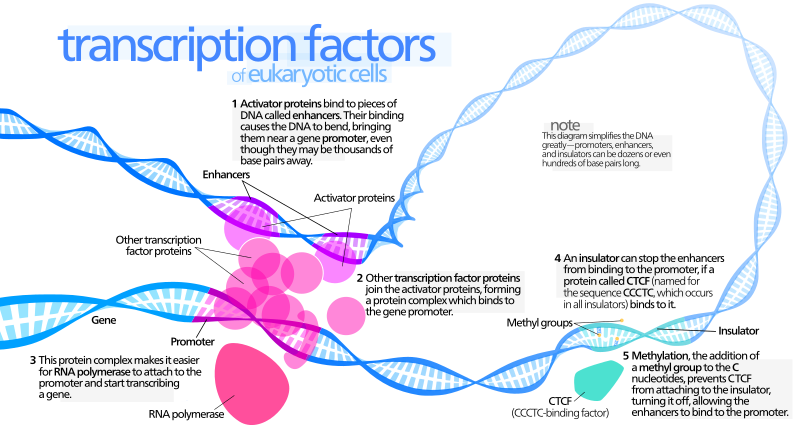
File:Transcription_Factors.svg · Wikimedia Commons · See Wikimedia Commons
transcription factor
Sign in to saveAlso known as transcription factors
protein that binds to DNA and regulates gene expression by promoting or suppressing transcription
Research
972,583 papers- The transcription factor GABPA is a master regulator of naive pluripotency.Nature cell biology · 2025
- Transcription factor dimerization activates the p300 acetyltransferase.Nature · 2018
- Transcription factor AP-1, and the role of Fra-2.Immunology and cell biology · 1996
- Database for Plant Transcription Factor Binding Sites.Methods in molecular biology (Clifton, N.J.) · 2023
- Chromatin accessibility and transcription factor binding through the perspective of mitosis.Transcription · 2020
via PubMed
Wikidata facts
- Subclass of
- DNA-binding protein
- Image
- LacI Dimer Structure Annotated.png
Show 2 more facts
- Commons category
- Transcription factors
- topic's main category
- Category:Transcription factors
Sources (2)
via Wikidata · CC0
~37 min read
Encyclopedic overview
Illustration of an activator
In molecular biology, a transcription factor (TF) (or sequence-specific DNA-binding factor) is a protein that controls the rate of transcription of genetic information from DNA to messenger RNA, by binding to DNA sequences. Specificity can be due to sequence motifs, or epigenetic modifications . The function of TFs is to regulate—turn on and off—genes in order to make sure that they are expressed in the desired cells at the right time and in the right amount throughout the life of the cell and the organism. Groups of TFs function in a coordinated fashion to direct cell division, cell growth, and cell death throughout life; cell migration and organization (body plan) during embryonic development; and intermittently in response to signals from outside the cell, such as a hormone. There are approximately 1600 TFs in the human genome, where half of them are C2H2 zinc fingers. Transcription factors are members of the proteome as well as regulome.
Excerpted from Wikipedia’s “transcription factor” article, available under the CC BY-SA 4.0 licence.