Category
page 1Boletaceae

Imleria badia
species of fungus

Boletaceae
The Boletaceae are a family of mushroom-forming fungi, primarily characterised by small pores on the spore-bearing hymenial surface (at the underside of the mushroom), instead of gills as are found in most agarics. Nearly as widely distributed as the agarics, the family is renowned for hosting some prime edible species highly sought after by mushroom hunters worldwide, such as the cep or king bolete (Boletus edulis). A number of rare or threatened species are also present in the family, that have become the focus of increasing conservation concerns. As a whole, the typical members of the famil
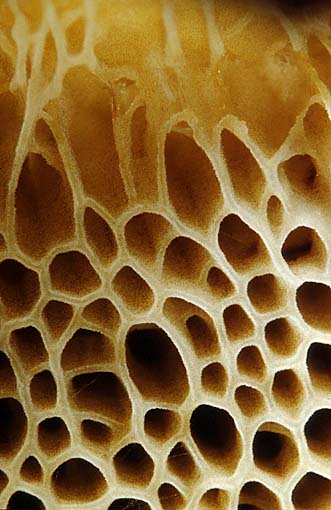
Xerocomellus chrysenteron
species of fungus

Xerocomus subtomentosus
species of fungus

Hemileccinum impolitum
species of fungus
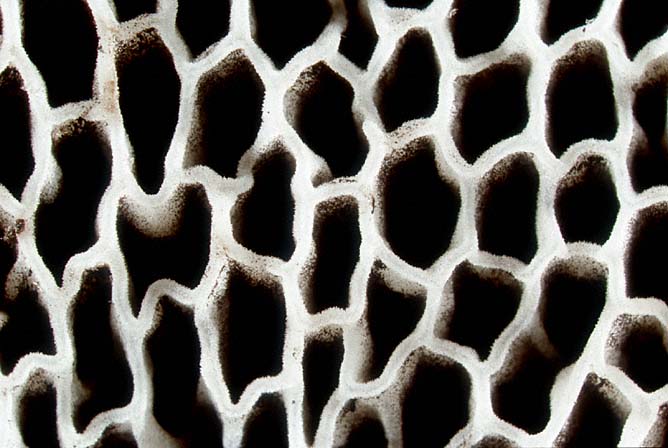
Strobilomyces strobilaceus
species of fungus

Hortiboletus rubellus
species of fungus

Xerocomus
thumb|260x260px|Xerocomus silwoodensis
thumb|260x260px|Xerocomus squamulosus
thumb|260x260px|Xerocomus ferrugineus
thumb|343x343px|Xerocomus illudens
Xerocomus is a genus of poroid fungi related to Boletus. Most members of Xerocomus are edible, though of mediocre gastronomical value and inferior to the sought-after porcini.

Cyanoboletus pulverulentus
species of fungus

Imperator torosus
species of fungus in the family Boletaceae native to southern Europe east to the Caucasus and Israel.
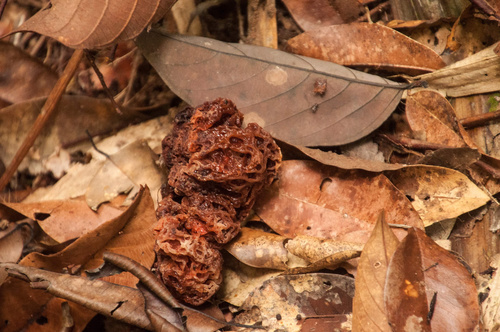
Spongiforma squarepantsii
species of fungus

Xerocomellus porosporus
species of fungus
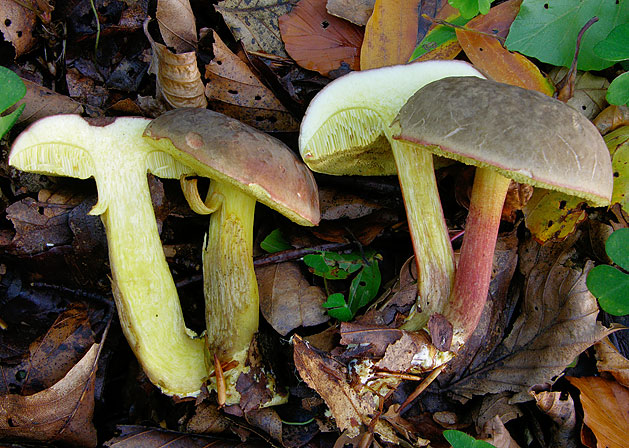
Xerocomellus pruinatus
species of fungus

Strobilomyces
Strobilomyces is a genus of boletes (mushrooms having a spongy mass of pores under the cap). The only well-known European species is the type species S. strobilaceus (also named S. floccopus), known in English as "old man of the woods".

Lanmaoa fragrans
species of fungus

Buchwaldoboletus lignicola
species of fungus

Imperator rhodopurpureus
species of fungus

Xerocomellus
Xerocomellus is a genus of fungi in the family Boletaceae. The genus, as it was described in 2008, contained 12 species. However X. rubellus and X. engelii were transferred to the new genus Hortiboletus and X. armeniacus was transferred to the new genus Rheubarbariboletus in 2015. Molecular analysis supports the distinction of Xerocomellus species from Boletus and Xerocomus, within which these species were formerly contained. Xerocomellus in fact is only distantly related to Xerocomus and is most closely related to Tylopilus, Boletus sensu stricto, Porphyrellus, Strobilomyces, and Xanthoconium

Aureoboletus
Aureoboletus is a genus of bolete fungi in the family Boletaceae. It was circumscribed by Czech mycologist Zdeněk Pouzar in 1957. A taxonomic monograph was published in 2010 by Wolfgang Klofac. At least 11 species in these genus are edible and have been traditionally consumed in different regions of the world

Imleria
Imleria is a genus of fungi in the family Boletaceae. It was established in 2014 by Alfredo Vizzini as a new genus for what had previously been named Boletus badius or Xerocomus badius. It was placed in its own genus because of its distinct morphological features and because it had previously been found to belong in its own genus in a molecular phylogenetics study by Gelardi et al. (2013). Zhu et al. (2014) placed three more species in Imleria. Species of Imleria which can be found in Europe, North America and Asia. The genus is named in honor of the Belgian mycologist Louis Imler (1900–1993).
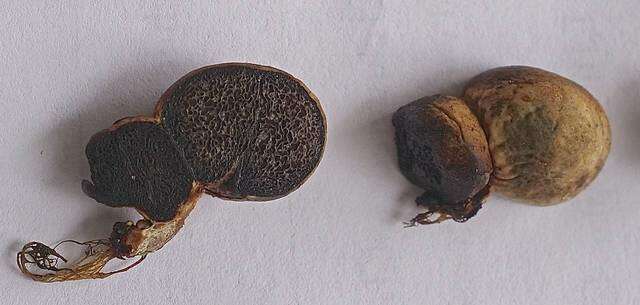
Chamonixia
Chamonixia is a genus of truffle-like fungi in the family Boletaceae. The genus is widely distributed, especially in temperate regions, and contains eight species. Chamonixia was circumscribed by French mycologist Léon Louis Rolland in 1899.

Hemileccinum
Hemileccinum is a genus of fungi in the family Boletaceae. It was erected in 2008 by Josef Šutara to contain two species united by a number of shared morphological features: H. depilatum and the type H. impolitum. In 2014, Wu et al. found it to be distinct from other bolete genera in a molecular phylogenetic study and found it to be most closely related to Corneroboletus. In 2015, H. subglabripes was transferred to Hemileccinum from Boletus based on DNA evidence, while subsequent studies further confirmed the monophyly of the genus.
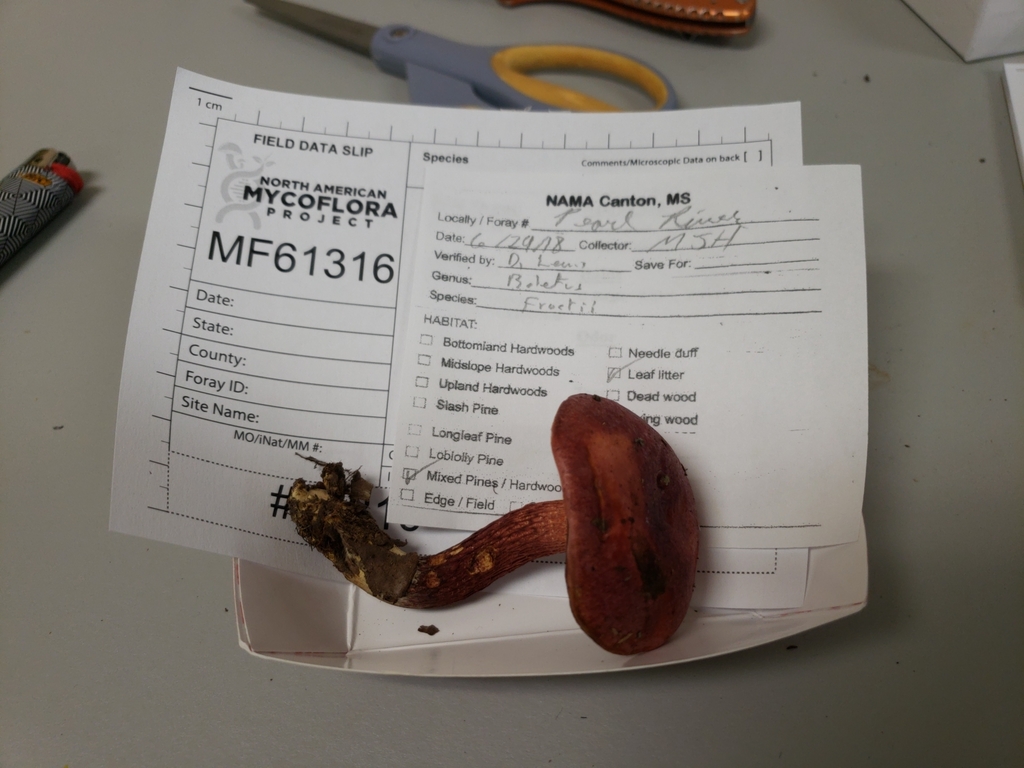
Butyriboletus frostii
species of fungi in the genus Butyriboletus
%20Bresinsky%20%26%20Manfr.%20Binder%20154221%202011-06-27.jpg)
Leccinellum
Leccinellum is a genus of fungi in the family Boletaceae. Mycologists Andreas Bresinsky and Manfred Binder circumscribed the genus in 2003 to contain Leccinum species with a yellow pore surface and a trichoderm-like cap cuticle. Leccinellum nigrescens (originally Leccinum nigrescens Singer 1947) was designated the type species; this taxon has since been renamed to Leccinellum crocipodium (Letell.) Della Maggiora & Trassinelli.

Imperator
genus of fungi
Gastroboletus
Gastroboletus is a genus of fungi in the family Boletaceae. Species in the genus have misshapen caps, poorly developed or absent stipes, and are often buried or partially buried. Gastroboletus has tubes arranged irregularly, rather than vertically as in typical boletes. The edibility of most species is unknown, and those known to be edible are not highly rated.
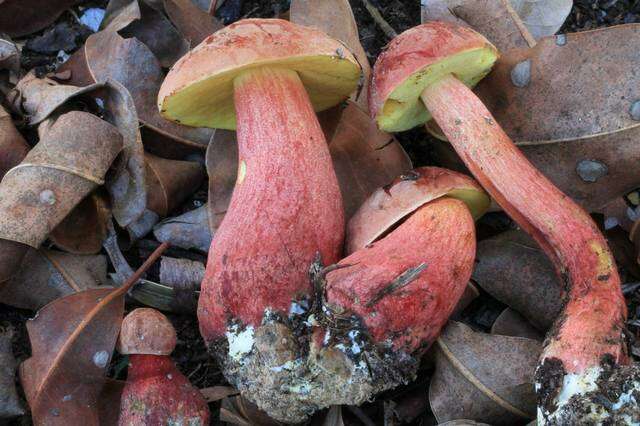
Heimioporus
Heimioporus is a genus of fungi in the family Boletaceae. The genus is widely distributed in tropical and subtropical regions, and contains about 15 species.
%20Both%20%26%20B.%20Ortiz%201288209.jpg)
Buchwaldoboletus
Buchwaldoboletus is a genus of bolete fungi in the family Boletaceae. It was circumscribed by mycologist Albert Pilát in 1969. According to a 2011 survey of the genus, Buchwaldoboletus contains about a dozen species that are saprotrophic and lignicolous.
==Taxonomy==
The genus name of Buchwaldoboletus is in honour of Niels Fabritius Buchwald (1898 - 1986), a Danish botanist and Professor of Phytopathology at a Agriculture College in Copenhagen. It was established by Albert Pilát in 1969, moving Pulveroboletus lignicola to position of the Buchwaldoboletus type species on account of its occurren
Hortiboletus bubalinus
species of fungus

Austroboletus
Austroboletus is a genus of fungi in the family Boletaceae. The widely distributed genus contains species that form mycorrhizal relationships with plants.
.jpg)
Fistulinella
Fistulinella is a genus of bolete fungi in the family Boletaceae. The genus has a pantropical distribution, and contains 15 species. Fistulinella was circumscribed by German mycologist Paul Christoph Hennings in 1901.
Rheubarbariboletus armeniacus
species of fungus

Hortiboletus
Hortiboletus is a genus of fungi in the family Boletaceae. It was circumscribed in 2015 by Giampaolo Simonini, Alfredo Vizzini, and Matteo Gelardi. The erection of Hortiboletus follows recent molecular studies that outlined a new phylogenetic framework for the Boletaceae. Hortiboletus is derived from the Latin word hortus "garden", referring to a typical habitat of the type species, Hortiboletus rubellus. The bolete H. bubalinus, originally described as a Boletus and later placed in Xerocomus, was transferred to the genus by Bálint Dima. In 2015, Alona Yu. Biketova transferred Boletus cam
%20Singer%20635704%202016-07-13.jpg)
Xanthoconium
Xanthoconium is a genus of bolete fungi in the family Boletaceae. It was circumscribed by mycologist Rolf Singer in 1944, who included Boletus affinis and what was then known as Gyroporus stramineus as the type species. These two species were part of the "strange group of species described by Murrill and Snell as white-spored Gyropori, and separated by the latter under the new generic name Leucogyroporus." C.B. Wolfe described three species from the United States in 1987: X. chattoogaense, Xanthoconium montaltoense, and X. montanum. , the nomenclatural database Index Fungorum list se
%20Figure%202.jpg)
Pulveroboletus
Pulveroboletus is a genus of fungi in the family Boletaceae. The genus has a cosmopolitan distribution and contains 41 species.
Cyanoboletus
Cyanoboletus is a fungal genus in the family Boletaceae. Circumscribed in 2014, it contains four species: C. flavosanguineus, C. rainisii, C. sinopulverulentus, and the type, C. pulverulentus. The generic name is derived from the Ancient Greek cyano ("blue"), referring to the rapid blue bruising reaction of the fruit bodies when cut.
Boletochaete
Boletochaete is a genus of fungi in the family Boletaceae. The genus contains three species found in Africa and southeast Asia. American mycologist Rolf Singer circumscribed the genus in 1944.
==Species==
{| class="wikitable sortable"
!Image !!Scientific name !! Taxon author !! Year !! Distribution
|-
| ||Boletochaete bicolor || Singer || 1986||
|-
| ||Boletochaete hastulifera || (Corner) E. Horak || 2011||Malaysia
|-
| ||Boletochaete mirans || (Corner) E. Horak || 2011||Malaysia
|-
| ||Boletochaete setulosa || M. Zang || 1986||
|-
| ||Boletochaete spinifera || (Pat. & C.F. Baker) Singer || 19
Sinoboletus
Sinoboletus is a genus of fungi in the family Boletaceae.
Rubroboletus rubrosanguineus
species of fungus
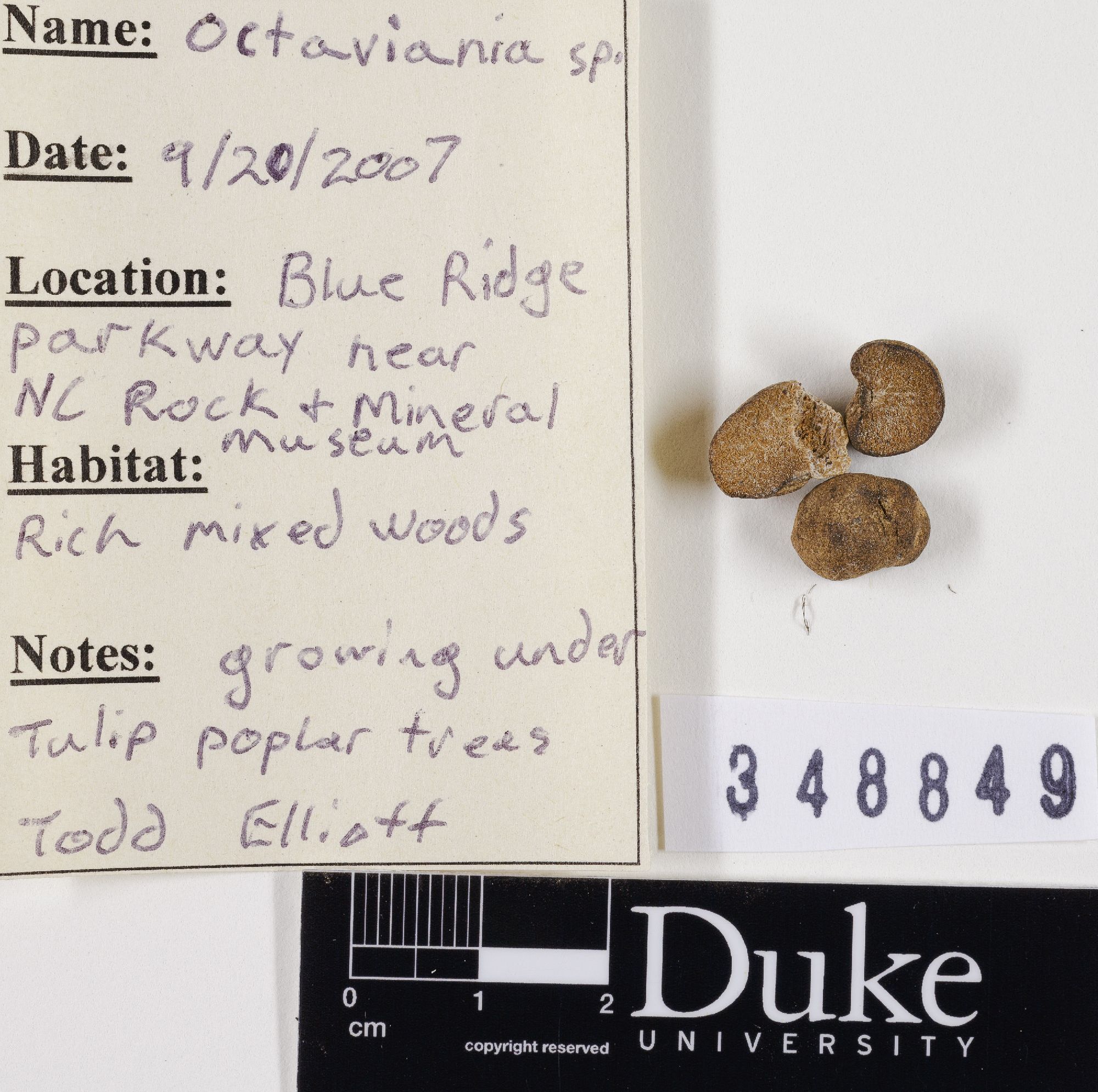
Octaviania
Octaviania is a genus of truffle-like fungi in the family Boletaceae. The widespread genus is estimated to contain 15 species.

Xerocomus silwoodensis
species of fungus
Veloporphyrellus
Veloporphyrellus is a genus of fungi in the family Boletaceae. Species are characterized by having a pinkish to pinkish-gray hymenophore, a membrane-like partial veil that hangs from the cap margin, smooth spores, and a trichoderm-like cap cuticle.

Xanthoconium affine
species of fungus
Lanmaoa
Lanmaoa is a fungal genus in the family Boletaceae. It was circumscribed by Chinese mycologists Nian-Kai Zeng and Zhu L. Yang in 2015 to contain several species formerly classified in the genus Boletus (L. carminipes, L. flavorubra, L. pseudosensibilis), as well as the newly described Asian boletes L. angustispora and L. asiatica. The erection of this genus follows recent molecular studies that outlined a new phylogenetic framework for the family Boletaceae. Zeng and Yang named the genus after Chinese naturalist (1397-1476).
==Species==
{| class="wikitable"
|-
! Image
Retiboletus
Retiboletus is a genus of fungi in the family Boletaceae. The genus, first described in 2002, contained six species distributed in north temperate regions.
==Species==
, Index Fungorum lists the following species:
{| class="wikitable sortable"
! Image !!Name !! Taxon author !! Year
|-
|120px ||Retiboletus ater || Yan C. Li & T. Bau || 2020
|-
| ||Retiboletus brevibasidiatus || Raspé & Chuankid || 2021
|-
| ||Retiboletus brunneolus || Yan C. Li & Zhu L. Yang || 2021
|-
|120px||Retiboletus flavoniger || (Halling, G.M. Muell. & L.D. Gómez) Manfr. Binder & Halling || 2002
|-
|120px||Retiboletus fu
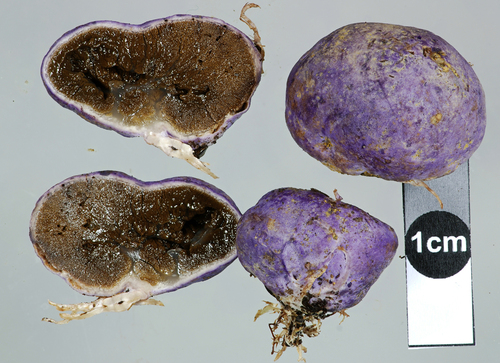
Leccinum pachyderme
species of fungus
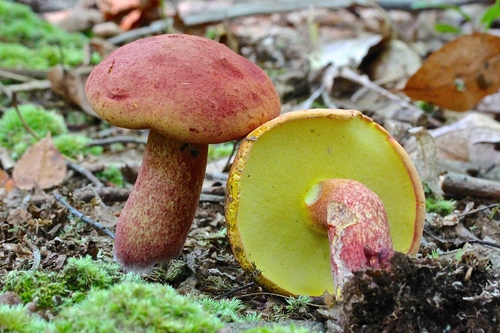
Baorangia bicolor
species of fungus
Spongiforma
Spongiforma is a genus of sponge-like fungi in the family Boletaceae. Newly described in 2009, the genus contains two species: S. thailandica and S. squarepantsii. The type species S. thailandica is known only from Khao Yai National Park in central Thailand, where it grows in soil in old-growth forests dominated by dipterocarp trees. The rubbery fruit bodies, which has a strong odour of coal-tar similar to Tricholoma sulphureum, consists of numerous internal cavities lined with spore-producing tissue. S. squarepantsii, described as new to science in 2011, is found in Malays

Retiboletus ornatipes
species of fungus
Imperator luteocupreus
species of fungus
Rossbeevera
Rossbeevera is a genus of sequestrate (truffle-like) fungi in the family Boletaceae. It was first published in 2012 under the erroneous name Rosbeeva, but was corrected to Rossbeevera in the same issue. The genus was created to contain species formerly placed in Chamonixia, but characterized by having ellipsoid to spindle-shaped spores with 3–5 longitudinal ridges, bluish-green to deep blue fruit body staining reaction, and a thin whitish peridium. The Chinese species R. yunnanensis is the earliest diverging lineage within the genus, and has a close phylogenetic relationship with the bole
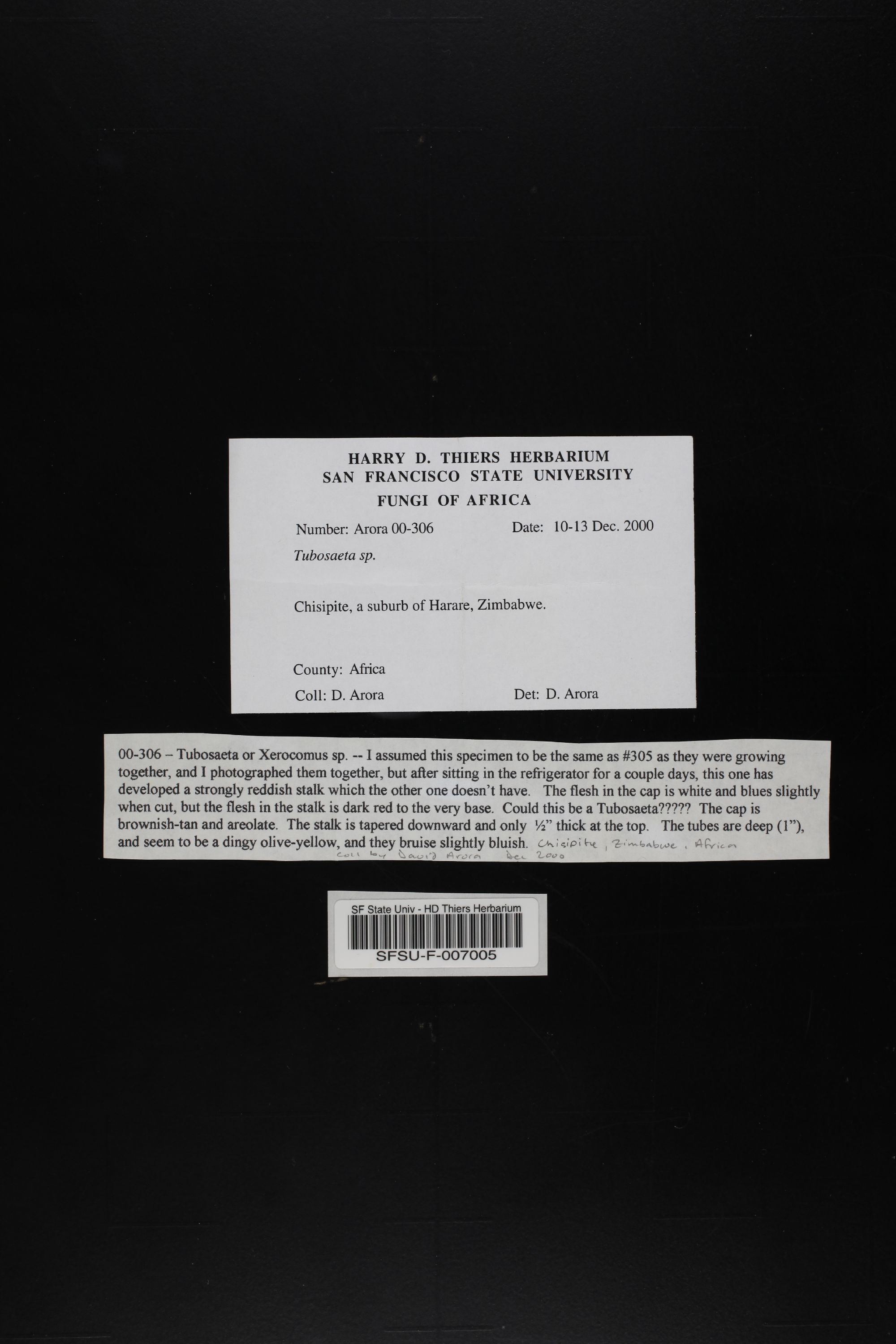
Tubosaeta
Tubosaeta is a genus of fungi in the family Boletaceae. The genus was circumscribed by mycologist Egon Horak in 1967.
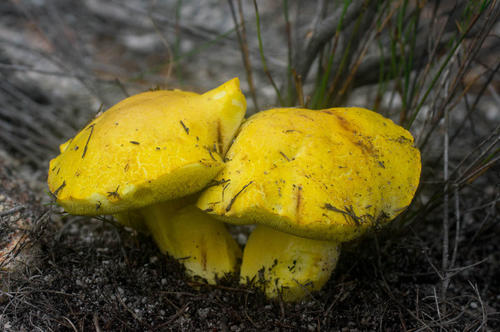
Buchwaldoboletus hemichrysus
species of fungus
Harrya
Harrya is a fungal genus in the family Boletaceae. It was circumscribed in 2012 to contain the species Harrya atriceps and the type Harrya chromapes.

Chamonixia caespitosa
species of fungus
Baorangia
Baorangia is a fungal genus in the family Boletaceae. It was circumscribed by Chinese mycologists Gang Wu and Zhu L. Yang in 2015 with B. pseudocalopus (formerly classified in Boletus) as the type species. Baorangia emilei and B. bicolor were transferred to the genus from Boletus that same year. The erection of Baorangia follows recent molecular studies that outlined a new phylogenetic framework for the Boletaceae. The generic name—derived from the Chinese words bao ("thin") and rang ("hymenium")—refers to the characteristically thin hymenophore, which distinguishes it fr
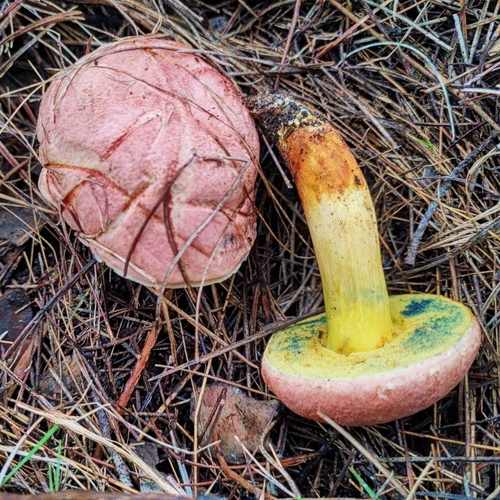
Rheubarbariboletus persicolor
species of fungus
Rheubarbariboletus
Rheubarbariboletus is a fungal genus in the family Boletaceae. Circumscribed in 2014, it contains two species found in Europe: Rheubarbariboletus persicolor, and the type, R. armeniacus. The generic name is derived from the Latin rheubarbarum, meaning "rhubarb", referring to the color of the flesh at the base of the stipe. The genus is closely related to Xerocomellus, but differs by having smooth spores, the unchanging yellowish to orange-rhubarb coloring of the stipe base, and the distinctive dark-green to black color reaction with iron sulphate on both the surface of the cap and on the
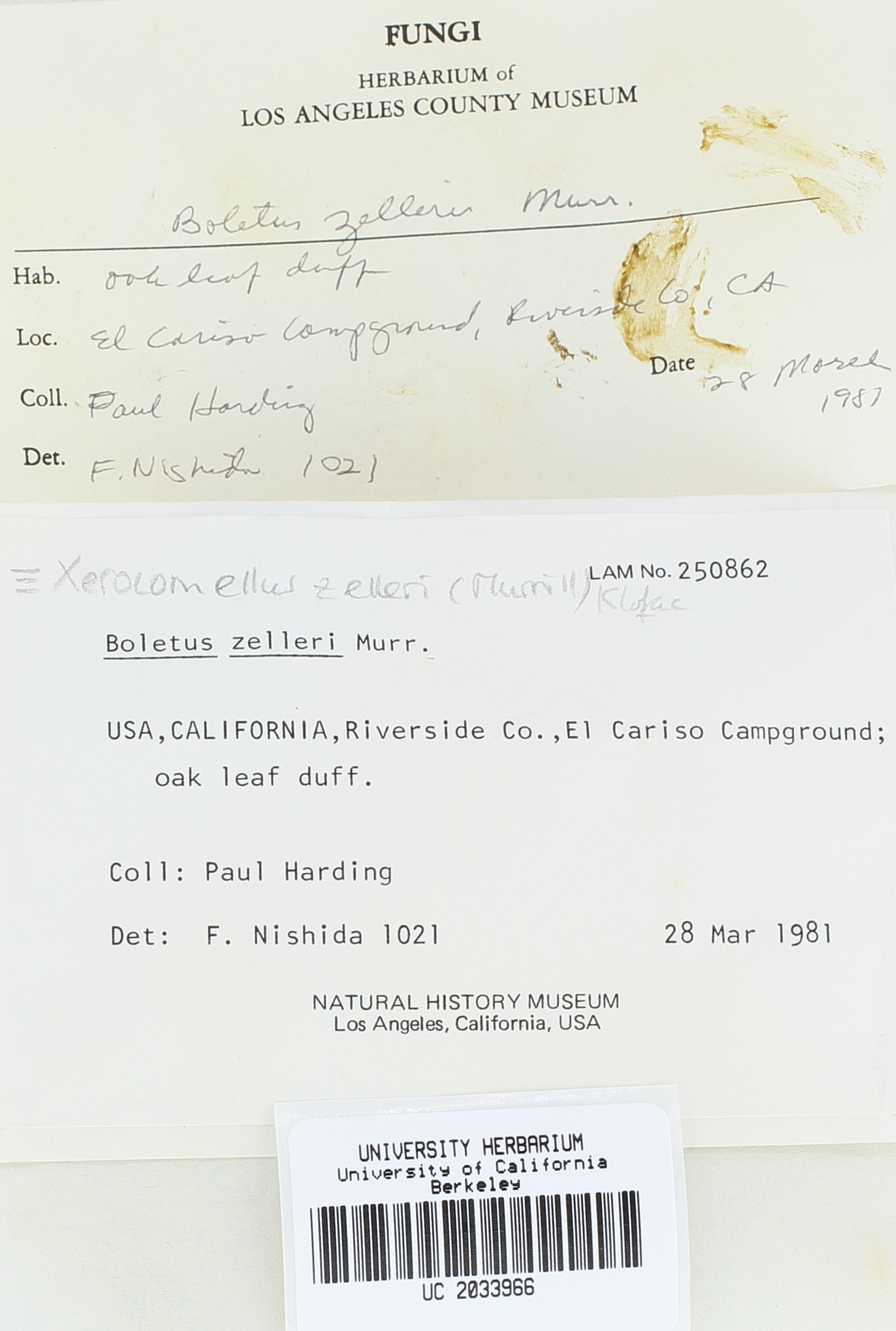
Xerocomellus zelleri
species of fungus
Sutorius
Sutorius is a genus of fungi in the family Boletaceae. Its type species is the widely distributed Sutorius eximius (formerly referred to the genera Boletus, Ceriomyces, Leccinum, and Tylopilus). The Asian Boletus obscureumbrinus, found in Japan and China, was described by Japanese mycologist Tsuguo Hongo in 1968, moved to genus Sutorius in 2016, but then reclassified into genus Neoboletus in 2019. The Australian Sutorius australiensis and the southern Chinese Sutorius subrufus also belong to the genus.