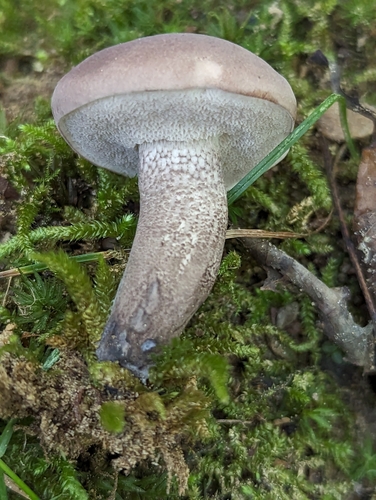
(c) Alisha Millican, some rights reserved (CC BY-NC), uploaded by Alisha Millican · cc-by-nc
Boletaceae
Sign in to saveAlso known as bolete, Boletogastraceae, Boletus, Chamonixiaceae, Octavianiaceae, Octavianinaceae, Strobilomycetaceae, Xerocomaceae
The Boletaceae are a family of mushroom-forming fungi, primarily characterised by small pores on the spore-bearing hymenial surface (at the underside of the mushroom), instead of gills as are found in most agarics. Nearly as widely distributed as the agarics, the family is renowned for hosting some prime edible species highly sought after by mushroom hunters worldwide, such as the cep or king bolete (Boletus edulis). A number of rare or threatened species are also present in the family, that have become the focus of increasing conservation concerns. As a whole, the typical members of the famil
OverviewAI-generated
Boletaceae is a family of fungi within the order Boletales, class Agaricomycetes, and phylum Basidiomycota. The taxon was described by Chevall. in 1826 and has the type species Boletus. Its common name is cevarke. The family is classified under the kingdom Fungi.
Records indicate that Boletaceae has an accepted taxonomic status. While one source lists a marine habitat, occurrence data from various institutions in the United States, Australia, China, and Costa Rica suggests a broader distribution. The family has been documented in 860,325 occurrences, with 257 specific records and 95 media files held by institutions including LSUM, FLAS, NY, MEL, and F. Additionally, 23 observations have been noted on iNaturalist.
Synthesized by Vinony from 36 facts across 7 sources: Wikidata, GBIF, iNaturalist, Gbif Occ, WoRMS, iDigBio, Vinony graph. Generated from structured data (not the Wikipedia text) and checked against those facts — may still contain errors.
Species
FAMILY
- KingdomFungi
- PhylumBasidiomycota
- ClassAgaricomycetes
- OrderBoletales
- FamilyBoletaceae
牛肝菌科(学名:Boletaceae)是担子菌门下伞菌目的一科。担子果肉质,孔状。约50余种,很多种可食用。世界性分布,在湿热带雨季常见于林中。 下分: Accomodates Afroboletus Aureoboletus 南牛肝菌屬 Austroboletus 条孢牛肝菌属 Boletellus 大孔牛肝菌属 Borofutus Boletochaete 牛肝菌屬 Boletus Chalciporus 叶腹菌属 Chamonixia Fistulinella Fuscoboletinus Gastroboletus Buchwaldoboletus Gastroleccinum Gastrotylopilus Gyrodon Gyroporus Heimioporus Leccinellum 疣柄牛肝菌屬 Leccinum Mucilopilus Paragyrodon Paxillogaster Phlebopus Phylloboletellus Phylloporus Pulveroboletus Retiboletus Rhizopogon Royoungia Setogyroporus Singeromyces Sinoboletus 松塔牛肝菌属 Strobilomyces 粘蓋牛肝菌屬 Suillus Tuboseta 粉孢牛肝菌屬 Tylopilus Veloporphyrellus 金孢牛肝菌屬 Xanthoconium 絨蓋牛肝菌屬 Xerocomus
via GBIF
Museum specimens
- Specimen records
- 257
- With media
- 95
- Family
- Boletaceae
- Collections
- LSUM, FLAS, NY, MEL, F, MIN
- Recorded in
- United States, Australia, China, Costa Rica
Wikidata facts
Show 8 more facts
- taxon name
- Boletaceae
- taxon rank
- family
- Commons category
- Boletaceae
- topic's main category
- Category:Boletaceae
- exact match
- wordnet-rdf.princeton.edu/wn31/112990040-n
- taxon author citation
- Chevall.
- taxon common name
- cevarke
- taxonomic type
- Boletus
via Wikidata · CC0
~21 min read
Encyclopedic overview
13 sectionsContents
- Description
- Taxonomy
- Genera
- Distribution
- Ecology
- Conservation
- Edibility
- Lookalikes
- Toxicity
- See also
- References
- Cited texts
- External links
The Boletaceae are a family of mushroom-forming fungi, primarily characterised by small pores on the spore-bearing hymenial surface (at the underside of the mushroom), instead of gills as are found in most agarics. Nearly as widely distributed as the agarics, the family is renowned for hosting some prime edible species highly sought after by mushroom hunters worldwide, such as the cep or king bolete (Boletus edulis). A number of rare or threatened species are also present in the family, that have become the focus of increasing conservation concerns. As a whole, the typical members of the family are commonly known as boletes.
Boletes are a group of mushrooms reasonably safe for human consumption, as none of them are known to be deadly to adults. Edible bolete species are especially suitable for novice collectors, since they pose little danger of being confused with deadly poisonous mushrooms, such as deadly Amanita species which bear gills instead of pores in their hymenial surface. Some boletes are toxic and may cause gastrointestinal poisoning if consumed, but these are unlikely to be confused with popular edible species in the family.
Excerpted from Wikipedia’s “Boletaceae” article, available under the CC BY-SA 4.0 licence.